
Pelvic Floor
 Anatomy & Physiology
Questions Answered Here
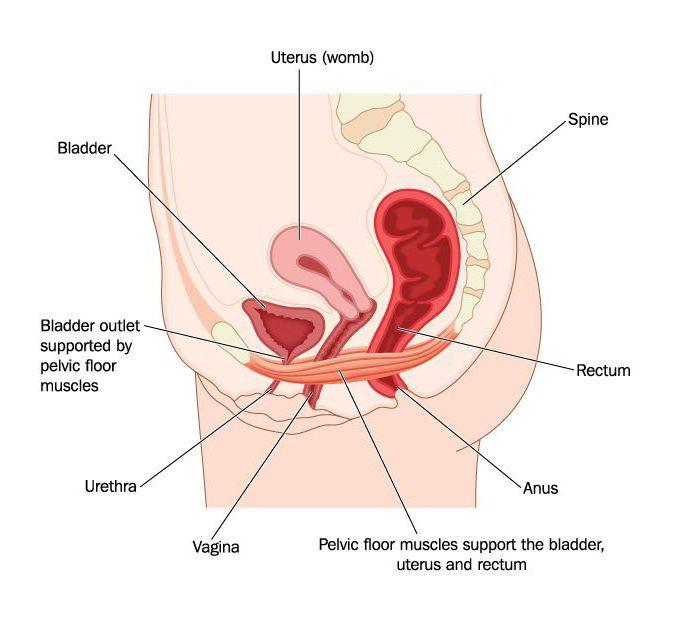
- Describe the pelvic floor. Provide a visual and remark on its function and sensitivities.
- Where is the pelvic floor located?
- What defines healthy, natural movement of the pelvic floor?
- Describe three general functions of the pelvic floor.
- How do pelvic floor muscles contribute to core functioning?
- What are some potential issues associated with the pelvic floor?
- What factors may lead to pelvic floor weakness?
- What factors may lead to a tight pelvic floor?
- What other habits, practices and factors may cause pelvic floor issues?
- What teachings and practices may contribute to pelvic floor health?
Introduction
The pelvic floor is often described as a “hammock” of muscles.
- This “hammock” is designed to keep the pelvic organs (bladder, uterus and rectum) in place and to support spinal and pelvic stability.
- These muscles respond to an increase in intra-abdominal pressure (coughing, sneezing, laughing or straining).
- The urethra, vagina and rectum pass through the pelvic floor muscles and are affected by their contractions and relaxations.
The “bony landmarks” that define the pelvic floor are:
- Pubic bone in front
- Tailbone in back
- Sit bones (Ischial Tuberosities) on either side
Healthy, natural movement of the pelvic floor includes both lifting and narrowing, plus widening and releasing.
Visuals: Trampoline and/or Kite
An optimally functioning pelvic floor [is like] a trampoline. It supports the weight of all our pelvic organs and allows any extra load to just bounce off its healthy, elastic fibers, tensing and releasing naturally… Eric Franklin compares natural movement of the pelvic floor to a kite. As you stand up the pelvic floor slightly lifts and narrows similarly to a kite picking the wind and taking off. Reversely, as you sit down (with untucked tail, using your sitbones) the pelvic floor widens and releases to its full length, like a kite descending down, opening and landing.– Ivanna Demmel
Functions
Overview
- The pelvic floor supports the bladder and reproductive organs (including a growing uterus in pregnancy).
- As a part of the core, pelvic floor muscles work in cooperation with the deep abdominal and deep back muscles to stabilize the low back.
- A healthy pelvic floor is associated with enhancing sexual comfort, sensation and arousal.
Specifically
Karlyn Driedger, PT, BScKIN, MScPT explains these five important functions of the pelvic floor:
- Sphincteric
- Support
- Stability
- Sexual
- Sump-pump
Sphincteric
- The muscles of the pelvic floor wrap around and control the opening of the bladder and rectum.
- They prevent leakage when there is an increase in intra-abdominal pressure.
- These muscles also have to relax appropriately to allow for urination and bowel movements.
Support
- The muscles support pelvic organs against gravity and increased intra-abdominal pressure.
- In women, excess strain on the pelvic floor (during pregnancy) or weakening of the pelvic floor (age, hormonal changes) can lead to prolapse.
Stability
- The pelvic muscles have attachments to the pelvis and hips and are an important part of the “core.”
- These muscles work in cooperation with hip, abdominal and back muscles to control movement of the sacroiliac and hip joints as well as stabilization of the low back.
Sexual
- A healthy pelvic floor is associated with enhancing sexual comfort, sensation and arousal.
Sump-pump
- The pelvic floor muscles act as a blood/lymph pump for the pelvis.
- A loss in this action can contribute to swelling or congestion.
Continue Reading with Ashtanga Tech
This study guide is available to members. Join to access 800+ in-depth guides on anatomy, philosophy, sequencing, and the science of practice.
Join for $5.50/mo — the cost of a DC coffeeAlready a member? Log in here
Discussion
or explore Student Union