
Respiratory Anatomy Part 2 – Accessory Muscles & More
 Anatomy & Physiology
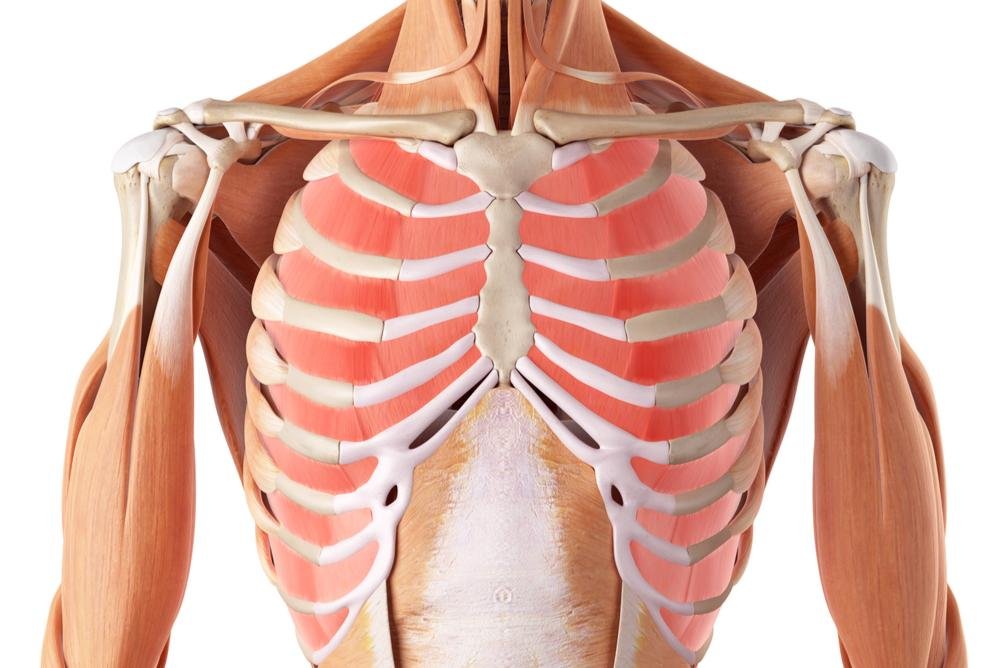
The Lungs
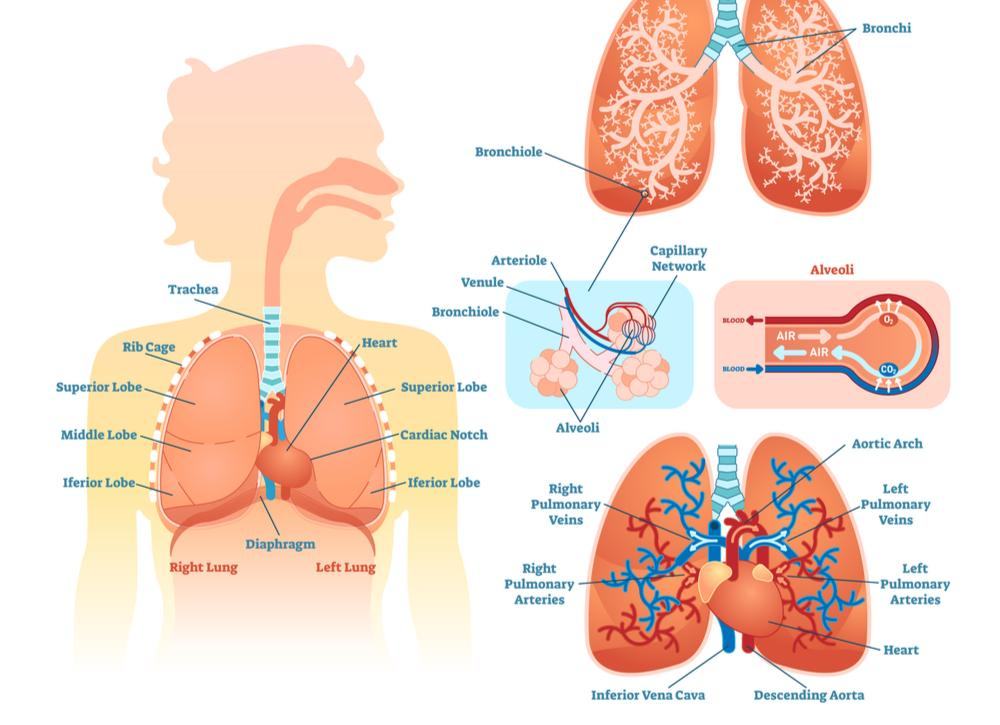
- Lungs have five lobes: three in the right lung (upper, middle and lower lobes) and two in the left (upper and lower lobes).
- Because lungs are pear-shaped, the fill capacity of the upper lungs is less than the lower.
- With a full inhalation, air reaches the lower lungs where, according to one source, there is more blood available for oxygen exchange. (Mukunda Stiles quoting John Douillard)
HOW THE DIAPHRAGM & LUNGS WORK
When relaxed, the diaphragm curves upward like a dome. When it contracts, it shortens and flattens, pushing on the digestive organs below and lengthening the chest cavity above. This expansion of the chest cavity draws air into the lungs. The lungs have no capacity to expand or contract on their own. They simply respond to the size and shape of their container, the chest cavity. When it expands, the lungs inflate and air rushes in to fill the vacuum. When the container shrinks, the lungs are compressed, and air is pushed out. – Julie Gudmestad
YOGA PRACTICES SUPPORT LUNG FUNCTIONING & MORE
After the age of 25 or so, the ability of your lungs to function gradually declines. In general, exchange of gases between the air and blood stream happens less efficiently and provides reduced immune functioning… Age-related changes in the muscles that enable you to breathe, including the intercostal muscles and your respiratory diaphragm, can make the muscles weaker and smaller… By practicing yoga poses that address your respiratory muscles, including forward bends, backbends, sidebends, and spinal twists, you can help maintain their strength. Breath practices that lengthen your inhalations and exhalations can also help strengthen your diaphragm and intercostal muscles. – Baxter Bell MD and Nina Zolotow
The Nose

- Tubes in the nose moisten air from the in-breath, and fine hairs filter it.
- Due to the relationship between a nose’s form and its function, people in different climates show a different nose structure.
- The nasal cycle refers to how humans and other animals breathe in patterns, alternating their breathing through one nostril and then the other.
- The right nostril corresponds to the left side of the brain (which governs thinking, intellect, and reason) and is connected to the sympathetic nervous system.
- The left nostril corresponds to the right side of the brain (responsible for feelings and intuition) and triggers the parasympathetic nervous system.
- See also Nadi Shodhana Pranayama.
WARMS, HUMIDIFIES & CLEANS
Both ways of breathing—through the nose and through the mouth—are possible, and each has its advantages and disadvantages. When you breathe through the nose, the air is warmed up and humidified; cleaned of dust particles; and cleaned of bacteria. Thus, the air that reaches the lungs is warm, purified, and of good quality. From this point of view, it is better to breathe through the nose… It’s easier to do deeper breathing through the mouth… When inhaling or exhaling through the mouth, you can also vary the airflow more easily than when you breathe through the nose. – Blandine Calais-Germain
ARE YOUR AIRWAYS OPEN & RELAXED?
The openings of the nose and nasal passageways, the mouth, the pharynx (back of throat), larynx (the passageway by the vocal cords), trachea and bronchial tree that leads to the air sacks inside your lungs make up the airways that allow oxygen to come into your lungs and carbon dioxide to be released from them. Breathing practices will help you learn whether the upper and lower passages are open and relaxed. If not, you can use calming breath practices or stress management tools to try to reopen them. – Baxter Bell MD
NASAL CYCLE
Ancient yogis detected what scientists now refer to as the nasal cycle. Humans (and other animals) cycle alternately from breathing through one nostril to breathing through the other, for periods ranging from a few minutes to a few hours. This pattern continues even during sleep. In one area of investigation, yogis compared the effects of left-nostril breathing, right-nostril breathing, and breathing through both simultaneously… More and more scientific research is supporting the notion that breathing through different nostrils has very different effects on the body. – Timothy McCall
SHAPE RELATED TO THE CLIMATE
Individuals from cold, dry climates, such as Greenland or Siberia, had higher and narrower nasal cavities than those from hot, humid climates, such as Papua New Guinea or Gabon… Narrowing of the nasal passage enhances contact between the air and the mucosal tissue, which helps to warm and humidify that air… Cold, dry climate populations also show a relatively longer nasal cavity, giving this population more space in which to bring incoming air in line with body temperature. Microscopic hairs called cilia, which line the nasal passage, help to keep out pathogens and dust that may infect or irritate the lungs, and the cilia work more efficiently when incoming air is moist. “Proper heating and humidification of air in colder climates are important for respiratory health,” says paleoanthropologist Nathan Holton of the University of Iowa. In warm-climate-adapted populations, inhalations are not directed toward the narrow upper part of the nasal cavity for warming. So “people from warm climates, moving into cold climates, could be more susceptible [to] colds and related diseases,” Noback says. – Joan Ramond
DIFFERENCES IN BREATHING THROUGH THE NOSE OR THE MOUTH
Both ways of breathing — through the nose and through the mouth — are possible, and each has its advantages and disadvantages. When you breathe through the nose, the air is warmed up and humidified; cleaned of dust particles; and cleaned of bacteria. Thus, the air that reaches the lungs is warm, purified, and of good quality. From this point of view, it is better to breathe through the nose… [However,] it’s easier to do deeper breathing through the mouth… When inhaling or exhaling through the mouth, you can also vary the airflow more easily than when you breathe through the nose. – Blandine Calais-Germain
Continue Reading with Ashtanga Tech
This study guide is available to members. Join to access 800+ in-depth guides on anatomy, philosophy, sequencing, and the science of practice.
Buy NowAlready a member? Log in here
Discussion
or explore Student Union