
ENS, Emotion, Energy
 Anatomy & Physiology

Overview
In this lesson, we explore the enteric nervous system (ENS).
Objective
Become familiar with the ENS (located within the abdomen) in terms of physical anatomy and its relationship to emotions, plus considerations from a subtle body perspective.
What You'll Get
Describe the location of the Enteric Nervous System (ENS), its connection to the brain, why it is called a “second brain” and how its related to serotonin. Provide examples of potential psychological and emotional considerations related to the abdomen and explain the related subtle body anatomy. Explain how Western and Eastern cultures typically differ in their view of the abdomen.
The Enteric Nervous System
- The Enteric Nervous System (ENS) is a system of nerves located in the abdomen.
- The ENS communicates with the brain and can act independently of it.
- It is often referred to as the “second brain.”
- Serotonin is both a hormone and a neurotransmitter responsible for feelings of happiness and well-being. Ninety percent of serotonin is produced in the second brain. (Alejandro Junger M.D., Clean Gut)
- Serotonin “plays a crucial role in developing our forebrain, which processes our emotions. Serotonin also enhances the growth of new neurons in the hippocampus, the part of the limbic brain that regulates the fight-or-flight systems.” (Alberto Villoldo, Ph.D.) Villoldo also proposes that serotonin, the “happiness” hormone, is chemically similar to DMT, “the spirit molecule” and that he believes serotonin plays an important role in the creation of DMT — allowing us to access higher states of consciousness in which we perceive the inherent interconnectedness of our existence.
THE SECOND BRAIN
Consider this: You have a second brain in your gut, and it’s every bit as important as the brain in your head. This second brain is a network of more than 100 million neurons that communicate directly with the brain in your head. The neurons form a latticelike sheath surrounding the entire alimentary canal, or digestive tract, the nearly 30-foot-long tube running from your mouth to your anus… Its main preoccupation is the daily grind of digestion: breaking down food particles to extract the nutrients, absorbing those nutrients, and then eliminating waste. It’s an enormous job, yet all this neural firepower isn’t dedicated exclusively to digestion and elimination. The vagus nerve — the longest of the cranial nerves — snakes up through the body from the gut to the brain, carrying a variety of vital information. – Alberto Villoldo, Ph.D.
From the Experts
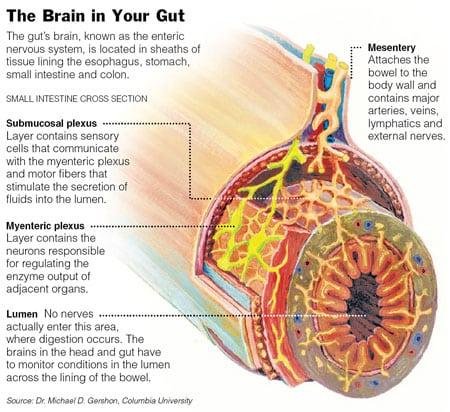
NERVES WITHIN THE ABDOMEN
The enteric nervous system (ENS) is a complex system of about 100 million nerves found in the lining of the gut. The ENS is sometimes called the “second brain,” and it actually arises from the same tissues as our central nervous system (CNS) during fetal development. Therefore, it has many structural and chemical parallels to the brain. Our ENS doesn’t wax philosophical or make executive decisions like the gray shiny mound in our skulls. Yet, in a miraculously orchestrated symphony of hormones, neurotransmitters, and electrical impulses through a pathway of nerves, both “brains” communicate back and forth. These pathways include and involve endocrine, immune, and neural pathways. At this point in time, even though the research is inchoate and complex, it is clear that the brain and gut are so intimately connected that it sometimes seems like one system, not two. – Jennifer Wolkin
SEROTONIN PRIMARILY MANUFACTURED IN THE GUT
Amazingly, if you were to isolate these neurons [in the gut] and clump them all together, they would form a mass of neurons larger than the ones in your head. In fact, the brain in your gut is way more active in the production of neurotransmitters than the brain in your head. Serotonin, the neurotransmitter responsible for the feeling of happiness and well-being, is primarily manufactured in the gut—90 percent of it, in fact. – Alejandro Junger M.D.
CAN WORK ON ITS OWN + SEND SIGNALS TO THE BRAIN
The ENS can work all on its own, without any input from the brain, to control the movement and absorption of food throughout the intestines. No other organ can call its own tune… But the ENS — sometimes considered a branch of the autonomic nervous system, although Gershon sees it as holding its own — does much more than control itself. It also sends signals north to the brain that directly affect feelings of sadness or stress, even influencing memory, learning, and decision-making. It relies on, and in many cases manufactures, more than 30 neurotransmitters, including serotonin, that are identical to those in the brain. What’s more, tinkering with the second brain in our gut has lately been shown to be a potent tool for achieving relief from major depression. Even autism, studies suggest, may be wrapped up in the neurobiology of the brain down under. “The nervous system actually started out in the gut,” says Emeran Mayer, director of the UCLA Center for Neuro-visceral Sciences… Most of my patients have a very good understanding that there is a close connection between their emotions and their guts.” – Dan Hurley
Continue Reading with Ashtanga Tech
This study guide is available to members. Join to access 800+ in-depth guides on anatomy, philosophy, sequencing, and the science of practice.
Join for $5.50/mo — the cost of a DC coffeeAlready a member? Log in here
Discussion
or explore Anatomy & Physiology