
⎯⎯⎯⎯⎯ ◆ ⎯⎯⎯⎯⎯
Musculoskeletal System Introduction
⎯⎯⎯⎯⎯ ◆ ⎯⎯⎯⎯⎯
 Anatomy & Physiology
Vocabulary
appendicular skeleton, axial skeleton, ball and socket joint, bones, hinge joint, joint, muscle, musculoskeletal system, osteocalcin, synovial joint

- APPENDICULAR SKELETON — The bones attached or appended to the axial skeleton (spine, skull and rib cage); bones of the upper and lower limbs plus the shoulder and pelvic girdles.
- AXIAL SKELETON — Spine, skull and rib cage
- BALL AND SOCKET JOINT — A type of joint that allows for a wide range of movement, including rotation.
- BONES — Living tissues that form the body’s structural framework.
- HINGE JOINT — A type of joint that provides greater stability than other types.
- JOINT — Junction / connecting point between bones.
- MUSCLE — A band or bundle of fibrous tissue that has the ability to contract; attached to bone by tendons.
- MUSCULOSKELETAL SYSTEM — Gives humans the ability to move via bones, muscles, and connective tissue.
- OSTEOCALCIN — A hormone released by bones that prompts the physiological effects of the fight or flight response.
- SYNOVIAL JOINT — The most common type of joint in the body; freely movable
See Also
This section gives the fundamental facts, or building blocks, of these anatomical structures. For much deeper information on movement and application, please see:
- Connective Tissue & Fascia
- Muscle Movement & Contraction
- Joint Movements / ROM
- Spinal Movement
- Flexibility & Stretching
Introduction
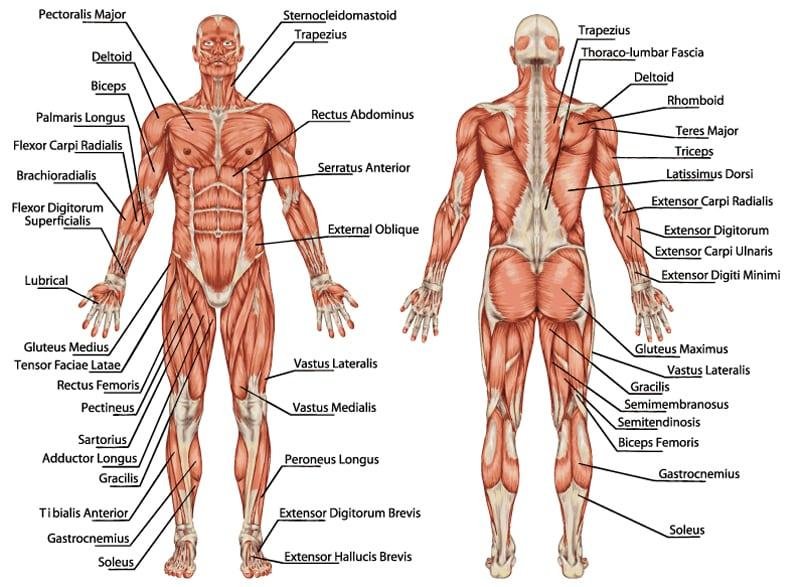
- The musculoskeletal system gives humans the ability to move using their muscular and skeletal systems.
- It includes bones, muscles and connective tissue. (While bones and connective tissue are often described separately for learning purposes, expert sources explain that bones are a type of connective tissue.)
- In addition to enabling body movement, the musculoskeletal system provides form, support and stability, protects vital organs, stores minerals such as calcium, produces red blood cells, moves blood and food, and generates body heat.
Continue Reading with Ashtanga Tech
This study guide is available to members. Join to access 800+ in-depth guides on anatomy, philosophy, sequencing, and the science of practice.
Join for $5.50/mo — the cost of a DC coffeeAlready a member? Log in here
Discussion
or explore Student Union