
Brain Physiology, Brain Hemispheres & Brain Waves
 Anatomy & Physiology
Vocabulary
alpha brain state, beta brain state, brain hemispheres, brain wave, corpus callosum, delta brain state, gamma brain state, split brain theory, theta brain state, whole brain functioning

- ALPHA BRAIN STATE – In the middle of the brain wave frequency spectrum, associated with being relaxed, intuitive, creative (7.5 or 8 to 12 or 14Hz)
- BETA BRAIN STATE – Associated with being awake and active, can also be experienced as stress, anxiety, fear and restlessness (12 or 14 to 30 or 35 Hz)
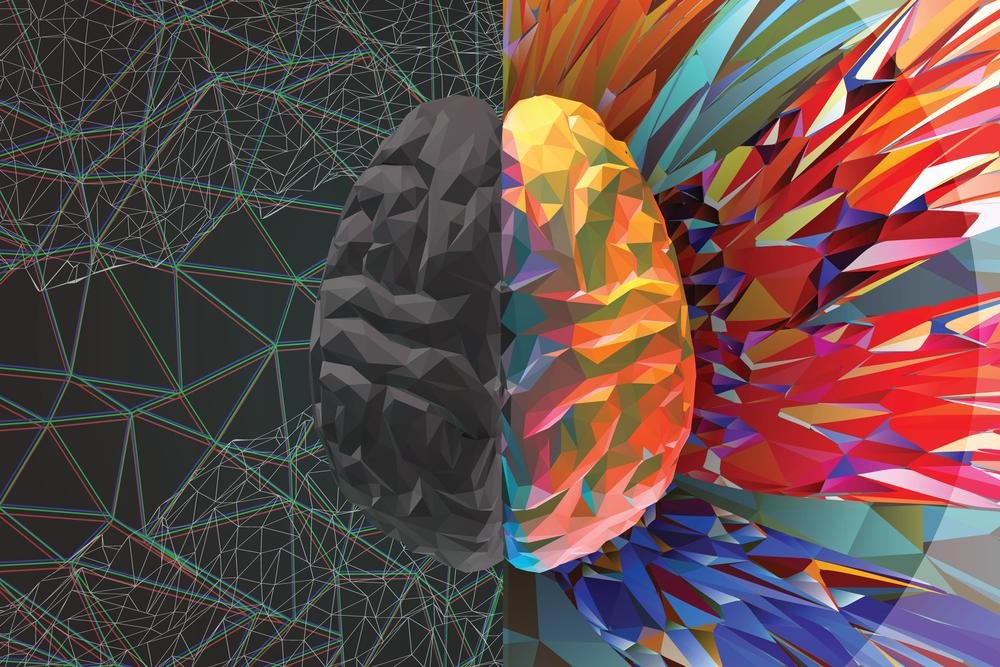
- BRAIN HEMISPHERES – The two halves of the brain separated by the corpus callosum, providing two different perspectives; the left hemisphere gives narrow, sharply focused attention to detail without understanding the larger context; the right sees the broad view of the world, perceiving interconnectedness and understanding body language and implicit meaning
- BRAIN WAVE – When a group of cells in the brain (called neurons) communicates via an electrical signal to another group of neurons; an EEG image of this communication creates wavelike patterns; brain wave frequency is measured in cycles per second, or hertz (Hz)
- CORPUS CALLOSUM – The place in the brain where information is transferred between the left and right brain hemispheres, resulting in synchronization and harmony in the brain; however, it is also involved in inhibiting transfer, stopping the other hemisphere from interfering
- DELTA BRAIN STATE – Low frequency (slowest) brain waves associated with deep, dreamless sleep and recovery (0.1 to 4 Hz)
- GAMMA BRAIN STATE – High frequency (the fastest) brain waves, associated with peak concentration and cognition (greater than 30 or 35 Hz)
- SPLIT BRAIN THEORY – Theory from the mid 1900’s that postulated that the brains’ hemispheres function separately and on completely different tasks; this theory has proven to be inaccurate as, in fact, the two sides work together
- THETA BRAIN STATE – Associated with healing and super-learning during light (REM) sleep or being extremely relaxed (3 or 4 to 8 Hz)
- WHOLE BRAIN FUNCTIONING – In contrast to the split brain theory, the brain’s hemispheres don’t have independent functions but rather, both are involved in all brain functions, albeit in different ways, bringing two different perspectives — this turns out to be a vitally important and practical distinction
Why Correcting the Split Brain Theory Matters
There is a need to correct the outdated conclusions of the Split Brain Theory which postulated that the brain’s hemispheres function separately and on completely different tasks.
THE TWO SIDES WORK TOGETHER
[More recent] research has shown that the brain is not nearly as dichotomous as once thought. For example, research has shown that abilities in subjects such as math are strongest when both halves of the brain work together… No matter how lateralized the brain can get… the two sides still work together. – Kendra Cherry
Split Brain Theory
In the 1950s and 1960s, Roger Sperry conducted experiments to study functional differences between the brain’s hemispheres. He found that if hemispheres were not connected, they functioned independently of one another, which he called a split-brain. For many years after, “Split Brain Theory” was taken to mean that each hemisphere has completely different roles with the left hemisphere being most prominent in language, logic, mathematical calculation and fact retrieval and the right side managing spatial information, visual comprehension and artistic ability.
Further, Jill Bolte Taylor’s Ted Talk and book, My Stroke of Insight, showed the results of watching the left side of her brain lose functionality and the right side gain prominence:
A neuroanatomist by profession, she observed her own mind completely deteriorate to the point that she could not walk, talk, read, write, or recall any of her life, all within the space of four brief hours. As the damaged left side of her brain–the rational, grounded, detail- and time-oriented side–swung in and out of function, Taylor alternated between two distinct and opposite realities: the euphoric nirvana of the intuitive and kinesthetic right brain, in which she felt a sense of complete well-being and peace; and the logical, sequential left brain, which recognized Jill was having a stroke, and enabled her to seek help before she was lost completely. – My Stroke of Insight book jacket
Taylor’s story is well-told, ultra-fascinating and has a lot to teach us — including the absolutely stunning observation that the chemistry of a feeling lasts only 90 seconds. Thus, any feeling we continue to feel longer than that is due to our thoughts re-creating the feeling.
Still, while these are fascinating and compelling accounts, both the Split Brain Theory and Taylor’s experience resulted from the unique and rare occurrence of one hemisphere being completely inaccessible. This is virtually never the case and instead, both hemispheres are connected via the corpus callosum.
Continue Reading with Ashtanga Tech
This study guide is available to members. Join to access 800+ in-depth guides on anatomy, philosophy, sequencing, and the science of practice.
Join for $5.50/mo — the cost of a DC coffeeAlready a member? Log in here
Discussion
or explore Student Union