
List of Feelings, Words for Naming Emotions
 Themes

Overview
In this lesson, we explore words that help to describe emotions and feelings.
Objective
Be aware of a few core emotions, plus hundreds of words that can be used to describe how we feel.
What You'll Get
Describe Plutchik’s Wheel of Emotions. Provide a short list of core emotions. List more than 250 words to describe emotions and feelings.
Introduction
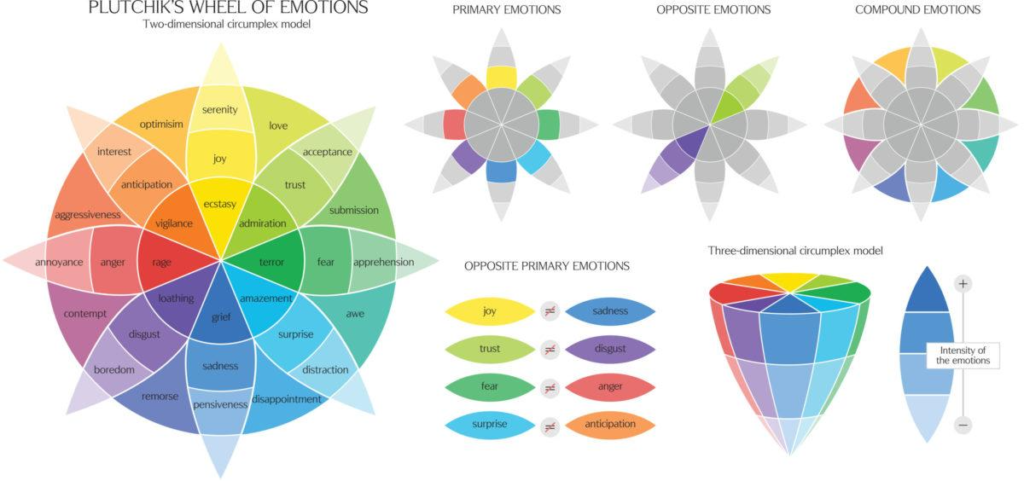
Plutchik’s Wheel is a well-publicized short list of emotions.
PLUTCHIK’S WHEEL
Robert Plutchik was an American psychologist and professor who studied human emotions. Plutchik’s theory was that there are 8 distinct, basic human emotions: happiness, sadness, fear, anger, disgust, surprise, acceptance, and anticipation. – January Nelson
Whether you prefer Plutchik’s list or your own, here’s a list we’ve devised that you can start with. Add and remove as you find helpful, and see the long list of 254 feelings in the alpha list below.
Happy
- Ecstatic
- Light or Vibrant
- Joyous
- Happy
- Grateful
- Excited
Loving
- Compassionate
- Loving
- Connected
- Peaceful
Sad
- Grief-stricken
- Sad
- Distraught
- Heavy
- Depressed
Afraid
- Anxious
- Afraid
- Alone
- Ashamed
Angry
- Irritated
- Angry
- Mad
- Disgusted
- Horrified
Confused
- Surprised
- Confused
- Lost
- Unsure
The words in this lesson are all commonly understood as feelings. As a side note, researcher Candace Pert (author of Molecules of Emotion) explains that, biochemically, there is a consistency with other states that are not necessarily thought of as feelings (including basic sensations and drive states):
Why you feel the way you feel is… a subject that has consumed me for over a decade… Emotions are… widespread across both human and animal kingdoms. They… are inextricably linked to the origins of the species. When I use the term emotion, I am speaking in the broadest of terms, to include not only the familiar human experiences of anger, fear, and sadness, as well as joy, contentment, and courage, but also basic sensations such as pleasure and pain, as well as the “drive states” studied by the experimental psychologists, such as hunger and thirst. In addition to measurable and observable emotions and states, I also refer to an assortment of other intangible, subjective experiences that are probably unique to humans, such as spiritual inspiration, awe, bliss, and other states of consciousness that we all have experienced but that have been, up until now, physiologically unexplained. – Candace Pert PhD
Continue Reading with Ashtanga Tech
This study guide is available to members. Join to access 800+ in-depth guides on anatomy, philosophy, sequencing, and the science of practice.
Join for $5.50/mo — the cost of a DC coffeeAlready a member? Log in here
Discussion
or explore Themes