
⎯⎯⎯⎯⎯ ◆ ⎯⎯⎯⎯⎯
Wheel of the Year Intro
⎯⎯⎯⎯⎯ ◆ ⎯⎯⎯⎯⎯
 Themes
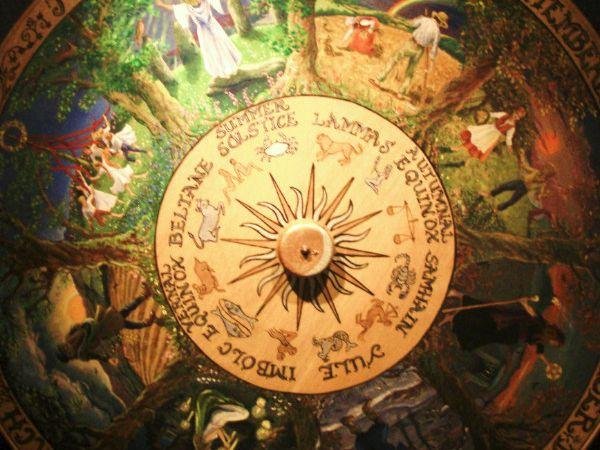
Overview
Honoring the Wheel of the Year connects us to light and dark, seasonal changes, and inner and outer rhythms.
The Earth’s Orbit
- When a star is the center of a planetary system, it is called a “sun.”
- The earth’s orbit around its sun is tracked in the Wheel of the Year observances.
- An “orbit” is a regular, repeating path that one object in space takes around another object.
Points on the Wheel
- The solstices and equinoxes are also known as Solar Festivals.
- The midpoints between solstice and equinox are related to agricultural cycles and are a part of the pagan calendar (Earth-based spiritual practices based on a reverence for nature). They are known as Gaelic Festivals or Fire Festivals.
- Together these observances comprise the Wheel of the Year.
Solstices
- Summer Solstice (Litha): longest day of the year
- Winter Solstice (Yule): shortest day of the year
Equinoxes
- Equinoxes are midpoints between the Summer and Winter Solstices.
- At these times, there is equal daylight and dark as the sun crosses the celestial equator.
- Vernal Equinox (Ostara) may also be considered the first day of Spring.
- Autumnal Equinox (Mabon) may also be considered the first day of Autumn.
Gaelic Seasonal Festivals
- Imbolc, Beltane, Lughnasadh and Samhain are sometimes referred to as Gaelic Seasonal Festivals and are part of the pagan calendar.
- The pagan calendar refers to observances based on a reverence for nature.
[Paganism refers to] variety of different religions ranging from Wicca to that of ancient Egypt and even Hinduism, among many others. Some Pagans are of no specific religion, but rather are eclectic… Another quite common feature of Pagan religions is that they tend to be nature oriented. – Urban Dictionary
Beltane & Samhain
- Beltane: approximate midpoint between the Spring Equinox and Summer Solstice; traditionally marked the beginning of summer
- Samhain: approximate mid-point between the Autumn Equinox and Winter Solstice; traditionally marked the end of the harvest season and the beginning of winter
- Beltane and Samhain divide the year into the “Dark Part” and “Light Part” – Samhain is about honoring Death; Beltane is about honoring Life
- They are a “time of ‘no-time’ when the veils between the two worlds are at their thinnest. No-time is when the two worlds intermingle and unite and the magic abounds.” (Popular Pagan Holidays)
Astronomical vs. Meteorological Seasons

Continue Reading with Ashtanga Tech
This study guide is available to members. Join to access 800+ in-depth guides on anatomy, philosophy, sequencing, and the science of practice.
Join for $5.50/mo — the cost of a DC coffeeAlready a member? Log in here
Discussion
or explore Student Union