
⎯⎯⎯⎯⎯ ◆ ⎯⎯⎯⎯⎯
Allegory of the Cave
⎯⎯⎯⎯⎯ ◆ ⎯⎯⎯⎯⎯
 Themes

Context & Source
Classical Greece
- In the history of Greece, there was a particular period of cultural and military achievements that came to be called “Classical Greece.”
- It lasted about 200 years in the fifth and fourth centuries B.C., ending at the death of Alexander the Great in 323 B.C.
- The classical period is considered to have been a time of “unprecedented political and cultural achievement.”
- For example, in 445 B.C., construction began on the Parthenon, the famous temple dedicated to Athena. From Classical Greece came the Greek tragedy, the historian Herodotus, the physician Hippocrates and the philosopher Socrates. It also brought political reforms that are ancient Greece’s most enduring contribution to the modern world: the system known as demokratia, or “rule by the people.”
Plato
- Plato was a philosopher in Classical Greece and the founder of the Academy in Athens, the first institution of higher learning in the Western world.
- Born around 428 B.C., Plato was a philosopher, a student of Socrates and a teacher of Aristotle.
- His writings explored justice, beauty and equality. He also discussed aesthetics, political philosophy, theology, cosmology, epistemology and the philosophy of language.
The Socratic Method
- The Socratic method or Socratic debate is named after the Classical Greek philosopher Socrates.
- The Socratic method searches for general, commonly held beliefs and scrutinizes them.
- It is a form of cooperative, argumentative dialogue between individuals, based on asking and answering questions to stimulate critical thinking and to draw out ideas and underlying presuppositions.
- It steadily identifies and eliminates hypotheses that lead to contradictions, causing better hypotheses to be found.
- The basic form is a series of questions formulated as tests of logic and fact intended to help a person or group discover their beliefs about a topic.
Socratic Dialogue
- The discussion of moral and philosophical problems between two or more characters in a dialogue is one version of the Socratic method.
- Socratic dialogue is the name given to this genre of literary prose developed in Classical Greece and demonstrated through the works of Plato and Xenophon.
- The dialogues are either dramatic or narrative and Socrates is often the main participant.
The Republic
- The Republic is a Socratic dialogue, written by Plato around 380 BC.
- It is Plato’s best-known work, and is considered one of the world’s most influential works of philosophy and political theory, both intellectually and historically.
- It concerns justice, the order and character of the just city-state, and the just human.
- In the dialogue, Socrates discusses with various Athenians and foreigners about the meaning of justice and whether the just man is happier than the unjust man. They consider the natures of existing regimes and then propose a series of different, hypothetical cities in comparison.
- They also discuss the theory of forms, the immortality of the soul, and the role of the philosopher and of poetry in society.
- In Book VII of The Republic is the allegory of the cave.
Allegory
- An allegory is a fictional, symbolic representation of truths or generalizations about human existence.
Allegory of the Cave
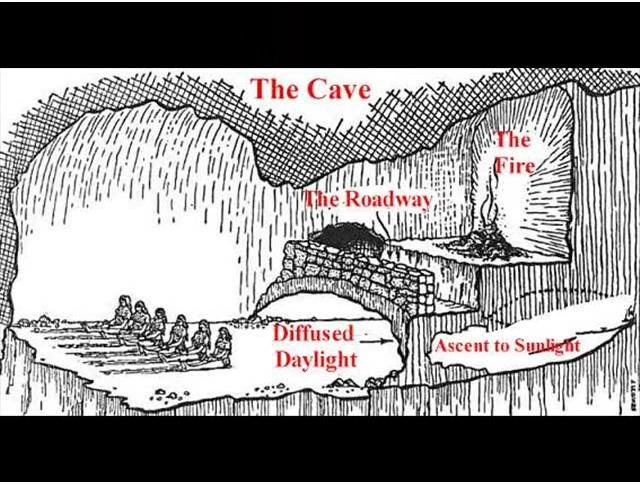
Image source: video by learnoutloud.com
An ode to limiting beliefs, the allegory of the cave offers a powerful model of a restricted world perspective. You can read the actual story in many sources.
- One translation of the text is here.
- For an audio reading of the original text, go here.
- For a video and telling using modern language, go here.
Following are the main points organized in a way to help you easily retain them for re-telling the story.
Plato’s teacher, Socrates tells his student a story with these key elements:
- Prisoners know nothing else
- A limited view
- Limited perception is believed to be reality
- Liberation brings a terrifying new reality
- The liberated person wishes to share the truth
- Prisoners reject the messenger and the truth
Continue Reading with Ashtanga Tech
This study guide is available to members. Join to access 800+ in-depth guides on anatomy, philosophy, sequencing, and the science of practice.
Join for $5.50/mo — the cost of a DC coffeeAlready a member? Log in here
Discussion
or explore Student Union