
Subconscious & Shadow
 Themes

Overview
In this lesson, we delve into the vital importance of exploring your subconscious mind and uncovering limiting beliefs.
Objective
Become familiar with the “subconscious,” “unconscious” and “the shadow” and how this very real aspect of human beings is related to creativity and psychological development plus specific strategies for uncovering limiting beliefs.
What You'll Get
Define “subconscious” and “unconscious.” Discuss the vast realm of the subconscious, including how it is programmed and what it controls. Describe how core beliefs are related to the subconscious. Define “the shadow” and explain how it is said to be related to creativity. Clearly explain the purpose in learning about the subconscious mind. Describe strategies that may help to uncover limiting beliefs and the type of thinking that may indicate the existence of a limiting belief. Explain what is meant by the term resistance in this context, how it may manifest, and the value in paying attention to where we feel resistance.
Vocabulary
shadow, shadow work, subconscious mind, the unconscious
We thank yoga teacher Diana Benigno for research and writing contributions.
- SHADOW – Another name for the subconscious, but may refer more specifically to an individual’s unacknowledged experiences and emotions or to collective, transpersonal energies that have been denied expression
- SHADOW WORK – Exploration of the subconscious mind to identify programming that is disempowering or otherwise contrary to conscious desires, and to gain access to hidden creative and life-giving possibilities
- SUBCONSCIOUS MIND – The part of the mind that is inaccessible to the conscious mind but that affects behavior and emotions
- THE UNCONSCIOUS – Synonymous with the “subconscious” or “subconscious mind”
What is It & How Does it Work?
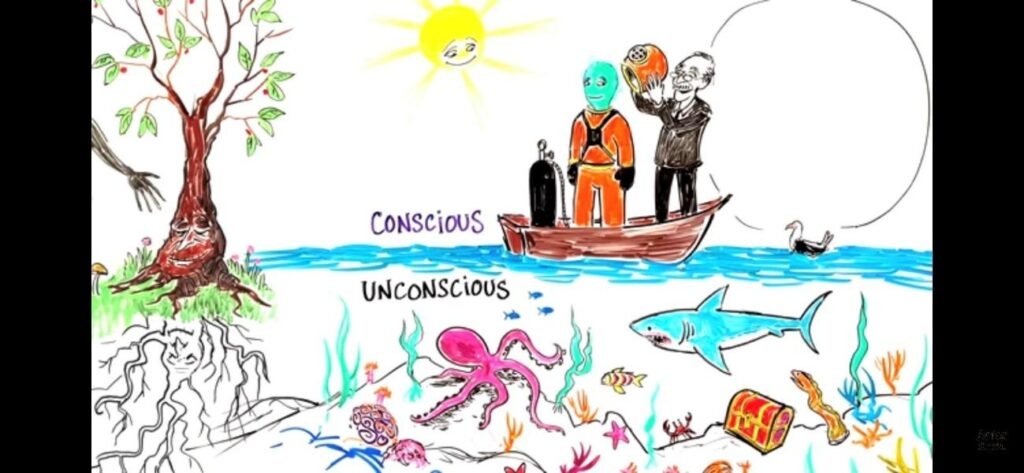
Image from After Skool video here
Here we use the words “unconscious” and “subconscious” interchangeably (as in this dictionary entry here).
- When used as an adjective, “unconscious” means comatose or inert. e.g. “The patient is unconscious.”
- As a noun, “unconscious” refers to the part of the mind that is inaccessible to the conscious mind but that affects behavior and emotions. e.g. “She had been unaware of the reason for her aversion to people with those traits until she recovered the trauma memory that had been stored in her unconscious (subconscious mind).”
WHAT IS THE SUBCONSCIOUS MIND?
The subconscious mind is the… mostly hidden mind that exists within you. It is like an immense memory bank with a virtually unlimited capacity that stores and retrieves information. The data stored in the subconscious mind can include beliefs, previous life experiences, memories, situations you have been through, skills and all images you have ever seen. It interprets, acts, and responds precisely the way you are programmed and attracts situations and circumstances that match the images within you… [It] has a significant effect on all actions. 95% of your brain activity happens beyond your conscious awareness… [When] you’re on autopilot mode… you’re acting unconsciously [with the subconscious programs running your thoughts and behaviors]. – Gaia Meditation, The Power of the Subconscious Mind
The Subconscious Doesn’t Learn or Function Like the Conscious Mind
Memory and imagery are absolutely real to the subconscious mind.
The subconscious mind does not know the difference between what is real and what is imagined. Since the subconscious mind works through images and does not know if so something is actually happening or is just a memory, the body reacts to the mental or visual image ‘as if’ is actually happening in that moment. This is why when we are watching a movie or reminded of a traumatic event, we experience the same physical feelings and sensations in our bodies as if we were actually having the experience in that moment… You knew the movie was not real but your subconscious mind did not because your subconscious mind cannot distinguish reality from fantasy… Some beliefs are so deeply seated in the subconscious mind that, even against all logical evidence that the belief is false, it is hard to release the belief from our programming. Deeply held fears are an example of a belief that is so deeply held that we may be able to consciously recognize the belief as untrue and illogical but we are still unable to release the belief from our subconscious mind and eliminate the fear… When we think of something contrary to our belief the cognitive dissonance can produce both uncomfortable feelings emotionally and physically. If we believe something contrary to what we desire, our subconscious mind will actively work against our desire because our subconscious mind is focused on keeping our belief system intact. – Dawn Demers
The subconscious mind does not reason or think autonomously. Instead, it runs programs. So the question is, how do those programs get written?
Right now you’re primarily using your conscious mind to read these words and absorb their meaning, but beneath that mental focus, your subconscious mind is busily working behind the scenes, absorbing or rejecting information based on an existing perception you have of the world around you. This existing perception began forming when you were an infant. With every experience, your subconscious mind soaks in information like a sponge. It rejected nothing while you were young because you didn’t have any pre–existing beliefs to contradict what it perceived. It simply accepted that all of the information you received during your early childhood was true… By the time you were 7 or 8 years old, you already had a solid foundation of belief based on all that programming from people in your life, television shows you watched, and other environmental influence – Dirk Roman
Bruce Lipton PhD, explains in this video that in the first seven years of life, the brain operates at a lower frequency, one that opens the gate to the subconscious mind. During this time, the subconscious is downloading what it observes and, thus, many subconscious programs are written during childhood.
- Lipton explains: Let’s say we read a book or watch a video and increase our knowledge. That is education of the conscious mind — but not the subconscious mind. Over time, we might “get really smart, but our life stays exactly the same.” Why? Because, as Lipton explains, the subconscious doesn’t learn in the way the conscious mind does. It doesn’t learn from talking, thinking, reading or learning in the typical sense but instead is programmed via hypnosis and via habit repetition (discussed more in the next lesson on programming the subconscious here).
- In addition, “every experience or emotion from the past that remains unacknowledged, unprocessed, or denied is stored in the realm of the unconscious, or shadow.” (Thomas Hubl)
Balance and homeostasis are of top priority to the subconscious mind.
- This is exemplified in maintaining bodily physiology, but it also affects behavior.
- “It ensures that you think and act in a manner consistent with what you have said or done in the past… It works night and day to ensure that your behavior matches a pattern consistent with your emotionalized hopes, thoughts, and desires… Through the memorization of all your comfort zones, the subconscious mind works to keep you in them… It goes against altering any established patterns of behavior, and you can always feel it pulling you back to the comfort zone every time you attempt something new.” (Gaia Meditation)
Continue Reading with Ashtanga Tech
This study guide is available to members. Join to access 800+ in-depth guides on anatomy, philosophy, sequencing, and the science of practice.
Join for $5.50/mo — the cost of a DC coffeeAlready a member? Log in here
Discussion
or explore Themes