
Stretch-Related Reflexes
 Anatomy & Physiology

Primary Vocabulary
- STRETCH-RELATED REFLEXES – Spinal reflexes that impact muscle length and tension: the Stretch Reflex, the Golgi Tendon Reflex and Reciprocal Inhibition
- SPINAL REFLEXES – Reflexes that bypass the brain, happening unconsciously
- STRETCH REFLEX – Messages from proprioceptors cause a muscle to contract; designed to prevent muscle tearing from a forceful action or going beyond normal range
- GOLGI TENDON REFLEX – When tension on a tendon exceeds a certain amount, the muscle automatically releases, preventing the tendon from being torn
- RECIPROCAL INHIBITION – When an agonist muscle contracts, the antagonist relaxes
More Vocabulary
- CLASP KNIFE REFLEX – Another name for the Golgi Tendon Reflex
- INVERSE STRETCH REFLEX – Another name for the Golgi Tendon Reflex
- MUSCLE SPINDLE STRETCH RECEPTOR – Another name for the Stretch Reflex
- MYOTATIC REFLEX – Another name for the Stretch Reflex
- SPINAL CORD REFLEX ARC – Another name for the Stretch Reflex
Overview
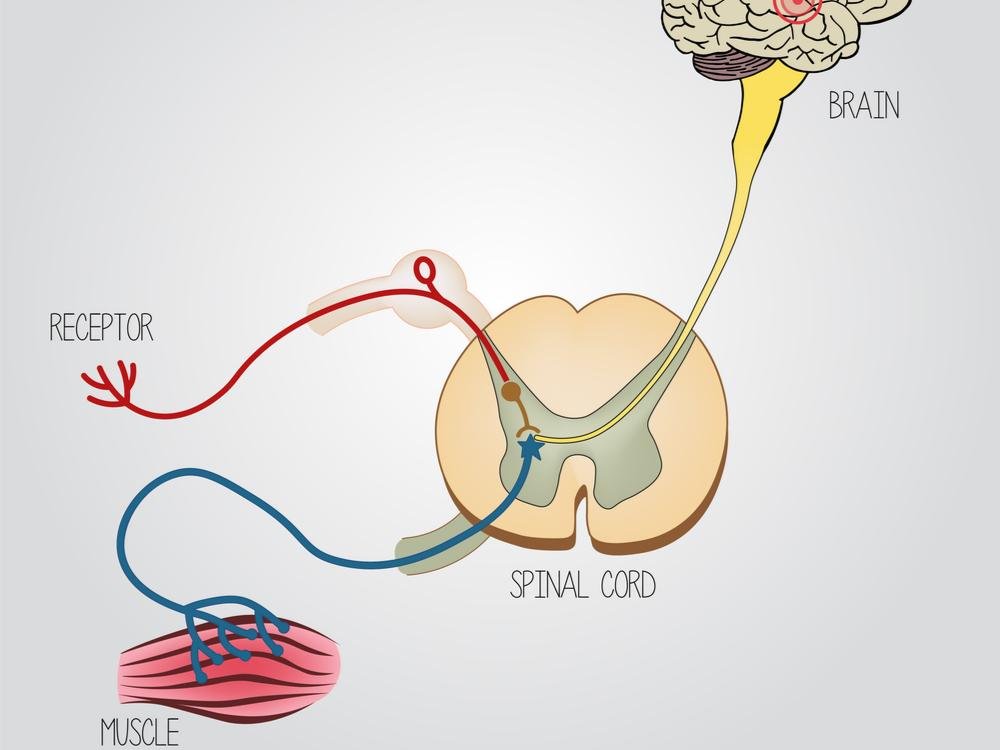
- The stretch-related reflexes are spinal reflexes, which means they are reflexive actions that bypass the brain.
- Spinal reflexes are “primitive and simple.” These are reflexes that happen in a fraction of a second.
- The spinal reflexes that impact muscle length and tension are: the Stretch Reflex, the Golgi Tendon Reflex and Reciprocal Inhibition.
- These are unconscious motor responses to sensory stimuli.
- These neurological responses cause either contraction or relaxation.
NOT LIKE “FAST REFLEXES”
In this context, reflexes have nothing at all to do with the lightning-fast reactions (“fast reflexes”) that are needed for expertise in video games… these reactions refer to unconscious responses carried out at the spinal level. – David Coulter
THE BRAIN IS THE LAST TO KNOW
In a spinal reflex, a sensation is felt at the site and relayed to neurons in the spinal cord via a sensory pathway. The spinal cord returns a signal along a motor pathway, signaling a movement in response to the sensation. This happens in fractions of a second, allowing people to jerk away before the brain is even aware of a problem. A signal is also sent to the brain, alerting it to the sensation and response. This happens so quickly that people may experience the sensation of pain almost simultaneously with the development of the reflex, even though the brain is actually the last to know in this situation. The nerve pathways carry signals like heat from burning, sharp sensations, and other painful feelings. These reflexes are highly primitive and simple, and probably evolved in humans a very long time ago. Many other animals demonstrate similar reflexes in response to pain, illustrating the way the body’s instinct for self-preservation is consistent across species large and small. – wiseGEEK
The Stretch Reflex

- The Stretch Reflex is also called the Myotatic Reflex, the Muscle Spindle Stretch Receptor, and the Spinal Cord Reflex Arc.
- It is a very fast reflex that causes a muscle to contract.
- It occurs because of messages from muscle spindles which are proprioceptors that convey information from muscle to the spinal cord. (unm.edu)
- It is designed to prevent muscle tearing caused by a forceful action or by taking the muscle beyond its normal range.
- The key learning for practice is that forcing a stretch or stretching rapidly intensifies the firing of the muscle spindle, causing the muscle to contract, thus inhibiting the possibility for deepening the stretch.
A FAMILIAR EXAMPLE
If you fall asleep in a lecture hall or a theater and your head drops suddenly, then shoots back up, that is an example of the stretch reflex. The spindle cells in your neck muscles detect the dangerously rapid stretching of the muscles… which triggers a reflexive contraction of those muscles and pulls your head back. This protective reaction prevents your neck muscles from being torn by an overly rapid stretch. – Craig Williamson
THE STRETCH REFLEX IN A NUTSHELL
The stretch reflex… is a pre-programmed response by the body to a stretch stimulus in the muscle. When a muscle spindle is stretched an impulse is immediately sent to the spinal cord and a response to contract the muscle is received. Since the impulse only has to go to the spinal cord and back, not all the way to the brain, it is a very quick impulse. It generally occurs in 1-2 milliseconds. This is designed as a protective measure for the muscles, to prevent tearing. The muscle spindle is stretched and the impulse is also immediately received to contract the muscle, protecting it from being pulled forcefully or beyond a normal range. – Stretch Coach
ANOTHER DESCRIPTION
The muscle spindle is a sensory receptor that is located in the “belly” of all skeletal muscles. It detects changes in length and tension within the muscle. Basically, when a muscle stretches, the muscle spindle sends a signal to the spinal cord, which then signals the muscle to contract and resist the stretch. This protects the muscle from tearing and is known as a “spinal cord reflex arc.” The muscle spindle is one of the reasons we never force ourselves into a stretch in yoga. Forcing a stretch intensifies the firing of the muscle spindle, causing the muscle to contract. This mechanism may block deepening of the stretch. Never force yourself into a stretch, but rather “dissolve” the blockages slowly by working with the spinal cord reflex arcs. – Bandha Yoga
MORE DETAILS
Muscle spindles are sensory receptors that are located in muscle. Their job is to detect changes in muscle length and the speed of change in muscle length… When muscles lengthen, the spindles are stretched. This stretch activates the muscle spindle which in turn sends an impulse to the spinal cord. This impulse results in the activation of more motor neurons at spinal level that send an impulse back to the muscle. This impulse tells the muscle to contract with greater force in order to decrease the speed at which the muscle is being stretched. The strength or degree of the muscles response is determined by the speed at which the stretch occurs; where the stretch occurs more rapidly, the spindle stimulates a greater firing frequency of the motor neuron, and the more forceful the contraction of the muscle is in response. This response is primarily protective, to avoid the potential damage that could occur when a muscle is rapidly stretched beyond its limit. – PT Direct
Continue Reading with Ashtanga Tech
This study guide is available to members. Join to access 800+ in-depth guides on anatomy, philosophy, sequencing, and the science of practice.
Join for $5.50/mo — the cost of a DC coffeeAlready a member? Log in here
Discussion
or explore Student Union