
Spinal Movements
 Anatomy & Physiology

Overview
In this lesson, we explore the movements of the spine and how they inform teaching.
Objective
Become proficient in using accurate terminology related to spinal movements and how to apply knowledge of the movements to inform teaching of the various categories of asana.
What You'll Get
Name the six directions of spinal movement and the two additional types of movement relevant to asana practice. Give a pose example for each. Understand the objective of spinal / axial extension poses. Describe “compression” and when it’s desirable. Describe some teaching considerations related to spinal alignment in forward bends, backbends, lateral bends, twists, spinal extension and inversions.
Introduction
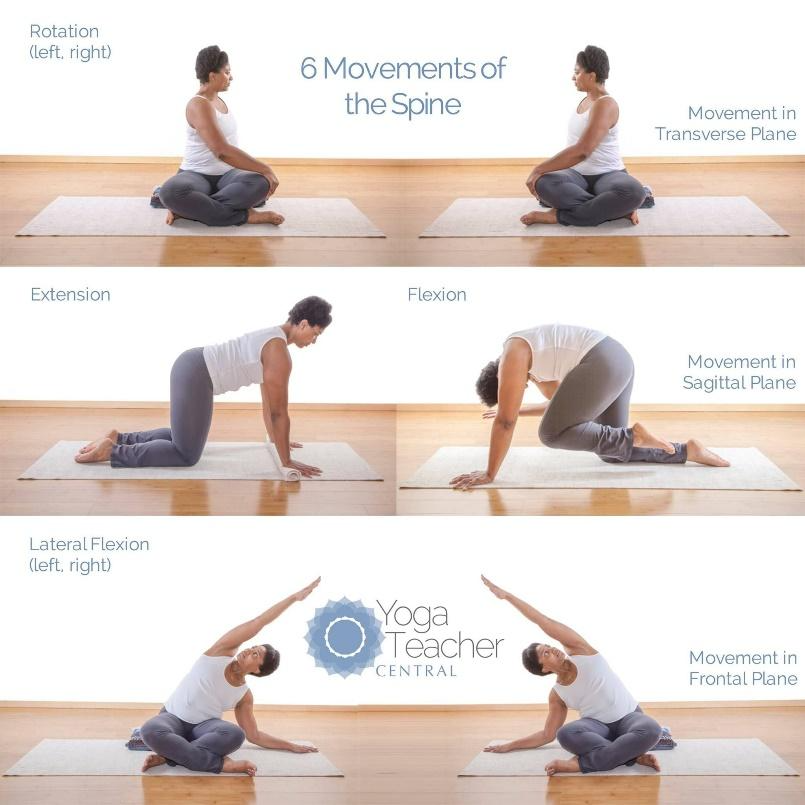
It’s generally accepted that a balanced yoga practice will move the spine in each of its six directions:
- Forward bend
- Backbend
- Side bend to the left
- Side bend to the right
- Twist to the left
- Twist to the right
In addition, the categories of extension and inversion are often included.
See below for a sample pose and link to the related Asana Category where you’ll find in-depth coverage of characteristics, cautions, and sequencing considerations for each of the different pose categories.
FLEXION & EXTENSION AS DEFINED BY SPINAL CURVES
A simple way to identify all the primary [kyphotic] curves is to notice all the parts of the body that contact the floor in Savasana, or corpse pose: the curve of the back of the head, the upper back, the sacrum, the backs of the thighs, the calves, and the heels. Consequently, the secondary [lordotic] curves are present in all the body parts that are off the floor in this position: the cervical and lumbar spine, the backs of the knees and the space posterior to the achilles tendons. From this perspective, spinal flexion can be defined as an increase in the primary spinal curves and a decrease in the secondary spinal curves. A reversal of this definition would define spinal extension as an increase in the secondary curves and a decrease in the primary curves. – Leslie Kaminoff
See also: Anatomy – Location & Movement Terminology
Forward Bending
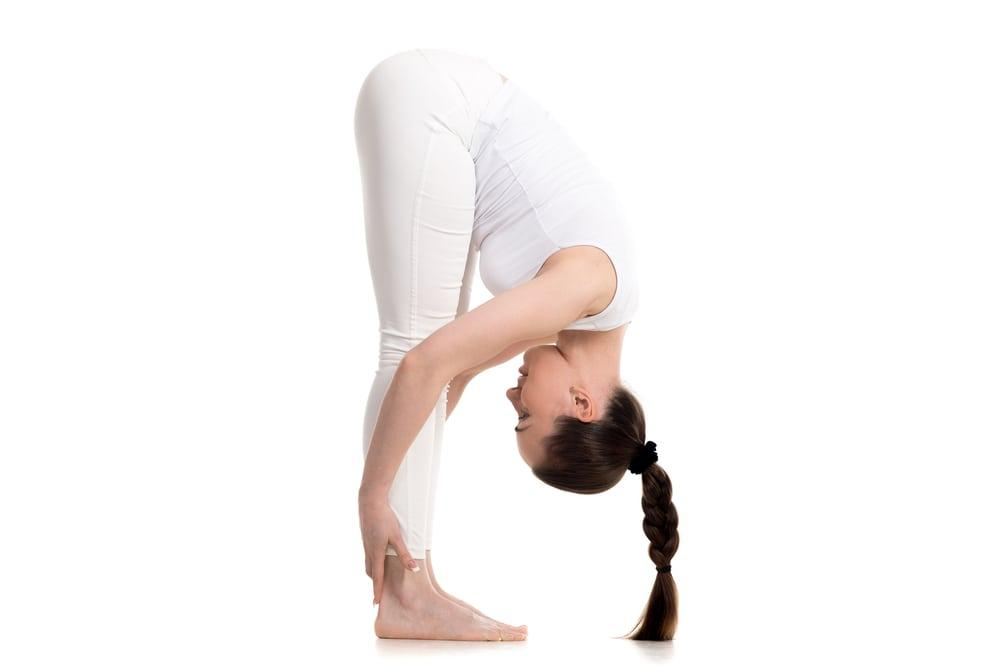
Sample Pose
Teaching Considerations
- In seated forward bends, a fundamental starting point is sitting upright as opposed to sitting back on the sit bones.
- Assess student in Dandasana (Staff Pose). Is she able to attain pelvic neutrality with the sacrum tilted slightly forward?
- Consciously lengthen the spine to maintain natural curves of the spine.
- Experts typically advise that forward bends begin with an anterior tilt of the pelvis but to then allow the pelvis to move into posterior tilt.
Go Deeper
- Asana Category: Forward Bends
- Asana Index (for specific pose cautions & cues)
- Asana Hub
Continue Reading with Ashtanga Tech
This study guide is available to members. Join to access 800+ in-depth guides on anatomy, philosophy, sequencing, and the science of practice.
Join for $5.50/mo — the cost of a DC coffeeAlready a member? Log in here
Discussion
or explore Anatomy & Physiology