
Sanskrit: Introduction
 Humanities
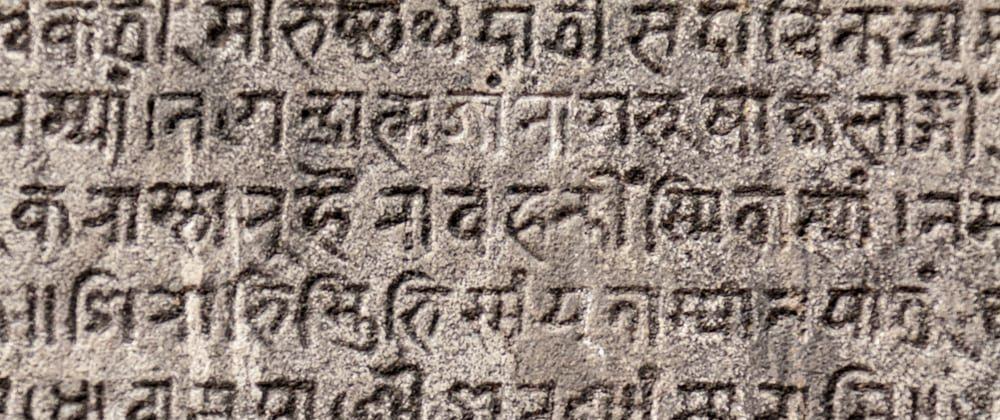
Overview
In this lesson, we introduce the Sanskrit language.
Objective
Gain an understanding of the origins of Sanskrit, its distinctive qualities, and the significance of it being the language of the original yoga texts.
What You'll Get
Define the word “Sanskrit” and review its origins. Explore how the language is unique and how it may impact those who use it. Consider reasons that teachers may wish to use Sanskrit in their teaching, and considerations for increasing effectiveness when they do.
Introduction

- “Sanskrit” means “refined,” “perfected,” “polished,” “sanctified, “perfectly or entirely done.”
- Often called “the mother of all languages,” Sanskrit is one of the oldest languages on Earth. (And a number of sources say it is the oldest language. Others claim the oldest to be Sumerian. Much more on that subject here.)
- It is the liturgical (public worship, services) language of Hinduism, Buddhism and Jainism.
- Sanskrit is one of the 22 official languages of India.
- Sanskrit is called a “sacred” or “spiritual language” and is regarded as a vibrational and healing language.
- It originated from oral traditions and was developed to communicate spiritual insights. (Nicolai Bachman)
- “It includes many words for spiritual experiences and concepts that have no equivalents in other languages.” (Russill Paul)
- Nearly all Sanskrit literature is in verse. (Encylopedia.com)
- “We need a language such as Sanskrit to capture the complexity of our deeper nature. It doesn’t make sense to use the language of the analyzing mind to cut through its own illusions, so we employ the discipline of sonic yoga to balance the limitations of our thinking, describing, analyzing mind.” (Russill Paul)
THE “HIGH” LANGUAGE
The name Sanskrit means “refined,” “consecrated” and “sanctified.” It has always been regarded as the “high” language and used mainly for religious and scientific discourse – Esoteric Learning
PERFECTLY DONE
The term ‘Sanskrit’ is derived from the conjoining of the prefix ‘sam’ meaning ‘samyak’ which indicates ‘entirely’, and ‘krit’ that indicates ‘done’. Thus, the name indicates perfectly or entirely done in terms of communication, reading, hearing, and the use of vocabulary to transcend and express an emotion. An extraordinarily complex language with a vast vocabulary, it is still widely used today in the reading of sacred texts and hymns… The language is believed to have been generated by observing the natural progression of sounds created in the human mouth, thus considering sound as an important element of language formation. This is one of the prime reasons why Sanskrit has been rich in poetry and its expressive quality of bringing out the best meaning through perfect sounds that are soothing to the human ear. Vedic Sanskrit also contains abstract nouns and philosophical terms which are not to be found in any other language. – Nikul Joshi
PERFECTED, POLISHED, REFINED
Sanskrit has been called the mother of all Indo-European languages. It’s considered to be one of the oldest languages on Earth, predating Greek and Latin, arising from the Proto Indo-European language spoken 7,000 to 8,000 years ago. The word “sanskrit” itself translates to perfected, polished or refined. And that translation is appropriate, given the healing power the language is thought to have. – Marget Braun
SIGNIFICANT IN INDIA AND HINDU TRADITION
Even though it is not a spoken language, its significance is such that it is one of the 22 official languages of India. As an integral part of Hindu tradition and philosophy, Sanskrit is mostly used today as a ceremonial language in Hindu religious rituals. It is a required subject in many schools. – About World Languages
A SPIRITUAL LANGUAGE OF MILLIONS OF AWAKENED PEOPLE
Sanskrit evolved to communicate and awaken spiritual experience… Sanskrit, as a spiritual language, has been accurately and uninterruptedly transmitted for at least four thousand years. The resonance of these sounds uttered by millions of people who have been awakened to spiritual reality assists us in our own use of the language. In other words, we draw from the power of numbers when we use Sanskrit; we connect our soul to numerous yogis and spiritual teachers who have employed this language in their own self-transformation… We need a language such as Sanskrit to capture the complexity of our deeper nature. It doesn’t make sense to use the language of the analyzing mind to cut through its own illusions, so we employ the discipline of sonic yoga to balance the limitations of our thinking, describing, analyzing mind. – Russill Paul
THE MEANING OF A SANSKRIT WORD REFLECTS HOW THE UNIVERSE WORKS
The grammar and structure of Sanskrit are intricate and have the power to bring refinement and clarity to mind. This refinement also settles the heart and brings peace and calm… The meaning of a Sanskrit word reflects how the universe works. For example, the word ‘smile’ in Sanskrit is ‘smitam.’ This means to ‘bloom, blossom and expand.’ We all know what it’s like to experience that expansive feeling when we receive a radiant smile from someone we love. It is like a newly opened flower sharing its beauty and perfection with everyone. This is ‘smittam.’ This is Sanskrit. – Sarah Mane
History & Evolution
- “Sanskrit is regarded as the ancient language in Hinduism, where it was used as a means of communication and dialogue by the Hindu Celestial Gods, and then by the Indo-Aryans. Sanskrit is also widely used in Jainism, Buddhism, and Sikhism.” (Ancient History Encyclopedia)
- The oldest form of the language in written form is traced back to the Rig Veda in the 2nd millennium BCE.
- The oldest form is called Vedic Sanskrit. From Vedic Sanskrit came Classical Sanskrit.
- Originally, Sanskrit was considered “a refined way of speaking, a marker of status and education, studied and used by Brahmins.” (About World Languages)
- Sanskrit continues to be widely used as a ceremonial language in Hindu religious rituals and Buddhist practice in the forms of hymns and mantras.
- There are a great many efforts being made to revive Sanskrit by various organizations around the world.
- Some English words have their root in Sanskrit. Richard Rosen provides four examples in this 2 minute video.
PASSED FROM GOD TO SAGE
The Sanskrit language was termed as Deva-Vani (Gods – language) as it was believed to have been generated by the god Brahma who passed it to the Rishis (sages) living in celestial abodes, who then communicated the same to their earthly disciples from where it spread on earth. – Nikul Joshi
PROFOUND HISTORY & MEANING
There is a deeply rooted faith among Indians that Sanskrit itself is the language of the Devas (Gods), which is why this language was known during the Vedic period (6,000 – 8,000 years ago) as Daivi Vak (the Divine speech)… Numerous important works from a cultural, spiritual and scientific standpoint, were written in this ancient language. All of the classic literature of Vedic times was written in Sanskrit too, including the classical texts of yoga, Vedanta and other spiritual and philosophical schools of ancient times, as well as the historical texts in the great sciences of astrology, astronomy, medicine, architecture and the physical sciences. The language is extremely regular, almost mathematical in its grammar and formulation. It is considered a sacred and mystical language — “the language of the Gods.” The script is called Devanagari, meaning “used in the cities of the Gods.” Words are constructed from a number of roots, each considered to have an intrinsic quality that embodies the meaning itself, rather than being an arbitrary symbol. Sound is considered the subtlest of all five elements, and controlling sound can help manipulate matter, as through the chanting of mantras. – Sanskrit History and Use as a Writing System
ORIGIN IN WRITTEN FORM: THE RIG VEDA
The origin of the language in written form is traced back to the 2nd millennium BCE when the Rig Veda, a collection of sacred hymns, is assumed to have been written after being continued for centuries through oral tradition and preservation of verbal knowledge in the Guru-Disciple relationship. – Nikul Joshi
EVOLUTION INTO CLASSICAL SANSKRIT
Classical Sanskrit has its origin in the end of the Vedic period when the Upanishads were the last sacred texts to be written down, after which Panini, a descendant of Pani and a grammar and linguistic researcher, introduced the refined version of the language. Panini’s timeline is assumed to be around the 4th century BCE, when he introduced his work ‘Ashtadhyayi’, which means eight chapters, forming the only available foundational and analytical text of Sanskrit grammar. It is considered to be the only source of Sanskrit grammar and vocabulary today, because everything that existed before had never been recorded except via their mention in Panini’s Ashtadhyayi. – Nikul Joshi
PREVIOUSLY, A MARKER OF STATUS & EDUCATION
Originally, Sanskrit was considered not to be a separate language, but a refined way of speaking, a marker of status and education, studied and used by Brahmins. It existed alongside spoken vernaculars, called Prakrits, which later evolved into the modern Indo-Aryan languages. – About World Languages
Continue Reading with Ashtanga Tech
This study guide is available to members. Join to access 800+ in-depth guides on anatomy, philosophy, sequencing, and the science of practice.
Join for $5.50/mo — the cost of a DC coffeeAlready a member? Log in here
Discussion
or explore Humanities