
Koshas / Panchamayakosha Model: Introduction & Overview
 Yoga Techniques and Fitness

Overview
In this lesson, we introduce the kosha model as a way of describing human beings and mapping our experience of the self.
Objective
Learn the kosha model and explore ways to apply and teach it.
What You'll Get
Name the originating source of the kosha model and describe its purpose. Define kosha and provide the names and meanings of each kosha. What is at the core of the koshas? Describe a way that you can teach koshas. What class practices might you use to teach the kosha model?

- “Anandamaya Kosha” — Bliss sheath or bliss body
- “Annamaya Kosha” — Food sheath or physical body
- “Atman” — Soul
- “Karana Sharira” — Seed or causal body, formed from the anandamaya kosha (bliss body)
- “Kosha” — Sheath, layer or body
- “Manomaya Kosha” — Mental sheath or mental and emotional body
- “Maya” — The cosmic illusion caused by an error in spiritual perception; illusion of separateness; or “that which is a relative reality”
- “Panca” — Five
- “Panchamayakosha” Model — A model describing five dimensions of human beings, a tool for mapping our experience of self
- “Pranamaya Kosha” — Vital sheath or energy body
- “Stula Sharira” — Physical body, formed from the annamaya kosha (physical body)
- “Sukshma Sharira” — Astral body, formed from the pranamaya kosha, (energy body), manomaya kosha (mental body) and vijnanamaya kosha (intellectual body)
- “Vijnanamaya Kosha” — Intellectual Sheath or Wisdom Body
Introduction
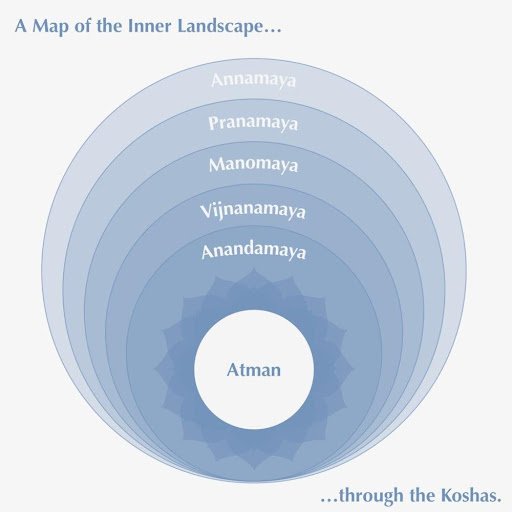
From the Vedic text the Taittiriya Upanishad, comes a model to describe human beings, a tool for mapping our experience of self. The model describes five koshas, translated as “sheaths” and often referred to as “layers” or “bodies.”
- Annamaya Kosha – Food Sheath or Physical Body
- Pranamaya Kosha – Vital Sheath or Energy, Prana or Life Force Body
- Manomaya Kosha – Mental Sheath or Mental & Emotional Body
- Vijnanamaya Kosha – Intellectual Sheath or Wisdom Body
- Anandamaya Kosha – Bliss Sheath or Bliss Body
WE ARE A COMPOSITE OF THE FINITE & INFINITE
Yoga asks us to consider that we are not only solely the physical body, [and] not only the thoughts and emotions we experience on a daily basis, but a composite of the finite and the infinite, woven into the fabric of many layers of being. The yogis called these layers koshas. – Yoga Journal
CONSIDERED SEPARATELY BUT ARE AN INTERRELATED SYSTEM
We describe and often work with the koshas separately but ultimately they are one interrelated system that make up the whole human being. – Beth Gibbs
This model is often called the panchamaya kosha model:
- panca = five
- maya = illusion of separateness or “that which has a relative reality”
- kosha = sheath, treasure or bud (as in bud of a flower)
FIVE DIMENSIONS IN THE PLAY OF ILLUSION
Though the soul – atman – is viewed as an unchanging witness, being human manifests through five —panca — constantly changing dimensions, which exist as parts of the illusion of separateness — maya. – Julia Romano
Physical, Astral & Causal Bodies

In addition, yogic philosophy describes three bodies—the physical, astral and causal—said to be formed by the koshas:
The Physical Body
- Stula sharira
- Formed from the annamaya kosha (physical)
The Astral Body
- Sukshma sharira
- Formed from these koshas: pranamaya (energy), manomaya (mental), and vijnanamaya (intellectual)
The Seed or Causal Body
- Karana sharira
- Formed from the anandamaya kosha (bliss)
Making Mindful Teaching Choices

When introducing philosophical topics in class, here are some considerations:
- Avoid making assumptions about students’ current knowledge and their perceptions of the concept’s validity and relevance.
- Consider taking time to specifically evaluate why you care about the topic, why your students might care, and how you can make it as real and as useful for them as possible.
- Remember that you have the option of using yoga philosophy to guide the way you plan, sequence, speak and teach — but without directly naming or speaking to the concept itself. Perhaps you are teaching in an environment where students may be “put-off” by Sanskrit or the Vedas. You always have the option of translating yogic wisdom into language that that will be most effective with your audience.
- Koshas and chakras are prime examples of concepts that can help to guide your teachings and words without the need to use the word kosha or chakra.
- See also: Guidelines for Teaching with Themes or Incorporating Philosophy
A Metaphorical Map or Model of the Inner Landscape
The koshas are a metaphoric “map” of the inner landscape. The model helps to demonstrate the practice of yoga as an inner journey.
Yoga therapists typically rely heavily on the kosha model as a guide to choosing yogic tools of healing for their clients. Here, a yoga therapist shares her integration of joy into her clients’ healing path:
A MODEL THAT POINTS TO MUCH MORE THAN ASANA
During my first conversation with a new yoga client I always ask – What do you enjoy doing? It is surprisingly effective in shifting people’s perspective. After talking at length about challenges, issues and shortcomings, if you ask a client “What do you do for fun?” many people are taken aback. As they start to reflect on things that bring them joy, they relax, soften, open up, take a step back to notice the big picture of their lives. This is an essential step in working with physical, physiological and mental-emotional issues – the ability to recognize that “I am not my condition.” – Olga Kabel
Continue Reading with Ashtanga Tech
This study guide is available to members. Join to access 800+ in-depth guides on anatomy, philosophy, sequencing, and the science of practice.
Join for $5.50/mo — the cost of a DC coffeeAlready a member? Log in here
Discussion
or explore Yoga Techniques