
Uddiyana Bandha
 Yoga Techniques and Fitness
Lesson Objective
In this lesson, we introduce uddiyana bandha, known as the abdominal lift.
Objective
Become familiar with uddiyana bandha, including its uses, cautions and practice technique.
Description
Translate the Sanskrit phrase “uddiyana bandha” and describe some uses and effects of this bandha. Provide associated cautions and describe two positions other than sitting from which this bandha can be practiced. Describe the technique for practicing uddiyana bandha.
Sanskrit
Uddiyana Bandha: Abdominal Lift
“uddiyana” = flying up, upward
“uddiyana bandha” = upward flying lock
oo-dee-YAH-nah BAHN-dah
Purpose / Effects
- Create heat.
- Expand the thoracic cavity.
- Strengthen respiratory muscles.
- Activates solar plexus energy center.
- Supports digestion.
- Strengthens diaphragm and abdominal organs.
- Said to force prana upward through sushumna nadi.
Numerous Effects
Up until now we have been doing beginners’ breathing and allowing the belly to expand on the in-breath—which is what it does naturally when we are breathing correctly. Now, if we apply abdominal lock, where does the breath go? You should notice that the inward and upward lift of uddiyana drives the breath into the space that contains the lungs (thoracic cavity) and actually pushes out, or expands, the rib cage, working the muscles between the ribs (the intercostals). So not only are we creating heat with this lock, but with practice we will truly expand the capacity of our thoracic cavity, rib cage, and lungs and strengthen the respiratory muscles. – Beryl Bender Birch
Force Prana Upward Through Sushumna Nadi
It is said that through uddiyana bandha, the great bird prana is forced to fly up through the sushumna nadi, the main channel for the flow of nervous energy, which is situated inside the spinal column. It is the best of bandhas and he who constantly practices it, as taught by his guru, becomes young again. – BKS Iyengar
Encourages Breath to Move Higher
Remember that in everyday inhalation the descending diaphragm pushes against the viscera, which, in turn, push against the belly muscle, which relaxes and balloons. Applied during pranayama inhalation, the lock sets up a breathing chain reaction: the firmed lower belly resists the pressure of the viscera, and the viscera, in turn, resist the downward movement of the diaphragm. Since it’s now prevented from descending fully into the belly, the diaphragm instead expands the rib cage much more than usual. This encourages the breath to move higher, into the upper chest around the eyes of the heart, enlivening the upper tips of the lungs, which are often dull. – Richard Rosen
Take Care
- Practice only on an empty stomach.
- Practice only after a complete exhalation.
- Practice jalandhara bandha at the same time.
- “Do not perform this lock by hardening your lower belly muscle… In the early stages of your practice, use this lock cautiously. Release as much tension from your lower belly as you can before you practice.” (Richard Rosen)
- “Remember that you’re locking only the lower belly on the inhale, not the upper belly (above the navel and below the xiphoid), which should continue to puff. You can touch your fingertips on this area for tactile aid to make sure there’s no hardness.” (Richard Rosen)
- Never inhale until uddiyana is released and abdominal organs are back to a relaxed state. (B.K.S. Iyengar)
- Many teachers recommend learning this bandha in a standing position, only moving to sitting after gaining experience. T.K.V. Desikachar suggests that uddiyana can also be learned in a supine reclining position.
Technique
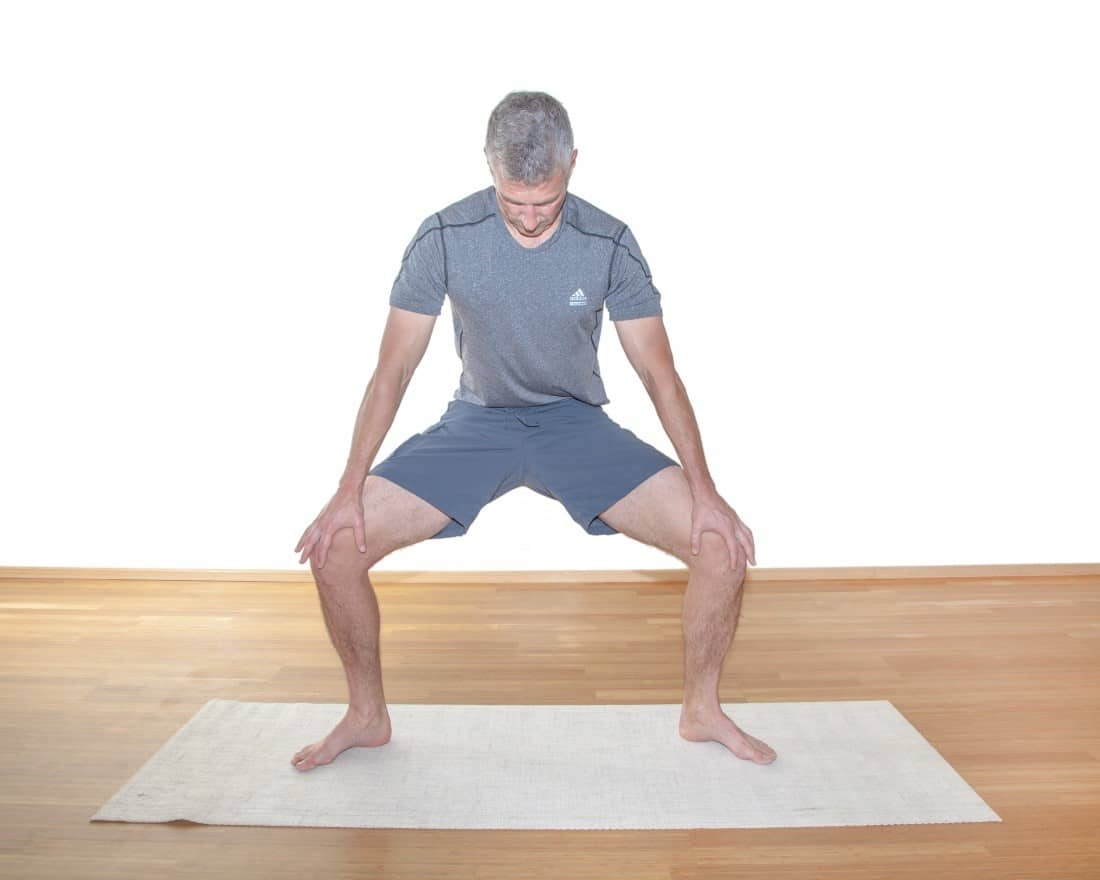
- Stand with feet apart. Bend slightly forward with hands on thighs.
- Bend arms slightly and lower chin into jalandhara bandha.
- Take a deep breath. Exhale forcibly, emptying lungs as completely as possible.
- Draw abdomen back toward spine and lift it upward, forming a hollow below diaphragm. (Do not hollow chest. – B.K.S. Iyengar)
Continue Reading with Ashtanga Tech
This study guide is available to members. Join to access 800+ in-depth guides on anatomy, philosophy, sequencing, and the science of practice.
Join for $5.50/mo — the cost of a DC coffeeAlready a member? Log in here
Discussion
or explore Student Union