
Restorative Yoga Part 2
 Yoga Techniques and Fitness
Overview
In this lesson, we present detailed teaching considerations for Restorative Yoga, including alignment, cueing, variations, sequencing, and hands-on assists.
Objective
Become knowledgeable about Restorative Yoga and review detailed teaching considerations for alignment, variations, and assists.
What You'll Get
You'll learn why keeping the head level with the heart in Savasana balances the energy body, and why maximal propping often helps students go deeper into relaxation. You'll discover how to guide students who struggle to let themselves be supported, and get specific alignment cues, variations, and sequencing ideas for restorative poses. You'll also explore hands-on assist options that can enhance the experience. Whether you're teaching students with chronic stress, injury, or just a need to rest deeply, this lesson gives you the practical tools to create a safe, effective, and profoundly restful experience.
Lesson Overview (Part 2 of 2)
- Objective: Become knowledgeable about Restorative Yoga and review detailed teaching considerations.
- Description: Provide considerations for alignment and cueing; variations; sequencing; and hands-on assists.
Foundational Teaching Considerations

YOU HAVE ARRIVED
[Savasana is] the ultimate earth hug. Let your pulse slow. Be in your body, firmly planted on the earth. You have arrived. – Yoga Journal
Key Points
- Ensuring proper alignment in a restorative pose is as vital as in any other type of practice; perhaps more important due to the long holds.
- A unique aspect of Restorative Yoga — and one that can be difficult for some students to comprehend — is that the purpose is NOT to feel strong stretching sensations.
- Once proper alignment, comfort, and ease are found, the focus turns to breath practices and engaging the mind in relaxing and/or healing visualizations.
- Students may be challenged to relax and to practice mindfulness while their body is still.
HEAD ON SAME LEVEL AS THE HEART
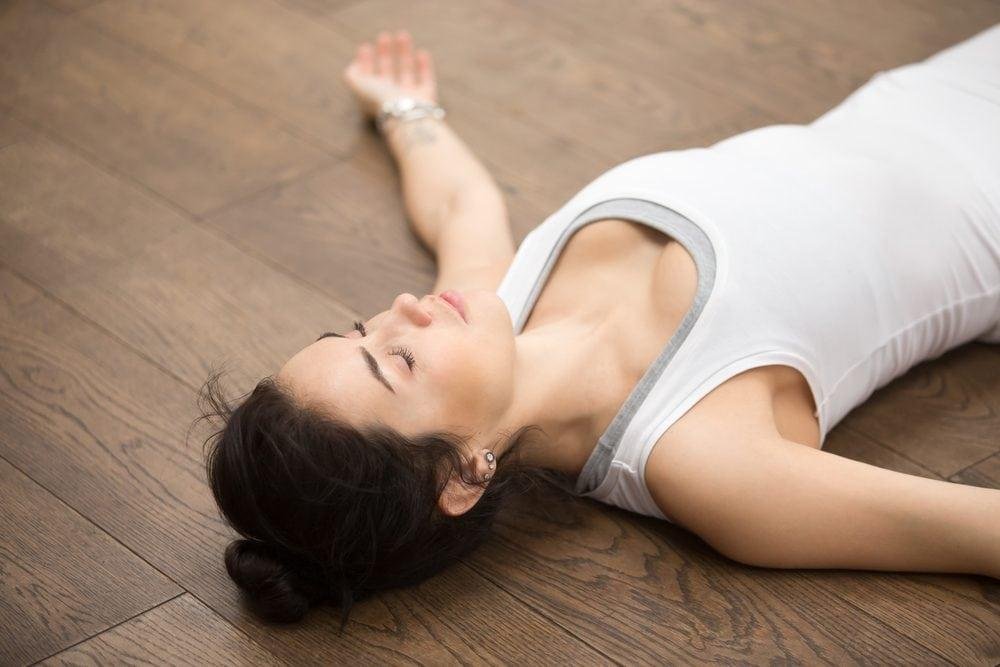
The difference between Savasana and other restorative poses is that the head should be in level with the heart. This rule derives from a physiological premise as well as symbolic. By lifting any part of the body for a longer time we increase the inner flow of prana (life force carried by breath) that resides in the given region of the body, hence influencing the particular Prana Vayu (energetic component) in order to work therapeutically in the area. However, in the Corpse Pose we seek to balance Vayus; specifically, we no longer work within the body to achieve anything, even in the therapeutic manner, but we gaze into the chattering mind itself. – Krystyna Rybinska
More Considerations
- When enough props are available, consider experimenting with maximal propping. Students may be able to “go deeper” with more support increasing their comfort and tension release.
- Some students may need to be guided in allowing themselves to be supported when they are accustomed to feeling strong sensations of stretch.
- Hands-on touch and massage can help students relax and release even more.
- Relaxing music with no words can be a welcome support for some students.
- Imagery and guided visualizations can be a vital aspect of Restorative Yoga, leading students to focus their minds on relaxation or healing.
- Aromatherapy can be an additional aid. (Ensure no allergies prior to using.)
SHOULDN’T FEEL STRONG SENSATIONS
[In Restorative Yoga] you shouldn’t feel strong sensations of stretch or strength the way you might in a more active yoga pose. Stretching and strengthening, although healthy, are both forms of tension in the body. They are a kind of good stress on the body, asking the body to adapt to the challenge of a pose. Restorative yoga is all about letting go of stress and tension. You will adapt the poses to your body, using whatever props make your body feel wonderful exactly as it is. As you hold each pose, look for a quality of ease in the body and the breath… The breathing and meditation elements of each pose make Restorative Yoga an active process of focusing the mind on healing thoughts, sensations, and emotions. – Kelly McGonigal PhD
For Those Who Struggle to Relax
Some Will Struggle with Their Mind
One author explains her struggle to relax in Savasana:
WHAT’S NOT TO LOVE?
A few of my friends cannot understand why I’ve always struggled with Savasana – “You just lay on the ground, what’s not to love?” But as someone whose brain rattles on as fast as it can whenever I get a moment of downtime, Savasana is never quite as relaxing or therapeutic as it should be… I’ve developed a few tricks to help me get more out of my entire yoga practice, Savasana included. – Amy Leonard
Managing the Mental Response to Disturbances
She goes on to share how she has worked with this by
- Making a to-do list before class so she can let it go during class
- Focusing on a sound
- Avoiding other commitments right after class, and
- Practicing at home.
In the following quote, Tracy Weber answered the question, “How can I tune out noises in Savasana?”
NOISES IN SAVASANA
Corpse Pose isn’t a time of quiet nothingness. It’s a period of active meditation… Our reactions to life’s distractions are more about us than the distractions themselves… Snoring is simply a sound, neither good nor bad. The yogini’s gremlin mind, however, makes it all about her. Oh good Lord, that man is snoring again. Why doesn’t the teacher do something about it? Doesn’t she realize that man is ruining my practice? Left unchecked, the mind will reel with righteous indignation, as if one man’s cat nap is some sort of personal… Instead of letting your monkey mind take control over you, why not take control over it? There are many different ways to do this, but one of the most powerful is to simply notice. Not the sound that’s distracting you, but your reaction to it… Whatever you notice, don’t allow your mind to amplify it. Instead, notice the thought; notice the emotion. Then bring your mind back to the feeling of the breath in your body… If you learn how to remain focused during distraction in Savasana, you might notice a ripple effect in the rest of your life. – Tracy Weber
Continue Reading with Ashtanga Tech
This study guide is available to members. Join to access 800+ in-depth guides on anatomy, philosophy, sequencing, and the science of practice.
Join for $5.50/mo — the cost of a DC coffeeAlready a member? Log in here
Discussion
or explore Asana Theory