
Asana Philosophy & Purpose – Definition & Purpose of Asana
 Yoga Techniques and Fitness
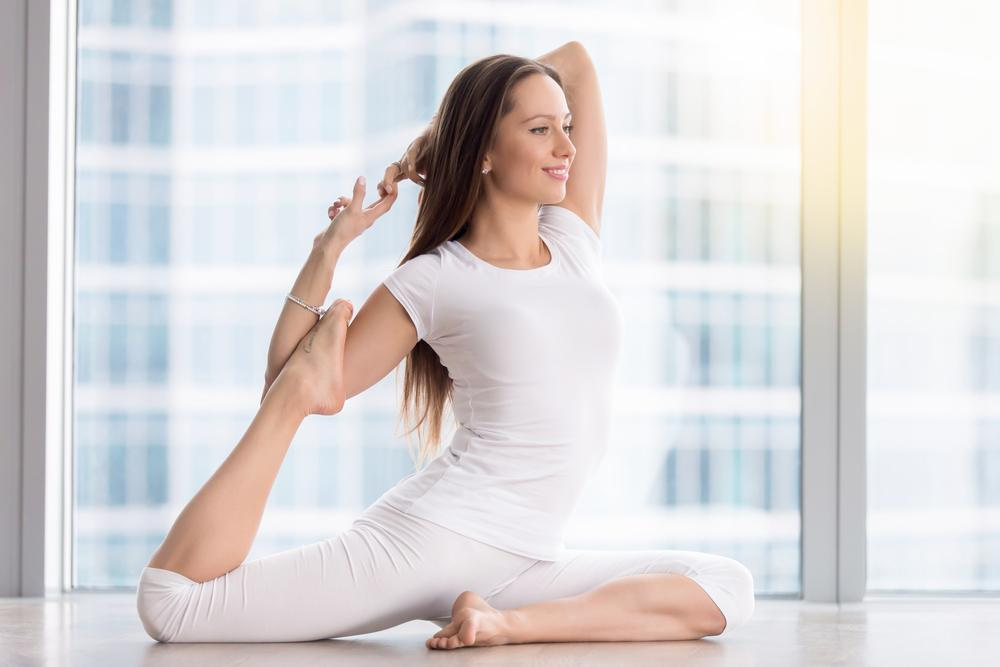
Recite and translate sutras 2.46 to 2.49 from Patanjali’s Yoga Sutras which define asana, explain what constitutes proper practice of asana, and describe the results of practice. Provide the ancient perspective on what defines health and fitness. Explore words of wisdom from teachers of various lineages regarding the purpose and benefits of asana.
Introduction
- The third of the eight limbs is asana, translated as “posture” or “seat.”
- Although asana may serve as the doorway to yoga for many students, it isn’t emphasized in The Yoga Sutras. Asana is discussed in only three of the 196 sutras.
- In sutra 2.46, asana is described as having the qualities of sthira and sukha. These are translated as “steady and comfortable,” “combining alertness and relaxation,” or “firm and relaxed.”
- The topic of sutra 2.47 is how to master asana. Translations include this: “By lessening the natural tendency for restlessness and by meditating on the infinite, posture is mastered.” (Swami Satchidananda) More translations below.
- Sutra 2.48 gives the result of asana mastery: to thereafter be undisturbed by the duality in life.
DOORWAY TO THE 8 LIMBS
Asana. Perhaps it should be called ahhhsana, for its tendency to produce sighs of pleasure. No matter what we call it, the profound, pleasing, transcendent, or transformative sensations that often accompany asana practice are probably the primary reason you were interested in the eight limbs of yoga. – Charlotte Bell
SMALL BUT IMPORTANT STEP ALONG THE PATH OF YOGA
Patanjali does not emphasize asana and devotes only three sutras to it, just enough to mention the basic characteristics of its practice. The Yoga Sutras treat asana as a small but important step along the path of yoga. – Nicolai Bachman
See Also
- Branches of Yoga
- What Is Yoga and Why Do We Practice It?
- Engage in Right Effort
- Asana Categories
- Asana Hub
Sutra Translations

Sutras 2.46 to 2.49 in Patanjali’s Yoga Sutras define asana, explain what constitutes proper practice of asana, and describe the results of practice.
Sutra 2.46: Asana
STHIRA SUKHAM ASANAM
- Asana is a steady, comfortable posture. – Swami Satchidananda
- Asana must have the dual qualities of alertness and relaxation. – T.K.V. Desikachar
- Steady and comfortable should be the posture. – Swami Satyananda Saraswati
- The natural comfort and joy of our being is expressed when the body becomes steady (asana). – Nischala Joy Devi
- Practicing yoga with strength and in a relaxed manner gives rise to harmony with the physical body (asana). – AshtangaYoga.info
- Posture (asana) is to be seated in a position which is firm but relaxed. – Swami Prabhavananda (YogaSutraStudy.info)
Sutra 2.47: How to master asana
PRAYATNA SAITHILYANANTA SAMAPATTIBHYAM
- By lessening the natural tendency for restlessness and by meditating on the infinite, posture is mastered. – Swami Satchidananda
- These qualities can be achieved by recognizing and observing the reactions of the body and the breath to the various postures that comprise asana practice. Once known, these reactions can be controlled step-by-step. – T.K.V. Desikachar
- By loosening of effort and by meditation on the serpent ananta, asana is mastered. – Swami Satyananda Saraswati
- As the body yields all efforts and holdings, the infinite within is revealed. – Nischala Joy Devi
- The key to success in this regard is practice with effort, which becomes progressively easier, combined with deep contemplation (samapatti). –AshtangaYoga.info
- Posture becomes firm and relaxed through control of the natural tendencies of the body, and through meditation on the infinite. – Swami Prabhavananda (YogaSutraStudy.info)
Sutra 2.48: Result of this mastery
TATO DVANDVANABHIGHATAH
- Thereafter, one is undisturbed by the dualities. – Swami Satchidananda
- When these principles are correctly followed, asana practice will help a person endure and even minimize the external influences on the body such as age, climate, diet, and work. – T.K.V. Desikachar
- Thereby the pairs of opposite cease to have any impact. – Swami Satyananda Saraswati
- Thereafter we are freed from the fluctuations of the gunas. – Nischala Joy Devi
- This results in a victory over the duality of life. –AshtangaYoga.info
- Thereafter, one is no longer troubled by the dualities of sense-experience. – Swami Prabhavananda (YogaSutraStudy.info)
Mukunda Stiles’ Poetic Translation
A yoga pose
is a steady
and comfortable position.
A yoga pose is mastered
by relaxation of effort,
to create a lessening
of the natural tendency
for restlessness,
and identification
of oneself as living
within
the infinite stream of life.
From that
perfection of a yoga posture,
duality,
such as praise and criticism,
ceases
to be a disturbance.
When this is acquired
then naturally follows
a cessation
of the movements
of inspiration and expiration;
this is called
regulation of breath.
– Mukunda Stiles
Continue Reading with Ashtanga Tech
This study guide is available to members. Join to access 800+ in-depth guides on anatomy, philosophy, sequencing, and the science of practice.
Join for $5.50/mo — the cost of a DC coffeeAlready a member? Log in here
Discussion
or explore Student Union