
⎯⎯⎯⎯⎯ ◆ ⎯⎯⎯⎯⎯
Inversions
⎯⎯⎯⎯⎯ ◆ ⎯⎯⎯⎯⎯
 Yoga Techniques and Fitness
Overview
In this lesson, we examine inversion poses as a category, and ways to apply this knowledge in teaching.
Objective
Understand the different categories of inversions based on which body parts are elevated, and how each type serves different purposes in practice.
What You'll Get
Become proficient in the nature and effects of inversion poses, and considerations for wisely teaching and sequencing them.
- ACTIVE INVERSIONS — Inversions that “require bearing weight through the hands and shoulders” e.g. Handstand, Forearm Stand, Shoulderstand and Headstand (source)
- CLASSIC INVERSIONS — Headstand (called the king of asanas) and Shoulderstand (the queen)
- FULL INVERSIONS — Poses in which the heart is higher than the head, and also the pelvis, legs and feet are higher than the heart
- INVERSIONS — Poses that invert the body’s relationship to space and gravity
- INVERT — To turn upside down
- MILD / PARTIAL / HALF INVERSIONS — Poses where the head is below the heart (but legs are not higher than the heart)
Introduction
To “invert” means to turn upside down. Yoga inversions invert the body’s relationship to space and gravity.
- In some types of inversions, the heart is higher than the head.
- In some types, the pelvis, legs and feet are higher than the heart.
- And in some types of inversions, both conditions are true: the heart is higher than the head and also the pelvis, legs and feet are higher than the heart.
Types of Inversions
Classic Inversions
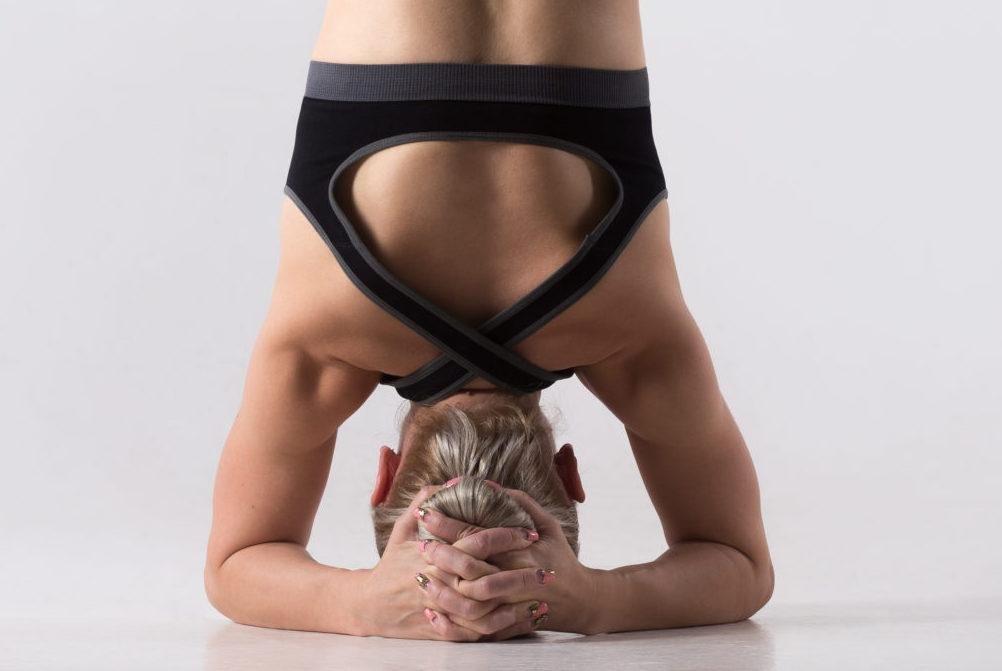
- “Classic” yoga inversions refer to Headstand (called the king of asanas) and Shoulderstand (the queen).
More Full Inversions
- In addition to “classic” inversions, other poses are considered “full” inversions when the heart is higher than the head and, also, the pelvis, legs and feet are higher than the heart.
- Examples include Forearm Balance and Handstand which are also arm balances and “active inversions.”
Mild Inversions
- Poses where the head is below the heart (but legs are not higher than heart) may be called “mild,” “partial” or “half” inversions.
- Examples include Downward Facing Dog, Dolphin Pose, Standing Forward Bend, and Wide Leg Standing Forward Bend.
Restorative Inversions
- There is another type of pose that may be considered a part of the mild inversion category or it may be deemed a separate type. In these “gentle” or “restorative” inversions, the feet are elevated in a restorative pose.
- Examples include Inverted Action / Legs Up the Wall, Viparita Karani with Chair and Restorative Bridge Pose.
Continue Reading with Ashtanga Tech
This study guide is available to members. Join to access 800+ in-depth guides on anatomy, philosophy, sequencing, and the science of practice.
Join for $5.50/mo — the cost of a DC coffeeAlready a member? Log in here
Discussion
or explore Asana Theory