
Jathara Parivartanasana (Revolved Abdomen Pose / Reclined Twist)
 Yoga Techniques and Fitness
Overview
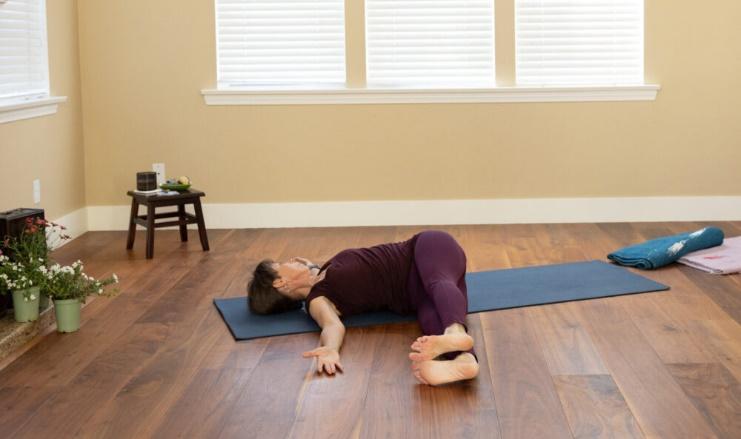
In this lesson, we introduce Jathara Parivartanasana (Revolved Abdomen Pose), a reclined twist that offers deep release and prepares the body for relaxation and meditation.
Objective
Become familiar with this pose and its variations, from the strength-demanding straight-leg version to gentler bent-knee alternatives that release tension without requiring core power.
What You'll Get
What You'll Get: You'll discover why most students love this pose at the end of practice—it releases the lower back and hips while teaching you to elongate the spine without fighting gravity. The lesson covers how to approach the full version with straight legs if you have strong abdominals, and how to use bent-knee and one-leg variations for tension release when strength isn't available. You'll learn how the pose squeezes and tones abdominal organs, opens the rib cage for fuller breathing, and soothes the spine and neck. For teachers and therapists, you'll understand how to sequence this pose both as transition to rest and earlier in practice when students are fatigued or tight from travel.
Jathara Parivartanasana
Reclined Twist
Jathara Parivartanasana
“jathara” = stomach
“parivrtta” = to revolve around
“tan” = to stretch or to go beyond
Revolved Abdomen Pose
Also known as: Reclined Twist
Notes
Most students enjoy this pose at the end of their practice as a transition into relaxation or meditation. But it also can be practiced earlier in your practice if you are feeling fatigued or your lower back is stiff or tight, such as after a long airplane flight. – Judith Lasater
- Revolved Abdomen Pose is practiced with straight legs, requiring very strong abdominals.
- Bent knee and one-leg variations with or without propping offer tension release without the strength required of straight leg version.
- This pose and its variations “are especially beneficial for learning to elongate the spine without having to lift against the gravitational pull, as we do in seated twists.” (Rama Jyoti Vernon)
Effects / Benefits
Musculoskeletal
Musculoskeletal effects may include the following.
- Stretches and strengthens core (abdominals, obliques & QL).
- Stretches hamstrings and outer hips.
- Relieves tension in lower back and hips.
- Opens rib cage, resulting in fuller breath.
- “Soothing to spine and neck.” (Erich Schiffmann)
Energy, Mood, Emotion
Effects to energy, mood or emotion may include the following.
- Centering.
A gentle twist is the basic yoga pose equivalent of hitting reset. – Rachel Land
Continue Reading with Ashtanga Tech
This study guide is available to members. Join to access 800+ in-depth guides on anatomy, philosophy, sequencing, and the science of practice.
Join for $5.50/mo — the cost of a DC coffeeAlready a member? Log in here
Discussion
or explore Asana Theory