
Tadasana (Mountain Pose)
 Yoga Techniques and Fitness
Overview
In this lesson, we introduce Tadasana (Mountain Pose), often called the most basic and foundational pose—the blueprint from which all other standing poses emerge.
Objective
Understand the alignment principles and deeper purpose of this seemingly simple pose, and how it teaches us to stand with balanced stillness and conscious presence.
What You'll Get
What You'll Get: You'll discover that Mountain Pose is far more than just standing still. This lesson explores how conscious weight distribution brings lightness, poise, and balance—and how our stance in this pose reflects how we carry ourselves in the world. You'll learn the distinction between Samasthiti and Tadasana, and why this pose is one of the best ways to become acquainted with stillness. For professionals, you'll understand how Tadasana teaches correct standing posture, strengthens legs and ankles, and serves as the foundational alignment template for all standing poses in your teaching.
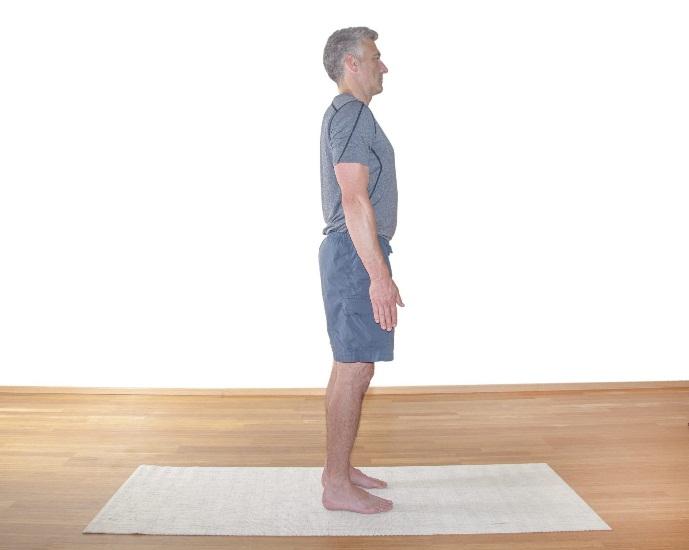
Tadasana
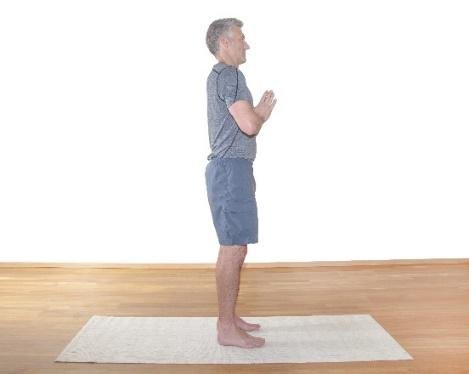
Pranamasana
Tadasana
“tada” = mountain
Mountain Pose
Samasthiti
“sama” = same, even or equal
sthiti = state, condition or stability
Equal Standing
Pranamasana
Some sources (including Dharma Mittra in Asanas: 608 Yoga Poses) call Tadasana with Anjali Mudra (Hands at Heart) by the name “Pranamasana”
SAMASTHITI & TADASANA ARE THE SAME
Samasthiti (Equal Standing) is a command to attention, to stand in balanced stillness. It is the practice of standing with equal, steady, and still attention. Tadasana (Mountain Pose) is the posture that invokes Samasthiti. These poses are not different. They are the same. – Maty Ezraty
* * *
In Sanskrit, the command for attention is sama-sthiti… Samasthiti means “standing still and straight.” Throughout the practice [of Surya Namaskar] , there will continually be the command of sama-sthiti. This means to return to Mountain Posture or attention position. – Beryl Bender Birch
Notes
- Often referred to as the most basic, foundational and fundamental pose; the blueprint or building block from which other poses are based
- “This pose, and coming back to this stillness after other poses, is one of the very best ways of becoming acquainted with stillness.” (Erich Schiffman, Yoga: The Spirit and Practice of Moving into Stillness 1996 p 94)
See Also
Continue Reading with Ashtanga Tech
This study guide is available to members. Join to access 800+ in-depth guides on anatomy, philosophy, sequencing, and the science of practice.
Join for $5.50/mo — the cost of a DC coffeeAlready a member? Log in here
Discussion
or explore Asana Theory