
Urdhva Hastasana (Upward Salute) & Standing Backbends
 Yoga Techniques and Fitness
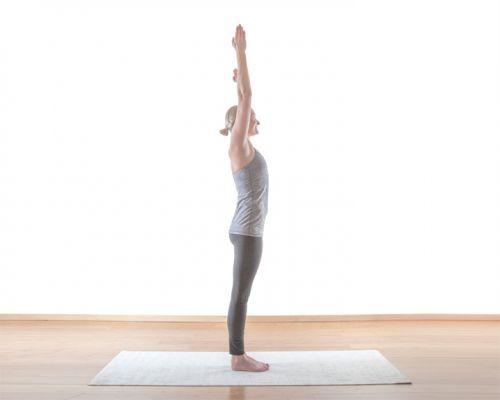
Urdhva Hastasana
Anuvittasana
Urdhva Hastasana
Upward Salute
Hasta Uttanasana
Raised Hands
Also known as: Raised Arms Pose
Anuvittasana
Standing Backbend
Extended Tadasana
Extended Mountain Pose
Naming Conventions
- In Urdhva Hastasana, the spine is lengthened up.
- Urdvha Hastasana may also be called Talasana (Palm Tree Pose).
- Names for a Standing Backbend include Hasta Uttanasana (Raised Hands Pose), Extended Tadasana (Extended Mountain Pose) and Anuvittasana (anuvitta = found, obtained).
- When Anuvittasana is used, it is usually “translated” simply as Standing Backbend.
Surya Namsakar
These poses are an element of Surya Namaskar (Sun Salutations) and the many vinyasa variations from Sun Salutes. Some sources teach Upward Salute in their vinyasas and some teach a Standing Backbend.
- Most sources use a Standing Backbend in the Classical (Lunge) Salute and Urdhva Hastasana in Surya Namaskar A. Joseph and Lilian LePage clearly use this approach in Yoga Teachers' Toolbox 2005 pgs 11-12 (referring to the Standing Backbend as Extended Tadasana).
- Sources that teach Surya Namaskar with Urdhva Hastasana include:
- David Swenson, Ashtanga Yoga: The Practice Manual 1999 p 17 (Surya Namaskar A - Swenson does not call the pose by name but simply demonstrates it—with no backbend.)
- Silva Mehta, Yoga: The Iyengar Way 2009 pgs 146-147 (Surya Namaskar A)
- Martin Kirk & Brooke Boon, Hatha Yoga Illustrated 2006 pgs 210-211 (Both Surya Namaskar A and Classical Sun Salute)
- Beryl Bender Birch, Power Yoga 1995 pgs 63-71 (Urdhva Hastasana with palms together & gaze up, Surya Namaskar A)
- Sources that teach Surya Namaskar with a Standing Backbend include:
- Swami Satyananda Saraswati, Asana Pranayama Mudra Bandha 2008 pgs 162-174 (Classical Sun Salute)
- Dharma Mittra, Asanas: 608 Yoga Poses 2003 pgs 24-35 (Classical Sun Salute)
Effects / Benefits
- Stretches abdomen
- Stretches shoulders & armpits
- Expands lungs
See Also
Cautions
When choosing a variation or alternative, consider the following:
- The heart / purpose of the pose.
- The role it is playing in the sequence.
- Why the pose is not accessible or appropriate for this student at this time.
Shoulder or Neck Issues
In the case of shoulder or neck issues, use caution, or avoid.
Arching Low Back
Watch out for arching the low back / sticking buttocks out as shown here.
Avoid These Cues
- Do not use the cue to “draw shoulder blades together” as the shoulder blades must widen in this pose.
- Do not use the cue to “move your shoulder blades down your back” when arms are up as they must elevate when upper arms are above shoulders.
SHOULDER BLADES MUST WIDEN
When arms are overhead, the shoulder blades must protract (widen) and upwardly rotate so that the arms can lift. Drawing the shoulder blades together in this position is counterproductive to this functional movement. – Rachel Scott
SHOULDER BLADES MUST ELEVATE
As Turzi explains, the shoulder blades must be allowed to elevate and upwardly rotate when the upper arms lift higher than the shoulders. When not allowed to do this, the scapulohumeral rhythm is disrupted, the shoulder joint gets pinched, and the front ribs must either thrust forward or the arms widen into a “V” shape. Allowing my shoulder blades to scoot up my back has been therapeutic for my left shoulder, which was often prone to minor injury (in part because of the enthusiasm with which I’d been shoving my shoulder blades down my back for years). Now I encourage my students to shrug their shoulder blades up their backs when their arms lift—and if that action crunches their neck, I enjoin them to lift up more through the crown of the head, while keeping the chin slightly tucked. – Amber Burke
Verbal Cues
It’s typically advised that teachers provide no more than three instructions per pose so that students have time to work with the teaching. Here you’ll find many options from which to choose. Some cues make the same point in different ways, and occasionally some can be contradictory... so please try them out for yourself. When cues are unusual or uniquely described, we have noted the source.
Legs & Feet
It’s usually advised to teach standing poses “from the ground up.” Avoid focusing on upper body alignment, pose refinements or deepening the expression of the pose until the foundation is properly aligned and steady.
- Place feet together, or hip-distance apart.*
- Point toes toward front of mat.*
- Align feet parallel with sides of mat.*
- Align feet evenly (avoiding one foot being slightly in front of the other).
- Activate quadriceps.
*Please see: Common Problems in Alignment Cueing for Standing Poses
Arms
- Keep arms shoulder-width to find proper alignment.
- Bring palms together only if possible without hunching shoulders forward.
- Straighten elbows; reach up through your pinkies.
- Reach up strongly.
- In Standing Backbend, continue to keep arms and spine in straight line.
More Cues
- Lift kneecaps / engage quadriceps.
- Lengthen torso.
- Lift rib cage.
- In Urdhva Hastasana, gaze forward (or up at thumbs if palms together).
- When gazing up, lengthen neck so as to avoid compression.
Continue Reading with Ashtanga Tech
This study guide is available to members. Join to access 800+ in-depth guides on anatomy, philosophy, sequencing, and the science of practice.
Join for $5.50/mo — the cost of a DC coffeeAlready a member? Log in here
Discussion
or explore Student Union