
Purvottanasana (Upward Plank)
 Yoga Techniques and Fitness
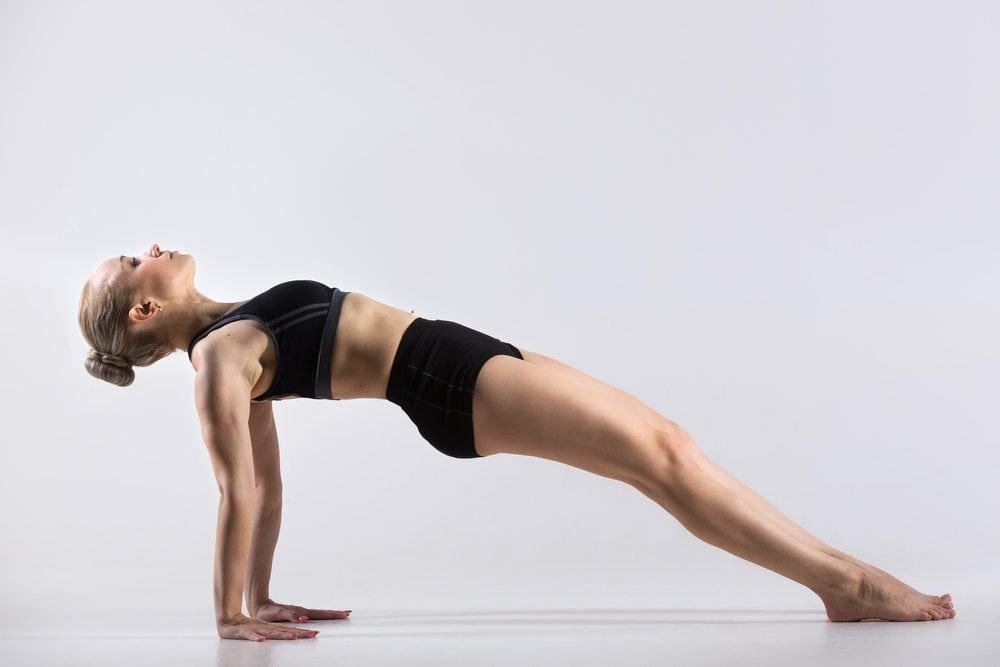
Purvottanasana
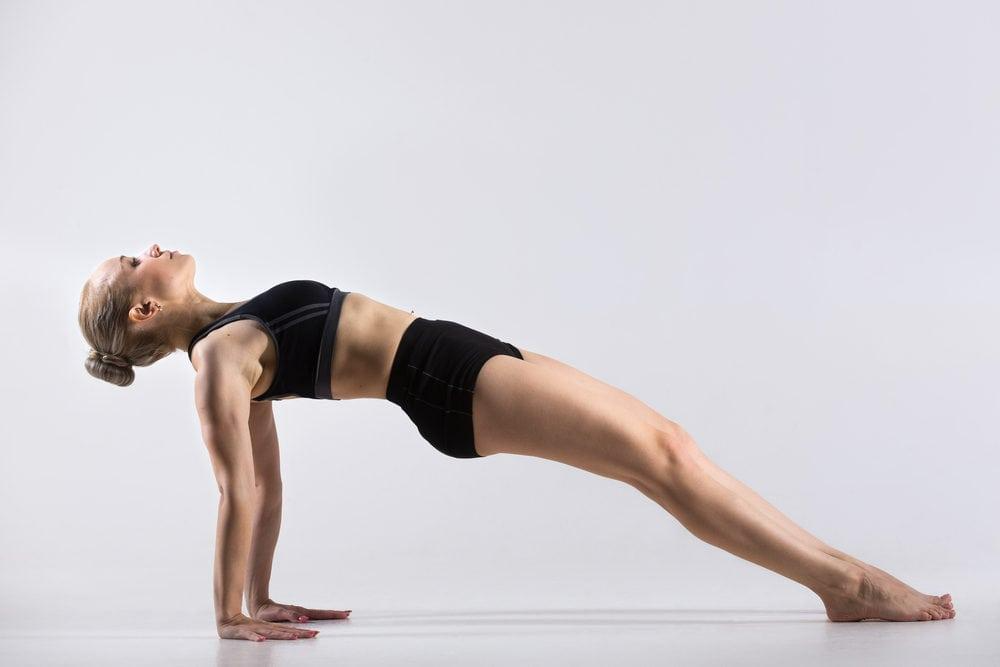
Reverse Table Top

Purvottanasana
purvo-tan-AHS-ahna
“purva” = east side (front of body)
“uttana” = intense
Intense Eastward Facing Stretch
Also known as: Upward Plank and Front of Body Stretch
Heart of Pose
- Strengthening / Stabilizing
- Front Body Stretch
Sequencing
- Excellent for balancing the effort and effects of Chaturanga Dandasana.
- Neutralizes forward bends, opening front of body.
- Prepare by lengthening hip flexors in modified Low Lunge, lifting back foot.
See Also
Effects / Benefits
People Experience Poses Differently
- The following effects may be associated with this pose.
- Knowing such common effects is typically useful for planning sequences. However, since there are no universal truths in how different people experience poses, please use caution with this information.
- For example, rather than telling students what to expect when practicing a pose or technique, you may wish to invite them to take note of effects on their breathing and their mind, and what they feel in their body.
See Also
- Wise Word Choice
- Inclusive & Accepting Word Choice
- Asana Categories Hub
- Planning & Sequencing Hub
Energy, Mood, Emotion
Effects to energy, mood or emotion may include the following.
- Heating, energizing.
- Can inspire “an overall feeling of release and expansion.” (Baron Baptiste)
Inner Body
Inner body effects may include the following.
- Stimulates abdominal organs, kidneys and adrenal glands.
- Massages thyroid and thymus.
Musculoskeletal
Musculoskeletal effects may include the following.
- Strengthens back body.
- Strengthens arms and wrists.
- Strengthens “the whole rotator cuff.” (Beth Spindler)
- “Stabilizes pelvis.” (Joseph LePage)
- Strengthens core.
- Strengthen buttocks, back and legs.
- “Increases strength and hardiness of entire body including muscles of respiration and heart.” (Joseph LePage)
- Stretches front body.
- Stretches neck, shoulders, chest, abdomen, legs, front of ankles.
- Stretches hip flexors including psoas.
ESPECIALLY GOOD BACK BODY STRENGTHENER
Upward Plank pose is an especially good strengthening pose because it works in a way that other backbends don’t. If you look at Camel pose (Ustrasana), gravity assists your body when you drop into the backbend. In Upward Plank, however, you have to work against gravity to lift into the pose, so your back body needs to step up to the task. Upward Plank is excellent for building strength in the postural support muscles in the back… It also loads the arms behind you in extension, building strength in the upper back and shoulders. – Beth Frederick
Purvotttanasana is an effective way to balance the muscular actions of Chaturanga Dandasana.
Some people practice Chaturanga too much, and as a result the muscles of the chest tighten, the shoulders are being drawn forward and you end up with a bulky rounded stiff upper back and collapsed chest………basically not a very balanced way to practice yoga. It will also prevent an effortless opening of the chest in backbends. Upward plank pose is a great counterpose… Basically you can say this pose stretches most of the muscles Chaturanga strengthens. Also, it strengthens muscles in the upper body that you need/want to be strong to be able to practice Chaturanga in a healthy way. My message and advice is to practice this pose regularly and extensively if you love your Chaturanga and really work on getting strong in this pose. This will help your Chaturanga to be healthy and to stay injury free! — Esther Ekhart
BALANCE VINYASA SEQUENCES AND SHOULDER OVERUSE ISSUES
As a yoga therapist, I am quite familiar with shoulder-overuse issues. And I have maxed out my own shoulders more than once during teacher trainings when I repeatedly demonstrated cycles of chaturanga and upward and downward dogs. In an ideal world, doing so many repetitions would be avoided and more varied movement would be favored, but in teacher trainings and some styles of asana we sometimes overpractice in order to refine a certain movement. So, perhaps shaking up that repetitive cycle with purvottanasana… or its cousin chatus pada pitham … can provide some needed balance in our sequences. – Beth Spindler
Therapeutic Uses*
- Depression
- Digestion (source)
- Fatigue
* This pose is often associated with positive effects related to the conditions listed. But unless trained in yoga therapy, teachers are usually advised against “prescribing” particular asanas to address specific conditions.
Cautions
When choosing a variation or alternative, consider the following:
- The heart / purpose of the pose.
- The role it is playing in the sequence.
- Why the pose is not accessible or appropriate for this student at this time.
Contraindications
- Heart disease
- High blood pressure
- Shoulder pain or injury
- Stroke
- Wrist injury
Weight-Bearing Alignment of Hands

In poses where the hands support the body weight, consider the following guidelines.
- Place hands shoulder-distance apart.
- Align wrist creases with front of mat.
- Check to be sure palm is flat on earth, fingers spread (but not excessively so).
- Watch for uneven spacing between fingers and/or a pinky that wings out too far. (However, in the case of Dupuytren’s Contracture, uneven spacing may be desirable.)
- Press down with hands so that all fingers and knuckles are pressing evenly.
- Ensure weight is not concentrated in wrist and heel of hand. You may need to focus on pressing into knuckles and roots of fingers to avoid excessive pressure in wrists.
- John Friend has also suggested pressing with pads of fingers and pulling them back isometrically.
- Once hands are aligned properly, you may wish to visualize drawing energy up from the center of the palms.
- A thicker yoga mat may be helpful but it should still be firm. Practicing on a soft or cushioned surface may cause hyperextension of the wrist.
Cautions
- Be cautious with weak wrists.
- Use caution with neck issues. One option is to support head on a chair seat.
- For back issues, begin with modifications.
Sinking in Full Pose
Watch out for sinking in hips or torso as shown here. Options include encouraging lift, offering a hands on assist, and/or practicing Reverse Table Top instead.
Sinking in Reverse Table Top
In Reverse Table Top, also watch out for sinking in hips and torso, and for neck strain, as shown here.
In proper alignment:
- The low back is in neutral.
- There is space in upper back, shoulders and neck.
- Shoulders are drawn away from the ears.
- Shoulder blades are drawn in toward the chest.
Continue Reading with Ashtanga Tech
This study guide is available to members. Join to access 800+ in-depth guides on anatomy, philosophy, sequencing, and the science of practice.
Join for $5.50/mo — the cost of a DC coffeeAlready a member? Log in here
Discussion
or explore Student Union