
Visvamitrasana (Flying Warrior)
 Yoga Techniques and Fitness
Overview
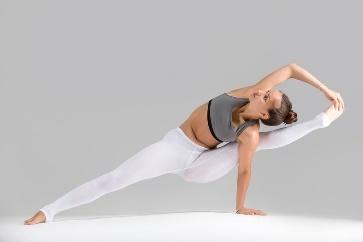
In this lesson, we introduce Visvamitrasana (Flying Warrior or Friend of the Universe Pose), a complex arm balance that combines sidebending, hamstring stretching, shoulder opening, and twisting in one shape.
Objective
Gain understanding of how seemingly separate actions come together in this pose: a standing leg, an arm balance, a sidebend, an awake core, and a split approaching the front leg.
What You'll Get
You'll walk away with a practice that challenges multiple body systems simultaneously, teaching you that complex poses are just simple actions layered together. The pose builds arm, core, and leg strength while opening your hips, shoulders, and hamstrings. For your own practice, it's a lesson in dedication and focus, where separate parts gradually integrate into flowing energy. If you teach, you'll learn how to break down this intimidating pose into accessible increments, helping students understand that it's not reserved for an elite group but available to anyone willing to practice the components. It's about transformation through persistent effort, just like the sage it's named after.
Visvamitrasana
“Visvamitra” = name of a sage
Pose Dedicated to Visvamitra
Friend of the Universe Pose
Flying Warrior
Heart of Pose
- Arm Balance
- Hip Stretch
Introduction
SIMPLE ACTIONS PUT TOGETHER IN A COMPLEX WAY
Visvamitrasana (Pose Dedicated to Visvamitra) seems like one of those poses. You know, the ones that seem reserved for an elite group of people whose club you’ll never be a member of. The complexity of the pose can look overwhelming and lead to the illusion that it is inaccessible… When you look at it in small increments, you can see it more clearly: The back leg is in a standing pose, the bottom arm is in an arm balance, the torso and top arm are in a sidebend, the abdominals are awake, and the front leg is approaching a split… As you learn to practice this pose, remember that it is a combination of simple actions put together in a complex way. – Jason Crandell
BEGIN BY FOCUSING ON SEPARATE PARTS; EVOLVE TO THE ACTIONS COMING TOGETHER
Named after an ambitious king who transformed himself into a yogic sage, Visvamitrasana is a complex asana: It’s an arm balance, hip opener, shoulder opener, hamstring stretch, and twist, all in one. As you practice it, you’ll notice—just as I did with surfing—that you start by focusing on separate parts of your body, which inhibits your balance, rhythm, and flow. But with dedication, all of the seemingly separate parts and actions will come together, and the energy of the asana will come alive. – Shiva Rea
MYTHOLOGY & THE CONNECTION BETWEEN VISVAMITRASANA & VASISTHASANA
Originally a king and member of the warrior class, Visvamitra achieved the status of brahmanical sage through his piety and asceticism. Though he earned great status and respected titles, Visvamitra was not satisfied with his ascension to the brahman class until the great sage Vasistha, a priest and author of the Vedas, acknowledged him (Light on Yoga). Visvamitra continued his rigorous penance for many years until finally Vasistha recognized him as his equal (FreeIndia.org). The competitive relationship between these two sages is the subject of many legends. And so the connection between Visvamitrasana and Vasisthasana is revealed: they are different, but equally powerful. Vasisthasana is graceful, simple, and elegant. Visvamitrasana is scrappy and complex. Both will test your strength and sense of balance. – DamnGoodYoga.com
Effects / Benefits
Musculoskeletal System
Musculoskeletal effects may include the following.
- Strengthens upper body: shoulder, side body.
- Strengthens hands & wrists.
- Strengthens legs.
- Stretches outer hips, glutes, hamstrings.
- Stretches shoulder (opposite of one strengthening).
- Twisting action.
Energy, Mood, Emotion
PATIENCE, PERSISTENCE, SELF-KNOWLEDGE
The thing that visvamitrasana and other challenging poses constantly remind me: Asanas aren’t obstacles to be conquered, prizes to be won, or accomplishments to check off some grand yogic to-do list. Rather, they’re tools we can use to get to know ourselves a little better — to learn how to observe and honor our bodies, to discover where we feel especially strong and/or flexible, where we feel not so especially strong and/or flexible, how we respond when we feel pissed off or agitated, and the ways in which we change, and learn, and grow over time. – Kat Heagberg
SENSATION OF INTEGRATION
You’ll gain firsthand experience of what it’s like to take seemingly disparate physical actions and integrate them. This sensation of integration — that is, the feeling that everything is coming together, whether you get into the full final pose or not — can be incredibly satisfying. With work, you’ll also get a glimpse of what it’s like to exceed your self-imposed limitations. Your ego will no longer feel that sense of separation that comes with the mistaken notion that there is an exclusive, members-only club that you’re not invited to, in yoga or in life. – Jason Crandell
Cautions
Continue Reading with Ashtanga Tech
This study guide is available to members. Join to access 800+ in-depth guides on anatomy, philosophy, sequencing, and the science of practice.
Join for $5.50/mo — the cost of a DC coffeeAlready a member? Log in here
Discussion
or explore Asana Theory