
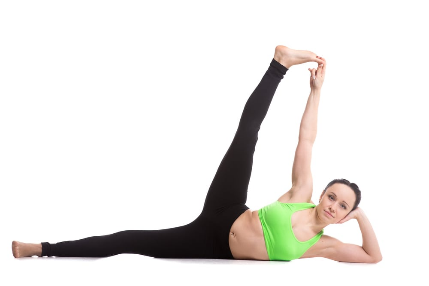
Anantasana(Side Reclining Leg Lift / Vishnu’s Pose)
 Yoga Techniques and Fitness
Anantasana
AH-nan-TAHS-ana
“anta” = end
“an” = without (Yoga Anatomy)
“ananta” = “without end” “eternal” “the infinite one” (Yoga Anatomy) and (Wikipedia)
Vishnu’s Pose, Reclining Pose Dedicated to Vishnu, Sleeping Vishnu’s Pose, Vishnu’s Couch Pose, Eternal One’s Pose, Side Reclining Leg Lift
Naming & Mythology
This pose got the name “Sleeping Vishnu’s Pose” based on images of Vishnu reclining on his side on top of a snake.
Some sources explain that “Ananta” is another name for the god Vishnu.
Some report that “ananta” is the name of the thousand-headed serpent upon whom Lord Vishnu rests. (Yogapedia) Others say the name is “related to” the serpent, named Sesha. (Wikipedia)
Ananta, a word meaning “unending” or “infinite,” describes what is timeless, beyond birth, growth, death, and all modifications — a limitless state of joy and contentment. This sweet, natural state of ours, beyond the things of the senses, is embodied by the vast mythological serpent, Ananta, whose coils support the universe and who serves as Vishnu’s couch when Vishnu rests between avataric incarnations. – Zo Newell
Heart of Pose
- Asymmetrical Balancing
- Core Strengthening
- Hip & Hamstring Stretching
Anantasana requires you to balance on the fine line of the side of the body while one leg extends up to infinity. Any number of things can pull you off balance. If you lose your focus, you might topple over, tweak your neck, or bruise your pride. Lose stability along your spine, slouch your back, or round your shoulders, and the pose collapses. – Lisa Walford
Notes
- Preparatory poses include Parighasana (Gate), Utthita Trikonasana (Extended Triangle) and Supta Padangusthasana (Reclined Hand to Toe)
- See also: Core Strengthening and Core Anatomy
Effects / Benefits
Energy, Mood, Emotion
Effects to energy, mood or emotion may include the following.
- As a balance pose, helps to improve concentration and mental clarity.
- Eases fatigue.
- Relieves stress and anxiety.
- Activates muladhara (root) chakra, providing grounding energy. (Yogapedia)
Musculoskeletal System
Musculoskeletal effects may include the following.
- Improves balance.
- Stretches and strengthens hips muscles. Develops balance in pelvic muscles.
- Stretches muscles of shoulders, back and side of torso.
- Stretches hamstrings, inner thighs and calves.
- Improves core stability including pelvic floor muscles and abdominal strength.
- Strengthens “armpit muscles and shoulders.” (Jaisiyaram)
Continue Reading with Ashtanga Tech
This study guide is available to members. Join to access 800+ in-depth guides on anatomy, philosophy, sequencing, and the science of practice.
Join for $5.50/mo — the cost of a DC coffeeAlready a member? Log in here
Discussion
or explore Student Union