
Ardha Baddha Padmottanasana(Half Bound Lotus Standing Stretch)
 Yoga Techniques and Fitness
Overview
In this lesson, we present Ardha Baddha Padmottanasana (Half Bound Lotus Standing Stretch), a challenging pose that combines hip opening, hamstring stretching, and balance.
Objective
Gain understanding of how to safely approach this demanding posture while practicing patience, compassion, and ahimsa (non-violence) toward your body.
What You'll Get
You'll walk away knowing how to protect your knees while opening your hips, hamstrings, and shoulders in a standing forward fold. This pose requires significant preparation and body awareness, making it an excellent teacher of listening to your limits. For your own practice, it builds focus and confidence when approached wisely. If you teach, you'll learn how to offer progressions and modifications that keep students safe while working toward greater opening. It's a practice in balancing ambition with care, both on and off the mat.
Ardha Baddha Padmottanasana
“ardha” = half
“baddha” = bound
“padma” = lotus
“uttana” = intense stretch
Half Bound Lotus Standing Stretch
In Bikram Hot Yoga, called Tree Pose
Heart of Pose
- Hip Stretch
- Hamstring Stretch
- Standing Balance
Cautions
Preparation Required
The body should be heated and prepared before practicing this challenging posture.
Patience & Compassion
- To wisely practice this pose requires patience, listening to the body and practicing compassion in order to avoid pushing past physical limits.
- This pose is often taught hand-in-hand with the teaching of ahimsa (non-violence).
Knee Risk
- Preparation poses and variations should be practiced until hips are sufficiently open to keep knees safe.
- The bent knee is, of course, at risk in Half Lotus.
- The knee of the standing leg is at risk of hyperextension due to the forward bend and because the bent leg pressing against standing leg may place too much pressure on that knee.
- See more in Anatomy of Knees: Function & Issues.
Effects / Benefits
Energy, Mood, Emotion
Effects to energy, mood or emotion may include the following.
- Can inspire confidence.
- Develops focus.
Inner Body
Inner body effects may include the following.
- Tones abdominal organs.
Musculoskeletal
Musculoskeletal effects may include the following.
- Opens hips, hamstrings, quads, back and shoulders.
- Strengthens standing leg.
Basic Form
Set Up
- Begin in Tadasana (Mountain).
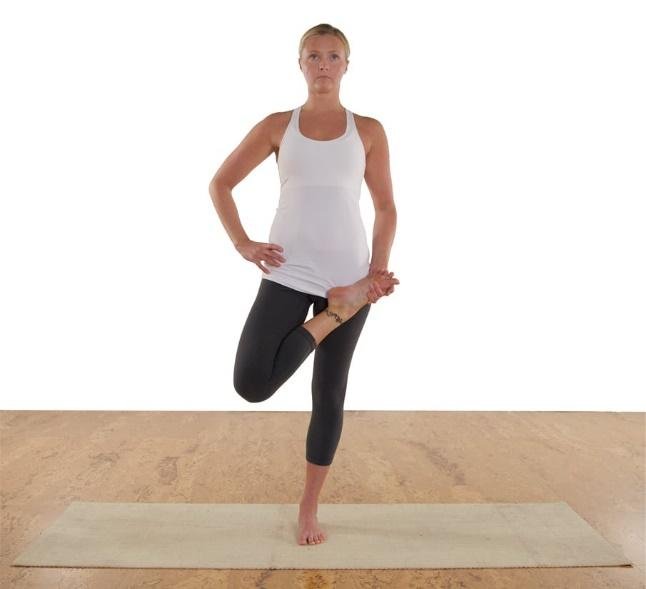
- Inhale, draw leg up at an angle.
- Hold foot with both hands or with opposite hand.
- Keep shoulders and hips square.
Moving Into Pose
Inhale
- Exhale, take hold of foot, or hold opposite arm.
- Inhale, stay or raise opposite arm.
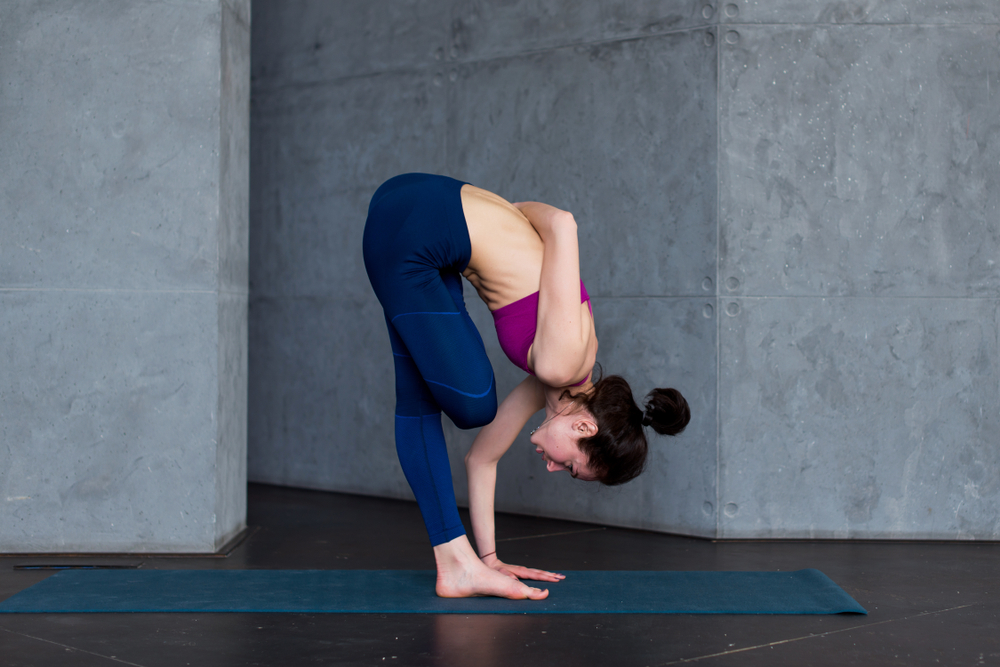
- Exhale, stay or bend at hips to fold forward.
- Take hand to block or floor beside foot.
Gaze
- Past end of nose
Hold Time
- 5 breaths or 20-30 seconds
Coming Out
- Inhale to come back up.
- Exhale to release foot.
To Emphasize
- Move with patience and compassion (integrity over ego).
- Keep hips level and square.
- If standing knee bends or hips move out of alignment, take a less intense bind or back off and do other hip stretching.
- When folding, draw chin toward shin.
- Avoid excessive rounding in back.
- Release any strain in neck.
Verbal Cues
General Verbal Cues
- Draw lotus heel toward navel.
- Release lotus knee down away from hip.
- Keep inner and outer heel reaching evenly.
- Keep shoulders square.
- “Lengthen your inner thigh toward the inner knee as you draw the skin of the outer knee up toward the hip. Continue this loop of energy to protect the knee and open the hip.” (Chuck Miller & Matty Ezraty)
- Keep hips level.
- Gaze forward.
Binding
- Hold wrist with opposite hand.
- If standing knee bends or hips move out of alignment, release effort to a less intense bind.
Folding
- Draw chin toward shin.
- Avoid excessive rounding in back.
- Release any strain in neck.
Inspiration
MAXIMIZING REVERENCE & MINIMIZING VIOLENCE
A good time to learn about maximizing reverence and minimizing violence is… with a posture like Ardha Baddha Padmottanasana. Yoga practice is designed to increase our awareness, amplify our sensitivity to the suffering of the world, and develop our compassion. One of the ways it does that is by teaching us to recognize what hurts and what feels good within our own body. If we catch ourselves pushing a little past our edge, greedily grabbing for more than our body can do safely, we can learn to recognize that behavior as a manifestation of himsa (violence). Hopefully, that recognition will help us avoid getting hit over the head by the lesson in the form of a painful injury. – Beryl Bender Birch
INTEGRITY VS EGO
A posture done with integrity is much more beautiful than one based in ego and illusion. Beyond that, the tendency to push is not useful and can lead to a host of injuries. Ardha Baddha Padmottanasana is a pose worth learning for any student—it challenges the hips, ham-strings, and shoulders, and it requires balance. But a better alternative to forcing the pose is to cultivate the qualities of restraint and intelligence… Strive to understand the actions of the pose and then work them intelligently until you can increase the intensity. Pain in any part of the body should not be confused with an “opening”; it is your body sending you a message. In this case, the joint below will suffer for the joint above, so if your hips are tight and you force your way into Half Lotus, your knees will suffer. Instead, choose to honor ahimsa and satya by staying present with what is happening in your body and then adapting your practice, rather than forging ahead unconsciously. – Chuck Miller & Maty Ezraty
Continue Reading with Ashtanga Tech
This study guide is available to members. Join to access 800+ in-depth guides on anatomy, philosophy, sequencing, and the science of practice.
Join for $5.50/mo — the cost of a DC coffeeAlready a member? Log in here
Discussion
or explore Asana Theory