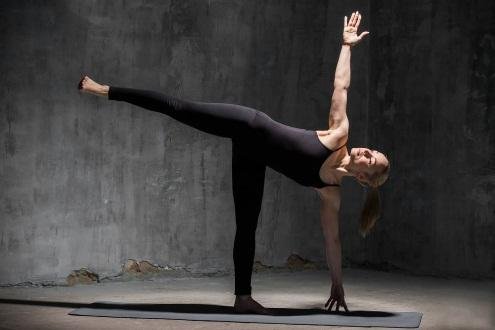
Ardha Chandrasana(Half Moon Pose)
 Yoga Techniques and Fitness
Overview
In this lesson, we explore Ardha Chandrasana (Half Moon Pose), a balancing posture that embodies the qualities of brilliance and radiance while challenging your sense of spatial orientation.
Objective
Understand how to create stability on two points of contact while strengthening the outer hips, core, and standing leg, and stretching the calves, hamstrings, and side body.
What You'll Get
You'll learn to root down through one hand and foot while extending out in all directions, a skill that teaches coordination and proprioception in a way that few other poses do. The balance is tricky because your head isn't upright, so your vestibular system has to adapt. For your own practice, this builds energy and focus while toning your core and legs. If you teach, you'll gain strategies for helping students find steadiness in asymmetry and develop the kind of calm that emerges from navigating challenge with breath and presence.
Ardha Chandrasana
Ardha Chandrasana Chapasana
Ardha Chandrasana
ARE-duh chun-DRAHS-anna
“ardha” = half
“chandra” = brilliance, moon
Half Moon Pose
“The Sanskrit word Chandra also refers to the qualities of brilliance or shine of the moon… A lightness and freedom can be experienced in this pose as if you can radiate in all directions.” – Marla Apt
Heart of Pose
- Balance
- Twists Torso
Joint Actions
- Standing leg: internal rotation; knee extension
- Lifted leg: hip external rotation, knee extension, ankle dorsiflexion
- See also: Joint Movements & ROM
Effects / Benefits
Energy, Mood, Emotion
Effects to energy, mood or emotion may include the following.
- Challenges and promotes focus and mental stillness.
- Boosts energy and mood.
- May ease tension and relieve stress.
- Brings a balance of heating and cooling.
Inner Body
Inner body effects may include the following.
- Challenges and develops the vestibular system in a relatively unique way. (See quote below.)
- Tones abdominal organs.
Our vestibular system, the apparatus in the inner ear that gives our brain information about motion, head position, and spatial orientation, is unfamiliar in… Half Moon Pose (Ardha Chandrasana). Even though you’re maintaining two points of contact (hand and foot), the pose is often more difficult for practitioners than Vrksasana (Tree Pose). That’s partly because the head is not upright. – Charlotte Bell
Musculoskeletal
Musculoskeletal effects may include the following.
Strengthens
- Core
- Spine
- Side body and abdomen
- Chest
- Outer hips, buttocks, legs
- Ankles and wrists
Stretches
- Calves
- Hamstrings, inner thighs, groins
- Back muscles
- Chest, shoulders
General
- As with all balancing practices, challenges and improves coordination, proprioception and balance
Ardha Chandrasana Chapasana
Half Moon Bow Pose / Sugarcane offers these additional effects:
- Stretches hip.
- The many effects of backbending
ROOTING DOWN & EXTENDING OUT TEACHES COORDINATION,
INTERDEPENDENCE, FOCUS
You are rooting down into the earth with your standing leg while simultaneously lifting and extending your raised leg into space. The meeting of these two forces — rooting down and extending out — gives you the power to balance and suspend your spine and torso in midair. The pose teaches coordination and can help you understand the interdependence of the actions in your body. It can train you to stay focused and balanced during challenging moments of transition in asana practice. – Nikki Costello
Therapeutic Uses*
- Digestive Issues
- Low Back Issues (some types, including “sacrum pain, sciatica pain and lumbar aches,” per Marla Apt)
- Osteoporosis (Baxter Bell MD)
- Stress & Tension
* This pose is often associated with positive effects related to the conditions listed. But unless trained in yoga therapy, teachers are usually advised against “prescribing” particular asanas to address specific conditions.
Contraindications & Cautions
Contraindications
This pose generally not recommended for students with these conditions:
Knee Risk
- Avoid hyperextending standing leg. Student can be guided to have a “micro-bend” in knee.
- Watch for misalignment of ankle and knee joints of standing leg. Guide students to point toes and knee straight ahead.
ADDING A STEP TO HELP WITH KNEE ALIGNMENT
It’s super-common for the front knee to collapse in toward center in half moon, which can make the pose feel more wobbly, and, over time, can lead to some not-so-happy knees. Before you open up into the pose, align your front knee by bending it slightly and lifting your heel, as though you were wearing a high-heeled shoe. Press into the ball of your right big toe, and track your knee toward the pinky-toe side of your foot… Keep rooting through the ball of your big toe and continue to track your knee toward the pinky toe as you slowly lower your front heel to the floor. You can keep a small bend in your front knee if it helps you to keep it aligned, or you can move your front leg toward straight. Maintain this healthy-knee alignment as you open up into the pose. – Kat Heagberg
Cases for Practicing Variations
In the following cases, Marla Apt recommends using wall variations:
- Fatigue
- Lower back weakness
- Leg weakness
- Pregnancy
In the following cases, Marla Apt recommends practicing versions with a block, enabling both legs to be straight:
- Back stiffness
- Hamstring tension
Alternatives
If variations do not address the student’s condition, these alternatives might be suitable:
Utthita Trikonasana (Extended Triangle Pose)
- Learn more: Utthita Trikonasana
Vrksasana (Tree Pose)
- Learn more: Vrksasana
See Asana Category: Balancing for more pose options.
Basic Form
Set Up
Place block in front of — and slightly outside — front foot.
- Begin in Utthita Trikonasana (Extended Triangle).
- With hand on block or floor beneath shoulder, bend front knee.
- Option: Traditional pose has top arm reaching straight up. This photo shows a variation of moving into pose with top arm at hip. Top arm can also reach straight back along hip and leg.
Utthita Trikonasana (Extended Triangle) and/or Utthita Parsvakonasana (Extended Side Angle) are often used as preparation and entry points for Half Moon Pose.
Moving Into Pose
Inhale
- Slide back foot closer to front.
- Avoid using momentum* and instead, slowly transfer weight to front foot and hand.
- Turn from the belly to open front torso toward sky.
- Keep grounded leg bent while getting balance. Then straighten.
- Extend top arm up (if shoulders can stack and balance is stable) or keep it at the hip.
* "Take your time, and don’t forget about your standing leg! While it can be tempting to "pop up" ... "shoot forward" or [otherwise]... come into half moon too quickly... [this] is a surefire way to feel unstable once you get there. There's no need to hurry! Take your time and set the stage for a steady ardha chandrasana right from the start." (Kat Heagberg)
Exhale
- Slowly straighten front leg.
- Draw kneecaps up.
- Press through both feet.
Gaze
- Traditional gaze is at upper fingertips.
- If neck tension is an issue, gaze down or neutral
Hold Time
- 20 seconds to 1 minute
Coming Out
- Exhale, bend front knee.
- Lower leg back to floor, reaching it long in preparation for Triangle Pose.*
- Inhale, adjust front leg into Triangle Pose.
*Marla Apt emphasizes here the benefits of going back through Triangle Pose on the exit as opposed to dropping the leg down next to the standing leg.
To Emphasize
- Keep standing foot and knee pointing straight ahead.
- Reach lifted leg straight back from hip.
- Keep spine long and chest opening upward.
- Align bottom arm under top arm.
- Radiate out from belly through spine, legs and arms.
Continue Reading with Ashtanga Tech
This study guide is available to members. Join to access 800+ in-depth guides on anatomy, philosophy, sequencing, and the science of practice.
Join for $5.50/mo — the cost of a DC coffeeAlready a member? Log in here
Discussion
or explore Asana Theory