Arm Position in Eka Pada Koundinyasana
This is Ashtanga Yoga Tech Support. Real questions from the community, answered.
The Question
How should your arms be in Eka Pada Koundinyasana?
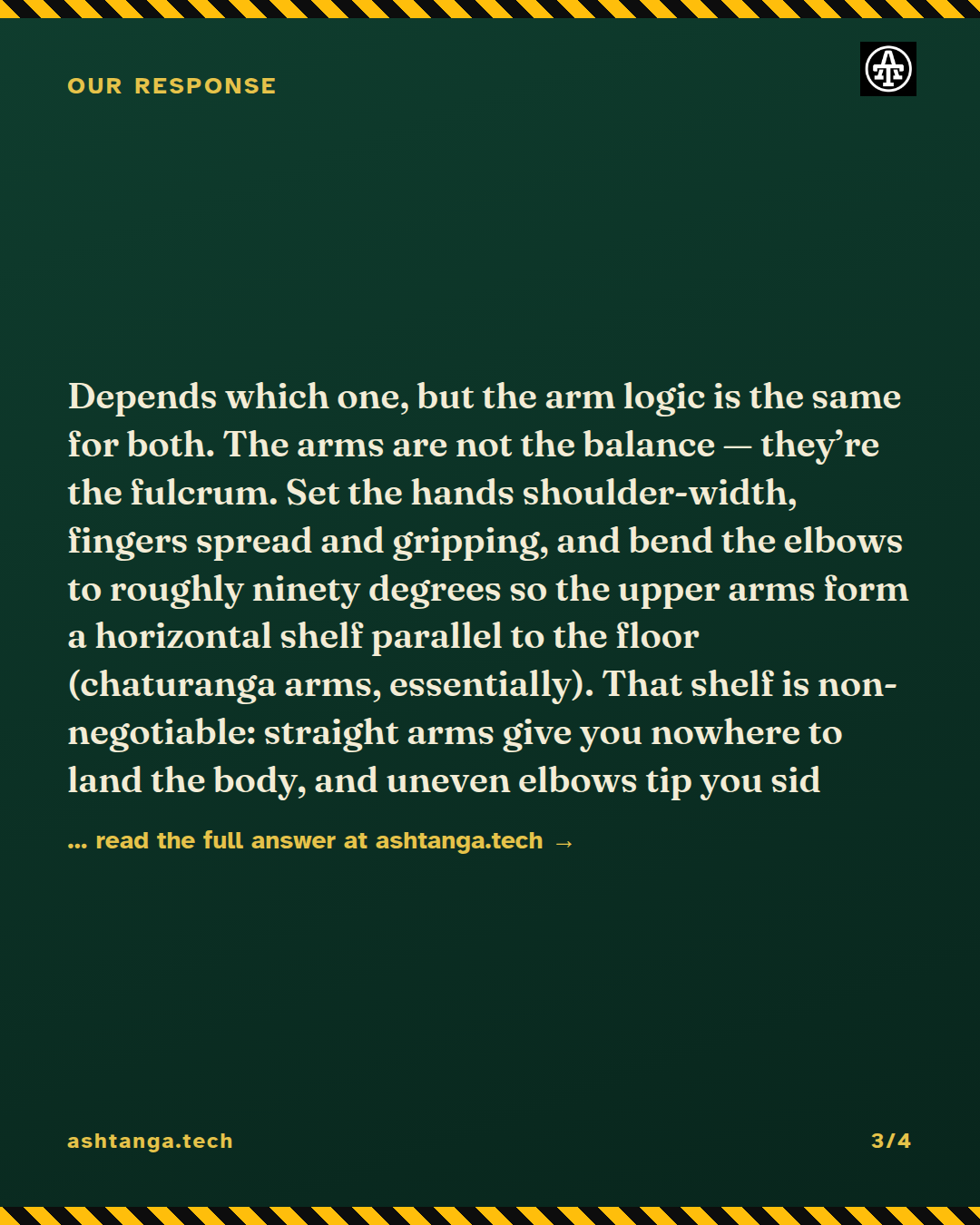
Our Response
Depends which one, but the arm logic is the same for both. The arms are not the balance — they’re the fulcrum. Set the hands shoulder-width, fingers spread and gripping, and bend the elbows to roughly ninety degrees so the upper arms form a horizontal shelf parallel to the floor (chaturanga arms, essentially). That shelf is non-negotiable: straight arms give you nowhere to land the body, and uneven elbows tip you sideways. In Eka Pada Koundinyasana I (the side-crow-with-a-leg-out family), one outer thigh hooks high onto the back of the same-side upper arm while the other leg shoots straight back — your bent arm is the platform the torso lever rotates over. In II (flying splits), the front leg drapes over the same-side upper arm and the back leg extends; both elbows still bend evenly and the chest stays forward so your weight crosses ahead of the wrists, not behind them. The recurring mistake is keeping the chest back and the elbows wide — that loads the wrists and you fold. Elbows in, chest forward, shelf level. The arms hold; the gaze and the chest do the steering.
More on Ashtanga Tech: Eka Pada Koundinyasana II (Flying Splits)
Carousel · Tech Support

1/4
Not sure where to start?
Chat with the intake assistant — tell it about your practice and it’ll point you to what fits.
Talk to the Intake Bot →
Discussion
or explore Student Union