
Ardha Baddha Poschimottanasana
 Yoga Techniques and Fitness
Overview
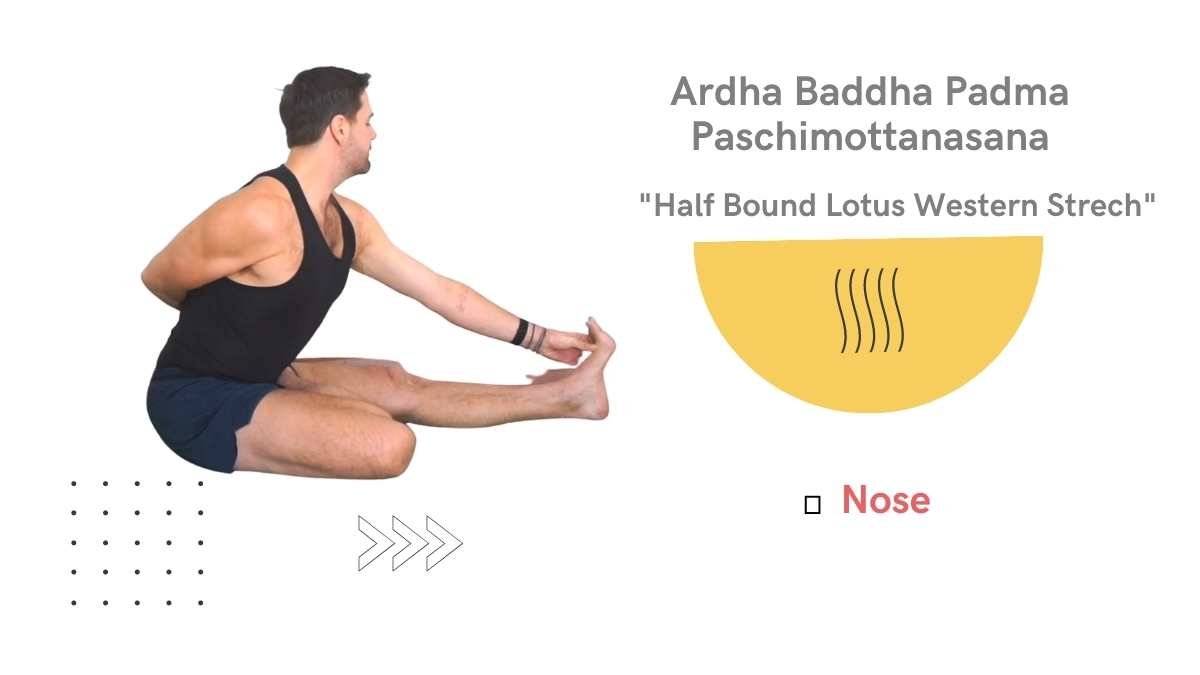
In this lesson, we explore Ardha Baddha Padma Paschimottanasana, a forward bend that combines lotus position on one leg with a forward fold over the extended leg.
Objective
Gain understanding of how this pose tells two parallel stories: hip opening through the lotus leg and hamstring stretching through the straight leg.
What You'll Get
You'll learn how to assess whether a student has sufficient external rotation to safely place the foot in lotus, and when to use a simpler bent-leg position instead. We cover the biomechanics of reaching behind the back to bind the lotus foot, what's happening in the internal rotators of the bent hip, and how to fold forward without forcing the knee. You'll walk away knowing never to push students into padmasana and understanding how to use facilitated stretching to gradually build the range of motion needed.
Ardha badha padma paschimottanasana has two parallel stories—a forward bend and a hip opener. The straight-leg hip flexes and the knee extends, with the trunk folding forward.
| ARDHA BADDHA PADMA PASCHIMATANASANA (20 MOVEMENTS) | ||
| 7 | SAPTA | Inhale, jump through, right foot bind |
| 8 | ASTAU | Exhale, fold |
| 9 | NAVA | Inhale, look up |
| Exhale | ||
| 10 | DASA | Inhale, lift up |
| 11 | EKĀDASA | Exhale, jump back, Chaturanga |
| 12 | DUADASA | Inhale, Upward-Facing Dog |
| 13 | TRAYODASA | Exhale, Downward-Facing Dog |
| 14 | CATURDASA | Inhale, jump through, left foot bind |
| 15 | PANCADASA | Exhale, fold |
| 16 | SODASA | Inhale, look up |
| Exhale | ||
| 17 | SAPTADASA | Inhale, lift up |
| 18 | ASTAUDASA | Exhale, jump back, Chaturanga |
| 19 | EKUNAVIMŠATIḤ | Inhale, Upward-Facing Dog |
| 20 | VIMSATIH | Exhale, Downward-Facing Dog |
Anatomy
Ardha badha padma paschimottanasana has two parallel stories—a forward bend and a hip opener. The straight-leg hip flexes and the knee extends, with the trunk folding forward. The bent-leg hip flexes, abducts, and externally rotates, with the foot placed into Lotus (Padmasana) position, thus opening the hip. If you can’t put the foot into Lotus, use a less difficult placement of the bent leg, for example, Janu Sirsasana. One arm reaches behind the back and grasps the big toe of the Lotus foot; the other hand grasps the outside of the straight-leg foot. It is important to note that you must have length in the internal rotators of the bent-knee hip in order to externally rotate it and place the foot on the thigh. Never force the foot into Pad- masana position, as you can injure the knee. If you are unfamiliar with this concept, review the section on Lotus (page 96). Use facilitated stretching of the internal rotators to dissolve blockages, so that you can eventually place the foot easily into Padmasana.
BASIC JOINT POSITIONS
- The straight-leg hip flexes.
- The knee extends.
- The ankle plantar flexes.
- The foot everts.
- The bent-leg hip flexes, abducts, and externally rotates.
- The ankle plantar flexes.
- The foot everts.
- The trunk flexes.
- The front-arm shoulder flexes, abducts and externally rotates.
- The back-arm shoulder extends, adducts, and internally rotates.
- The elbows flex.
- The forward wrist flexes.
- The back wrist extends.
Continue Reading with Ashtanga Tech
This study guide is available to members. Join to access 800+ in-depth guides on anatomy, philosophy, sequencing, and the science of practice.
Join for $5.50/mo — the cost of a DC coffeeAlready a member? Log in here
Discussion
or explore Student Union