
Baddha Konasana A & B
 Yoga Techniques and Fitness
Overview
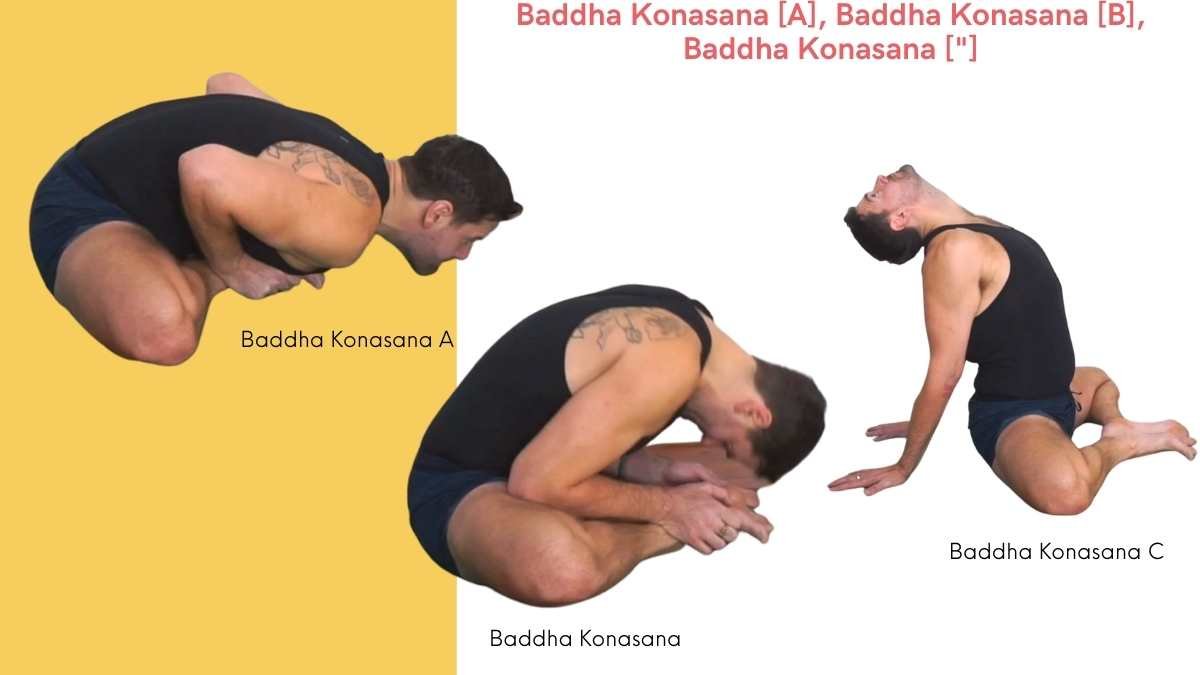
In this lesson, we present Baddha Konasana A and B, symmetrical poses that provide an opportunity to locate and balance asymmetries in the hips and pelvis.
Objective
Become familiar with how to use abduction, external rotation, and flexion of the hips to open the groin and lower back.
What You'll Get
What You'll Get: This pose is a mirror. Because it's symmetrical, any asymmetry in your hips or pelvis becomes obvious. You'll learn to work with the adductors, external rotators, and pelvic floor muscles to deepen the stretch. The two variations—one with the chest forward and one with the head down—teach different actions of the arms and back. For personal practice, it opens the hips and prepares you for lotus and other seated poses. For teachers and therapists, it's a foundational assessment tool. You'll see where students are tight and how they compensate, which informs how you sequence their practice.
Baddha konasana is a symmetrical pose as such, it provides an opportunity for locating and balancing asymmetries, particularly in the hips and pelvis.
| BADDHA KONASANA (13 MOVEMENTS) | ||
| 7 | SAPTA | Inhale, jump through, feet together |
| 8 | ASTAU | Exhale, fold, chest forward (A) |
| 9 | NAVA | Inhale, up |
| 10 | DASA | Exhale, fold, head down (B) |
| 11 | EKĀDASA | Inhale, up |
| Exhale | ||
| 12 | DUADASA | Inhale, lift up |
| 13 | TRAYODASA | Exhale, jump back, Chaturanga |
| 14 | CATURDASA | Inhale, Upward-Facing Dog |
| 15 | PANCADASA | Exhale, Downward-Facing Dog |
Anatomy
Baddha konasana is a symmetrical pose as such, it provides an opportunity for locating and balancing asymmetries, particularly in the hips and pelvis. First identify the elemental movements that create the form of the pose. For example, the hips flex, abduct, and externally rotate. Each component of hip movement is like a subplot in the story of the pose. Focusing on specific components brings greater awareness to the nuances of each movement. Begin with abduction: tight adduc- tors can restrict drawing the knees apart. Use facilitated stretching, as detailed in the Key Concepts, to create length in the adductor group and free the hips to open the knees. Then work on improving external rotation of the hips. Limitations in this movement may stem from tightness in the internal rotators the gluteus medius and minimus and the tensor fascia lata. Use the facilitated stretch provided for Padmasana (Lotus Pose) to increase the range of hip external rotation. Combine this with the mobility gained in abduction to deepen Baddha Konasana. Next, invoke the deep external rotators of the hip and the muscles of the pelvic floor to nutate the sacrum and gain subtle depth in the pose. Connect the hands and feet. One variation has the elbows bending to draw the body forward. In another variation, the back arches and the shoulder blades draw together to lift the torso upward, expanding the chest. Use the arms in combination with the hamstrings to draw the feet closer to the pelvis one objective of the final pose. Remember to maintain the knees as hinge joints. Gain most of your mobility from the hips, which are ball and socket joints.
BASIC JOINT POSITIONS
- The hips flex, abduct, and externally rotate.
- The knees flex.
- The ankles are neutral.
- The trunk extends.
- The shoulders flex, adduct, and externally rotate.
- The elbows flex.
Continue Reading with Ashtanga Tech
This study guide is available to members. Join to access 800+ in-depth guides on anatomy, philosophy, sequencing, and the science of practice.
Join for $5.50/mo — the cost of a DC coffeeAlready a member? Log in here
Discussion
or explore Student Union