
Marichiyasana C
 Yoga Techniques and Fitness
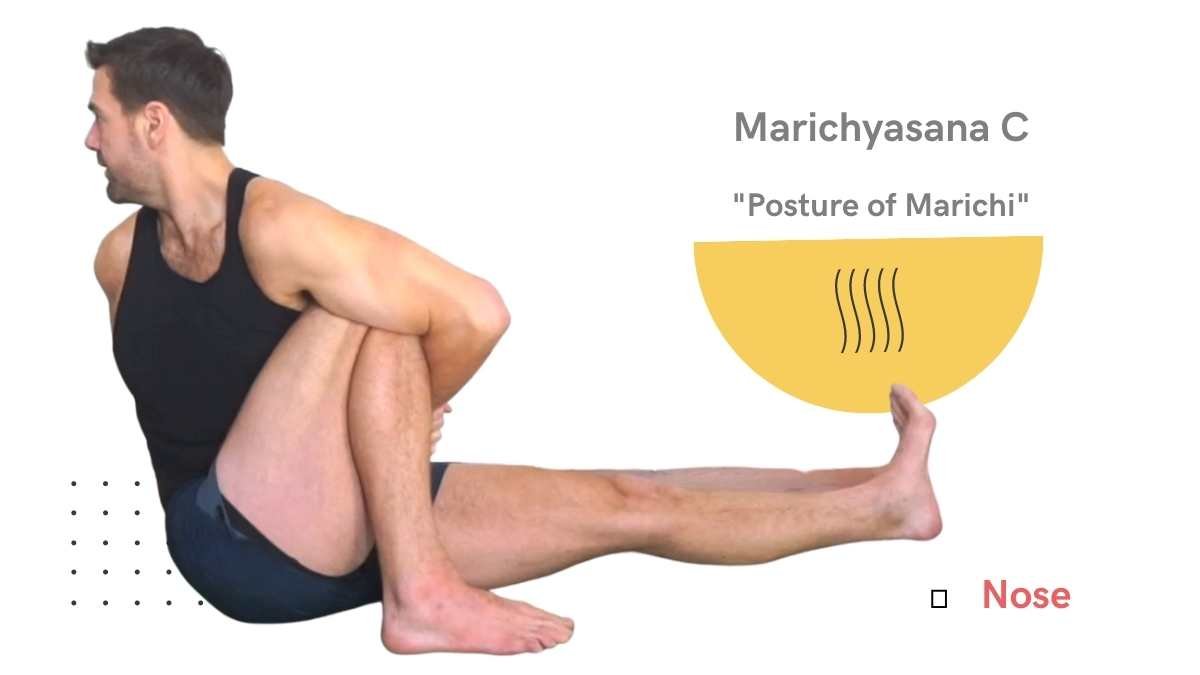
In this version of marichyasana, we turn the upper body away from the straight leg and toward the flexing knee. Similarly, the lower body, from the pelvis down through the legs, turns away from the upper body. The twisting trunk and vertebral column connect the shoulders and hips.
| MARICHASANA C (16 MOVEMENTS) | ||
| 7 | SAPTA | Inhale, jump through |
| Exhale, take posture twist to the right | ||
| 8 | ASTAU | Inhale, lift up |
| 9 | NAVA | Exhale, jump back, Chaturanga |
| 10 | DASA | Inhale, Upward-Facing Dog |
| 11 | EKĀDASA | Exhale, Downward-Facing Dog |
| 12 | DUADASA | Inhale, jump through |
| Exhale, take posture twist to the left | ||
| 13 | TRAYODASA | Inhale, lift up |
| 14 | CATURDASA | Exhale, jump back, Chaturanga |
| 15 | PANCADASA | Inhale, Upward-Facing Dog |
| 16 | SODASA | Exhale, Downward-Facing Dog |
Anatomy
In this version of marichyasana, we turn the upper body away from the straight leg and toward the flexing knee. Similarly, the lower body, from the pelvis down through the legs, turns away from the upper body. The twisting trunk and vertebral column connect the shoulders and hips. Each region of the body forms a subplot that contributes to the main story of the pose. For example, look at how the upper and lower extremities connect where the upper arm wraps over the bent knee. This point forms a focus of leverage with different variations, depending on the way the arm and the leg are used. For example, fix the knee in place and then press against it with the arm to turn the body. Then brace the arm and push against it with the side of the leg. Note the different effects of these two actions. Finally, press the arm and leg equally against each other. How is your experience of the pose different in each variation? Work your way into the shoulders. Note that the rotator cuff (the deep muscles of the shoulder) can subtly augment the twist. The more superficial muscles, such as the deltoids and latissimus dorsi, also have rotational components, depending on the angles of the fibers. Then look at the bent leg. There are muscles with rotational actions from the foot to the hip; any of these can be engaged to augment the twist to varying degrees. Each forms a chapter in the story of the pose. The breath provides the soundtrack.
BASIC JOINT POSITIONS
- The hips flex.
- The straight-leg knee extends.
- The held-leg knee flexes.
- The trunk rotates.
- The shoulders internally rotate and extend.
- The elbows extend and the forearms pronate.
- The held wrist extends.
Continue Reading with Ashtanga Tech
This study guide is available to members. Join to access 800+ in-depth guides on anatomy, philosophy, sequencing, and the science of practice.
Join for $5.50/mo — the cost of a DC coffeeAlready a member? Log in here
Discussion
or explore Student Union