
Supta Padangusthasana
 Yoga Techniques and Fitness
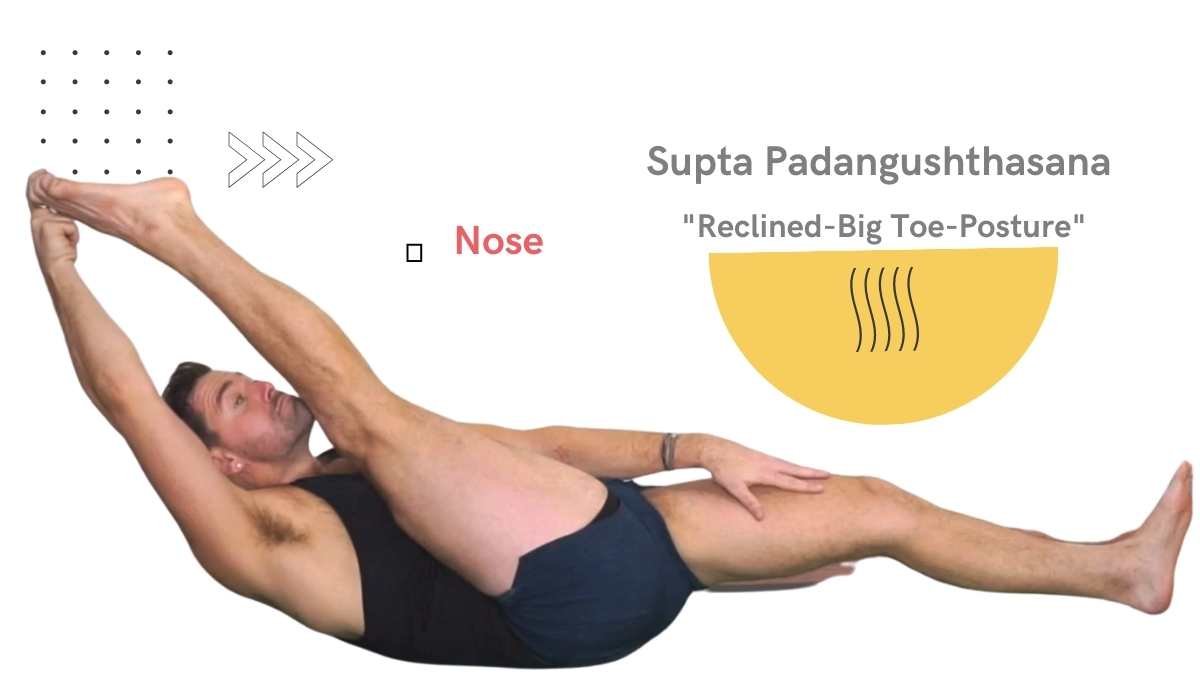
Supta padangusthasana flexes abducts, and externally rotates the hip of the lifted leg and straightens the knee. If we straighten the knee more or flex the leg up higher, we intensify the stretch of the hamstrings.
| SUPTA PADANGUSTHASANA (26 movements) | ||
| 7 | SAPTA | Inhale, jump through |
| Exhale, lie down | ||
| 8 | ASTAU | Inhale, right leg up, take toe |
| 9 | NAVA | Exhale, fold |
| 10 | DASA | Inhale, head down |
| 11 | EKÁDASA | Exhale, externally rotate right leg to the side, look left |
| 12 | DUADASA | Inhale, leg to the front |
| 13 | TRAYODASA | Exhale, fold |
| 14 | CATURDASA | Inhale, head down only |
| 15 | PANCADASA | Exhale, leg down |
| 16 | SODASA | Inhale, left leg up, hold toe |
| 17 | SAPTADASA | Exhale, fold |
| 18 | ASTAUDASA | Inhale, head down |
| 19 | EKUNAVIMSATIḤ | Exhale, externally rotate left leg to the side, look right |
| 20 | VIMSATIH | Inhale, leg to the front |
| 21 | EKAVIMSATIḤ | Exhale, fold |
| 22 | DUAVIMSATIḤ | Inhale, head down |
| 23 | TRAYOVIMSATIḤ | Exhale, leg down |
| 24 | CATURVIMSATIH | Inhale, Chakrasana |
| Exhale, Chaturanga | ||
| 25 | PANCAVIMSATIḤ | Inhale, Upward-Facing Dog |
| 26 | ŞATVIMSATIḤ | Exhale, Downward-Facing Dog |
Anatomy
Supta padangusthasana flexes abducts, and externally rotates the hip of the lifted leg and straightens the knee. If we straighten the knee more or flex the leg up higher, we intensify the stretch of the hamstrings. This is an example of triangulation, wherein the origin of the hamstrings on the ischial tuberosity represents one point of the triangle and the insertion on the lower leg represents another. The hamstrings are the apex or focal point. Actions that move the origins and insertions farther away from one another conspire to stretch the hamstrings. Externally rotating the thigh preferentially lengthens the semimembranosus and semitendinosus (the inside hamstrings). The shoulder and arm perform a secondary action that affects the focal point of this story. If you lift the arm and attempt to bend the elbow, you can draw the leg up higher. The trunk assists in this action when we slightly arch the back and rotate away from the lifted leg. Then there is the leg that remains extended along the mat. The foot of this leg tends to lift off the floor and externally rotate. Use coupled joint movements to address this: extend the lumbar spine and hip to bring the foot back to the ground. Then press the heel into the mat and attempt to drag it to the side. This cue engages the muscles that turn the thigh inward, countering the external rotation of the leg.
BASIC JOINT POSITIONS
- The hip of the leg on the mat extends and internally rotates.
- The hip of the held leg flexes abducts, and externally rotates.
- The knees extend.
- The trunk extends and the cervical spine rotates.
- The shoulder on the held-leg side abducts and externally rotates.
- The elbow extends.
- The other shoulder adducts and internally rotates.
- The elbow flexes slightly.
- The forearm pronates.
Continue Reading with Ashtanga Tech
This study guide is available to members. Join to access 800+ in-depth guides on anatomy, philosophy, sequencing, and the science of practice.
Join for $5.50/mo — the cost of a DC coffeeAlready a member? Log in here
Discussion
or explore Student Union