
Ubhaya Padangusthasana
 Yoga Techniques and Fitness
Overview
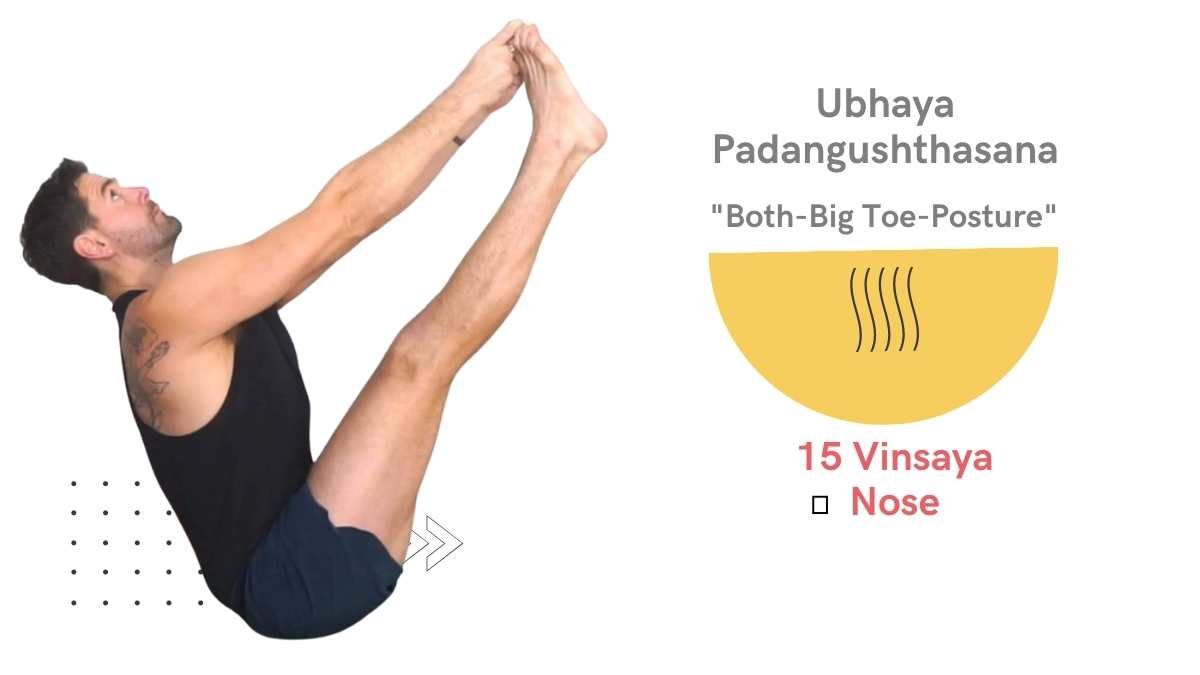
In this lesson, we explore Ubhaya Padangusthasana, a balancing pose that links the upper and lower extremities while engaging the core muscles.
Objective
Understand how to use the grip on the big toes to create a lock that allows you to lift the arms and straighten the knees while maintaining balance.
What You'll Get
What You'll Get: This pose combines the core strength of Navasana with the hamstring stretch of a forward bend. You'll learn to balance on the sitting bones while holding the big toes, using the grip to deepen the stretch without losing stability. The challenge is maintaining the form while breathing steadily. For personal practice, it builds the strength and flexibility needed for more advanced balancing poses. For professionals, it's a way to assess both core strength and hamstring flexibility simultaneously. You'll also learn how to cue students to use their breath and lower their center of gravity if they start to fall back.
Ubhaya Padangusthasana engages many of the same muscles as Navasana. In addition, it links the upper and lower extremities, connecting the shoulder girdle with the pelvic girdle via the torso.
| UBHAYA PADANGUSTHASANA (13 MOVEMENTS) | ||
| 7 | SAPTA | Inhale, jump through |
| Exhale, lie down | ||
| 8 | ASTAU | Inhale, legs up |
| Exhale, take toes | ||
| 9 | NAVA | Inhale, roll up, look up |
| Exhale, down | ||
| 10 | DASA | Inhale, lift up |
| 11 | EKADAŠA | Exhale, jump back, Chaturanga |
| 12 | DUADASA | Inhale, Upward-Facing Dog |
| 13 | TRAYODASA | Exhale, Downward-Facing Dog |
Anatomy
Ubhaya Padangusthasana engages many of the same muscles as Navasana. In addition, it links the upper and lower extremities, connecting the shoulder girdle with the pelvic girdle via the torso. Lifting the arms or bending the elbows accentuates flexing the hips and extending the knees. This creates a greater stretch of the backs of the legs, which is the focal point of this story. The grip on the big toes is an essential component, with the big toes flexing against the fingers and thumbs to create a lock. Ubhaya Padangusthasana is also a balancing pose, meaning that you can apply the principles of physics to stabilize the posture. For example, if you start to fall back, simply bend the knees to reestablish balance by lowering the center of gravity.
BASIC JOINT POSITIONS
- The hips flex.
- The knees extend.
- The ankles plantar flex.
- The feet evert.
- The trunk flexes.
- The shoulders flex, adduct, and externally rotate.
- The elbows extend.
- The forearms supinate.
Continue Reading with Ashtanga Tech
This study guide is available to members. Join to access 800+ in-depth guides on anatomy, philosophy, sequencing, and the science of practice.
Join for $5.50/mo — the cost of a DC coffeeAlready a member? Log in here
Discussion
or explore Student Union