
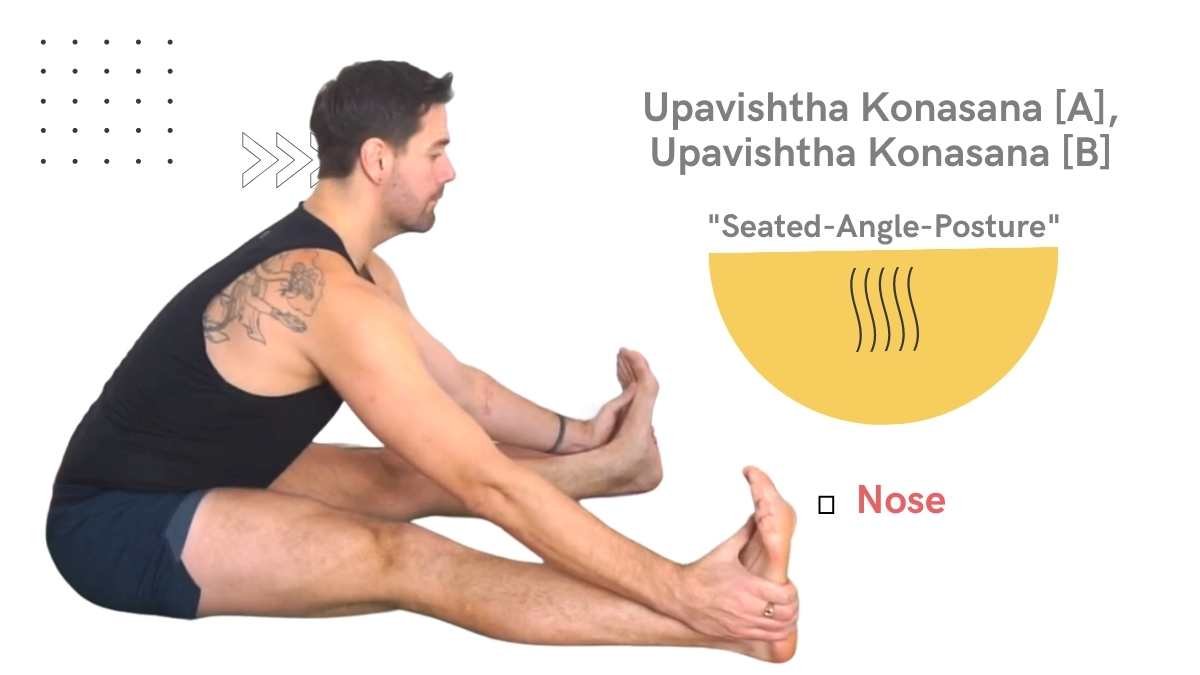
Upavishta Konasana A & B
 Yoga Techniques and Fitness
Compare upavistha konasana with baddha konasana and paschimottanasana. Look at the similarities and differences that make each pose unique in form and function.
| UPAVIṢTHA KOŅĀSANA (14 MOVEMENTS) | ||
| 7 | SAPTA | Inhale, jump through, hold feet |
| 8 | ASTAU | Exhale, fold. 5 Breaths. |
| 9 | NAVA | Inhale, look up. Exhale |
| 10 | DASA | Inhale, lift up, look up. Exhale |
| 11 | EKĀDASA | Inhale, lift up |
| 12 | DUADASA | Exhale, jump back, Chaturanga |
| 13 | TRAYODASA | Inhale, Upward-Facing Dog |
| 14 | CATURDASA | Exhale, Downward-Facing Dog |
Anatomy
Compare upavistha konasana with baddha konasana and paschimottanasana. Look at the similarities and differences that make each pose unique in form and function. For example, Baddha Konasana flexes, abducts, and externally rotates the hips. Although Upavistha Konasana is similar in this respect, the knees extend and the trunk flexes forward as in Paschimottanasana. Note that when the hips are fully flexing, as in Upavistha Konasana, the prime movers of this action are in a state of active insufficiency; that is, the contractile elements of the psoas and its synergists cannot generate significantly increased force to deepen the pose. You can, however, take advantage of the psoas muscle being polyarticular (crossing multiple joints); it runs from the lumbar spine and across the sacroiliac joint and front of the pelvis to insert into the femur. Engage the abdominals to slightly round the back; this lengthens the psoas major out to a point where contracting it will generate force to further flex the hips. Use the hands and arms to fix the hips in this new, more deeply flexed position, and then activate the erector spinae and quadratus lum- borum muscles to arch the lower back. To review, when a muscle is fully contracted, it cannot generate much force to deepen the pose. However, polyarticular muscles such as the psoas can move multiple joints along their length. This means that they can be stretched at one point and then contracted further along at another. Additionally, Upavistha Konasana connects the hands and feet to maintain and increase hip and trunk flexion.
BASIC JOINT POSITIONS
- The hips flex, abduct, and externally rotate.
- The knees extend.
- The ankles are neutral.
- The feet evert.
- The trunk flexes forward.
- The cervical spine extends.
- The shoulders extend, abduct, and externally rotate.
- The elbows flex.
- The wrists flex.
Continue Reading with Ashtanga Tech
This study guide is available to members. Join to access 800+ in-depth guides on anatomy, philosophy, sequencing, and the science of practice.
Join for $5.50/mo — the cost of a DC coffeeAlready a member? Log in here
Discussion
or explore Student Union