
Ardha Matsyendrasana
 Yoga Techniques and Fitness
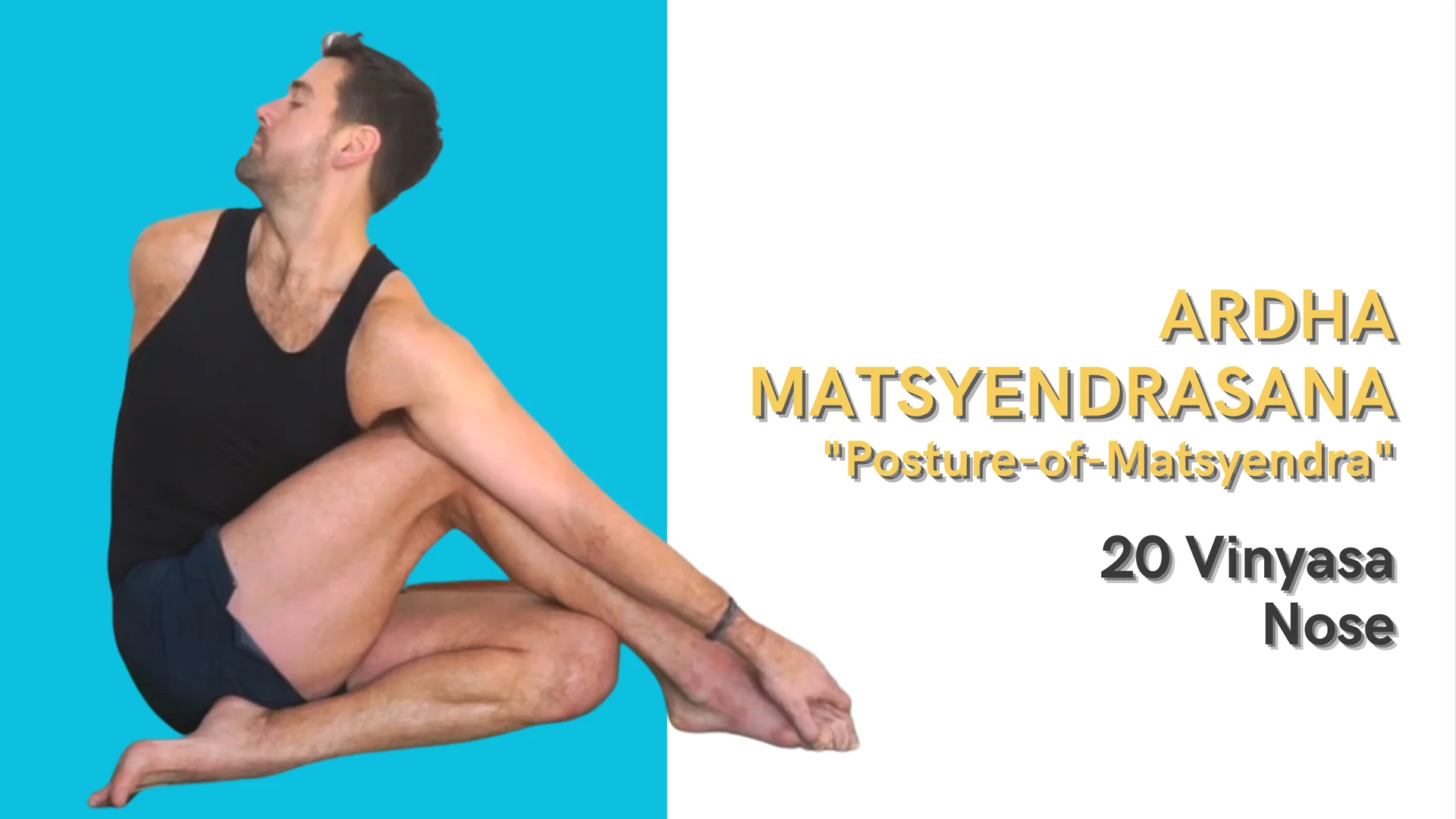
This twisting pose, reminiscent of the salmon twisting as it climbs upstream, uses the energy generated by binding the forward arm to the foot and the other arm (behind the back) to the thigh. We illustrate it here in its intermediate variation, using a belt to reel the back arm into the leg.
Vinyasa Count: Ardha Matsyendrasana
| # | Sanskrit | Instruction |
|---|---|---|
| 7 | Sapta | Inhale, jump through, straight legs, sit |
| 8 | Astau | Take position right side, five breaths |
| 9 | Nava | Inhale, lift up |
| 10 | Dasa | Exhale, jump back, Chaturanga Dandasana |
| 11 | Ekadasa | Inhale, Urdhva Mukha Svanasana |
| 12 | Duadasa | Exhale, Adho Mukha Svanasana |
| 13 | Trayodasa | Inhale, jump through, straight legs, sit |
| 14 | Caturdasa | Take position left side, five breaths |
| 15 | Pancadasa | Inhale, lift up |
| 16 | Sodasa | Exhale, jump back, Chaturanga Dandasana |
| 17 | Saptadasa | Inhale, Urdhva Mukha Svanasana |
| 18 | Astaudasa | Exhale, Adho Mukha Svanasana |
Anatomy
This twisting pose, reminiscent of the salmon twisting as it climbs upstream, uses the energy generated by binding the forward arm to the foot and the other arm (behind the back) to the thigh. We illustrate it here in its intermediate variation, using a belt to reel the back arm into the leg.
BASIC JOINT POSITIONS
- The hip of the leg that remains on the floor flexes, abducts and externally rotates.
- The hip of the other leg flexes, adducts, and internally rotates.
- The knees flex.
- The trunk flexes and rotates.
- The shoulder of the arm behind the back extends and internally rotates.
- The elbow of the same arm flexes and the forearm supinates.
- The shoulder of the arm that holds the foot abducts and externally rotates.
- The elbow of the same arm flexes.
- The forearm pronates.
- The ankle of the foot that is held plantar flexes.
Continue Reading with Ashtanga Tech
This study guide is available to members. Join to access 800+ in-depth guides on anatomy, philosophy, sequencing, and the science of practice.
Join for $5.50/mo — the cost of a DC coffeeAlready a member? Log in here
Discussion
or explore Student Union