
Bhujapidasana
 Yoga Techniques and Fitness
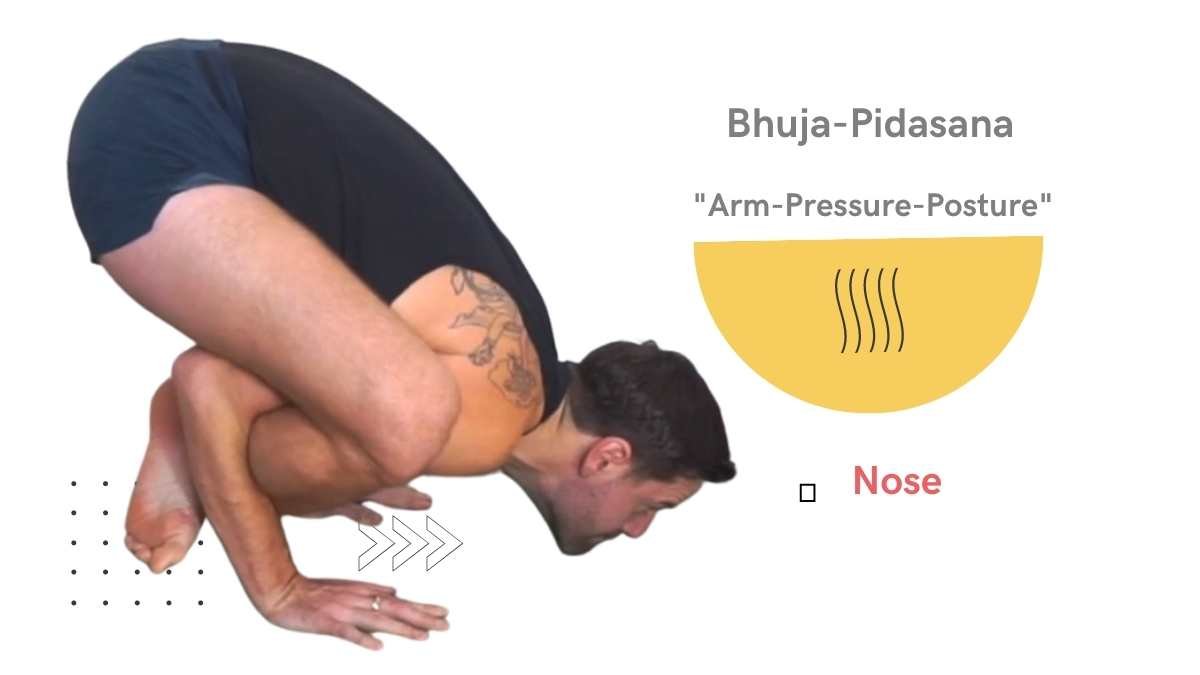
Bhujapidasana has many similar joint actions to those found in Tittibhasana, except here the ankles are crossed and the knees are flexed.
| BHUJAPIDASANA (13 MOVEMENTS) | ||
| 7 | SAPTA | Inhale, jump around hands, cross feet |
| 8 | ASTAU | Exhale, fold chin down |
| 9 | NAVA | Inhale, lift up |
| Exhale, Bakasana | ||
| 10 | DASA | Inhale, lift up |
| 11 | EKĀDASA | Exhale, jump back, Chaturanga |
| 12 | DUADASA | Inhale, Upward-Facing Dog |
| 13 | TRAYODASA | Exhale, Downward-Facing Dog |
Anatomy
Bhujapidasana has many similar joint actions to those found in Tittibhasana, except here the ankles are crossed and the knees are flexed. As with Tittibhasana, Kurmasana can be used to prepare the hips and back for the pose. Ideally, the legs are as high up as possible on the arms, with the weight of the body balanced over the hands. A great deal of flexibility must be attained in the lower back and gluteals to perform this posture. There should also be a sufficient external rotation of the hips (meaning the length of the internal rotators). Press up into the pose by straightening the elbows while squeezing the legs around the arms. The thighs form a bandha, or a “lock,” where they join with the arms. The contact point where the ankles cross forms another bandha. Attempting to pull the feet apart augments this lock, strengthening the abductors of the hips.
Alternatively, you can bend the knees and use the thighs and calves to squeeze the arms (while at the same time attempting to straighten the elbows).
BASIC JOINT POSITIONS
- The hips flex and adduct.
- The knees flex.
- The ankles dorsiflex.
- The feet evert.
- The toes extend.
- The trunk flexes.
- The shoulders flex, adduct, and externally rotate.
- The wrists extend.
- The cervical spine extends.
Continue Reading with Ashtanga Tech
This study guide is available to members. Join to access 800+ in-depth guides on anatomy, philosophy, sequencing, and the science of practice.
Join for $5.50/mo — the cost of a DC coffeeAlready a member? Log in here
Discussion
or explore Student Union