
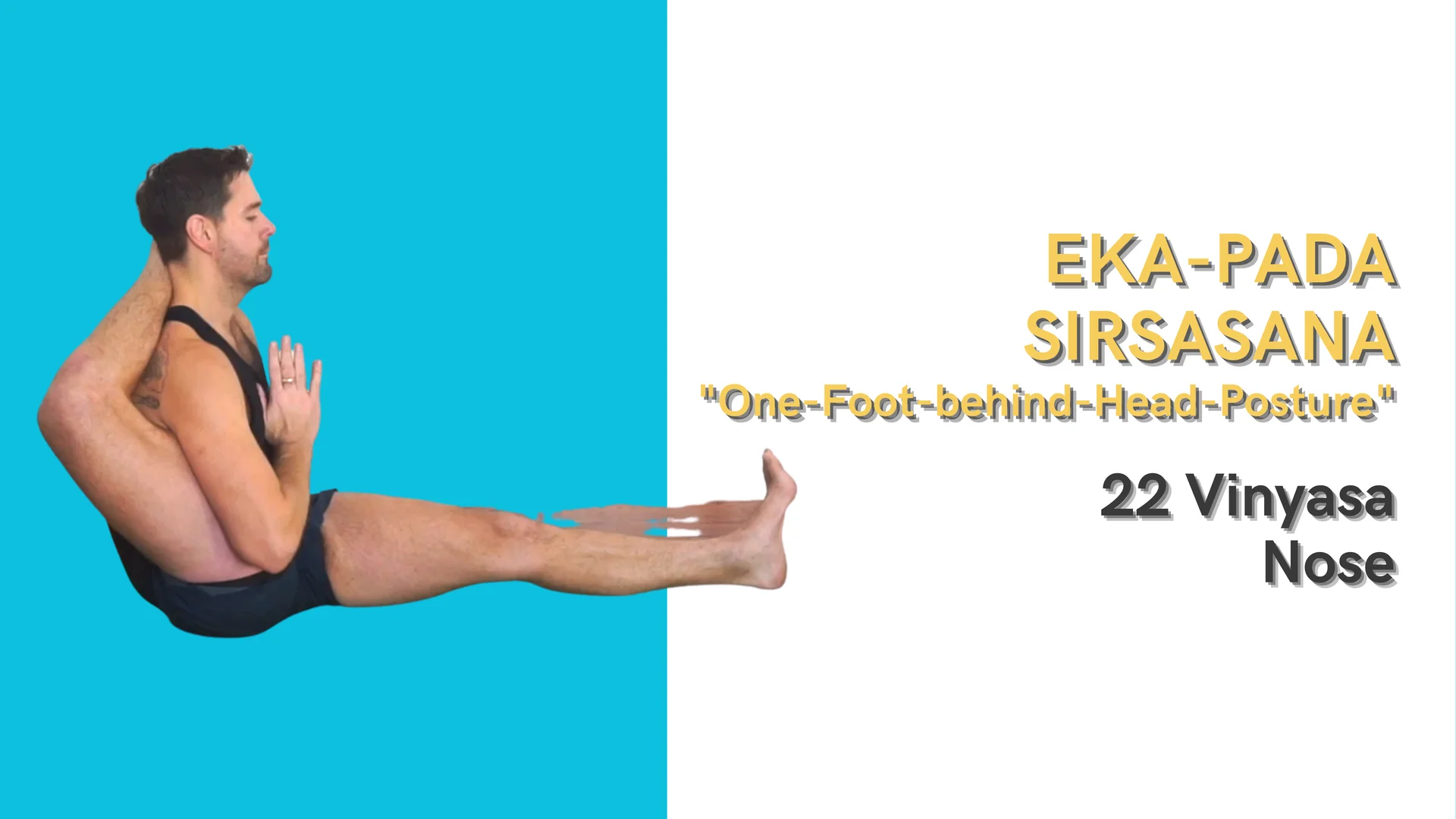
Eka Pada Sirsasana
 Yoga Techniques and Fitness
Overview
In this lesson, we present Eka Pada Sirsasana (One Leg Behind the Head Pose), an advanced inversion combining hip flexibility, core stability, and spinal alignment.
Objective
Gain understanding of how to stabilize the pelvis through co-contraction of the psoas and gluteals while maintaining proper alignment of the head, neck, and spine.
What You'll Get
You'll walk away knowing how to engage your core to prevent collapse on one side of the body, how to keep your weight rebounding up through the spine rather than dumping forward, and how to avoid neck strain by activating the shoulder girdle. For practitioners, this means safer progress in advanced leg-behind-head work. For teachers, therapists, and trainers, you'll gain clarity on cueing bandha, spinal alignment, and pelvic stability to guide students through this challenging pose without injury.
Vinyasa Count: Eka Pada Sirsasana
| # | Sanskrit | Instruction |
|---|---|---|
| 7 | Sapta | Inhale, jump around right side |
| 8 | Astau | Exhale, fold forward, hold wrist, five breaths |
| 9 | Nava | Inhale, come up, prayer hands |
| Exhale | ||
| 10 | Dasa | Inhale, lift up, chin to shin |
| 11 | Ekadasa | Exhale, jump back, Chaturanga Dandasana |
| 12 | Duadasa | Inhale, Urdhva Mukha Svanasana |
| 13 | Trayodasa | Exhale, Adho Mukha Svanasana |
| 14 | Caturdasa | Inhale, jump around left side |
| 15 | Pancadasa | Exhale, fold forward, five breaths |
| 16 | Sodasa | Inhale, come up, prayer hands |
| Exhale | ||
| 17 | Saptadasa | Inhale, lift up, chin to shin |
| 18 | Astaudasa | Exhale, jump back, Chaturanga Dandasana |
| 19 | Ekunavimsatih | Inhale, Urdhva Mukha Svanasana |
| 20 | Vimsatih | Exhale, Adho Mukha Svanasana |
Anatomy
Eka pada Sirsasana combines an inversion with a stretch of the gastrocnemius, hamstrings, and gluteals of the leg that is brought forward and down. This means there are three separate stories taking place in the pose: an inversion, a leg that is lowered to the ground, and a leg that remains in the air. The trunk is also important. There is a tendency to collapse the side of the body and the hip when lowering the leg. You can counter this by engaging the muscles on the other side of the trunk to expand the side that is shortening. Combine the actions of the two legs by co-contracting the core muscles of the pelvis, including the psoas of the flexing hip and the gluteals of the leg that remains in the air. This creates a bandha across the pelvis, tightening the sacroiliac ligaments and stabilizing the pose. Approach this head balance so that the weight of the body rebounds up through the vertebral column while preserving the natural spinal curves. Align the mechanical axis (the direction of gravity) with the anatomical axis of the spinal column. Avoid leaning forward by firmly engaging the gluteal and lower back muscles. Do not use the neck to attempt to draw the body forward, as this can cause injury. Instead, engage the muscles around the shoulder girdle, and press the sides of the forearms into the mat to support the body weight while keeping the neck free. Use the shoulders and arms to brace the body as you ease out of the pose.
BASIC JOINT POSITIONS
- The shoulders flex and externally rotate.
- The elbows flex.
- The forearms are neutral.
- The wrists flex.
- The trunk extends.
- The lifted-leg hip extends, adducts, and internally rotates.
- The lowered-leg hip flexes.
- The knees extend.
- The raised-leg ankle is neutral or the plantar flexes slightly.
- The lowered-leg ankle dorsiflexes.
- The feet evert.
- The toes extend.
Continue Reading with Ashtanga Tech
This study guide is available to members. Join to access 800+ in-depth guides on anatomy, philosophy, sequencing, and the science of practice.
Join for $5.50/mo — the cost of a DC coffeeAlready a member? Log in here
Discussion
or explore Student Union