
Janu Sirsasana A
 Yoga Techniques and Fitness
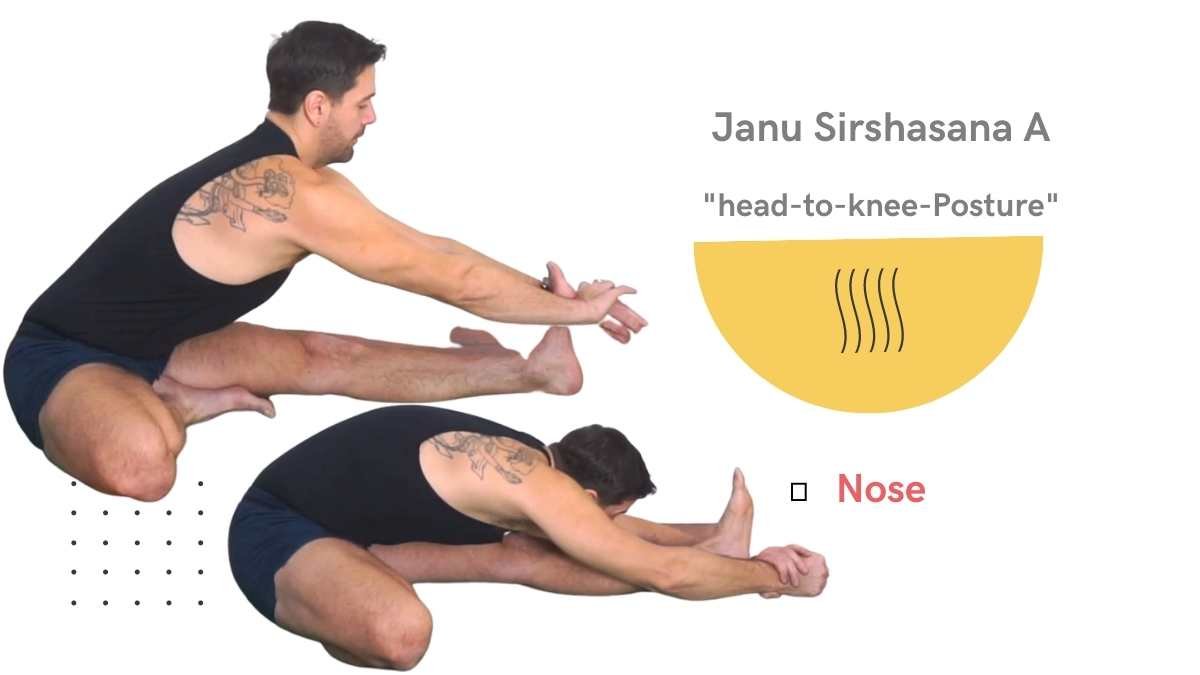
Janu Sirsasana is an asymmetric forward bend. It is similar to the hurlers’ stretch that athletes perform during warmup. This pose creates an intense stretch of the hamstrings in the straight leg. As with other poses that connect the upper and lower extremities, Janu Sirsasana also affects the lower back and shoulders. Focusing one’s attention on the bent leg can be used to refine this pose.
| JĀNU SIRṢĀSANA A (20 MOVEMENTS) | ||
| 7 | SAPTA | Inhale, jump through, right foot in |
| 8 | ASTAU | Exhale, fold |
| 9 | NAVA | Inhale, look up |
| Exhale | ||
| 10 | DASA | Inhale, lift up |
| 11 | EKĀDASA | Exhale, jump back, Chaturanga |
| 12 | DUADASA | Inhale, Upward-Facing Dog |
| 13 | TRAYODASA | Exhale, Downward-Facing Dog |
| 14 | CATURDASA | Inhale, jump through, left foot in |
| 15 | PANCADASA | Exhale, fold |
| 16 | SODASA | Inhale, look up |
| Exhale | ||
| 17 | SAPTADASA | Inhale, lift up |
| 18 | ASTAUDASA | Exhale, jump back, Chaturanga |
| 19 | EKUNAVIMŠATIḤ | Inhale, Upward-Facing Dog |
| 20 | VIMSATIH | Exhale, Downward-Facing Dog |
Anatomy
The main story in Janu Sirsasana is an asymmetrical stretch of the posterior kinetic chain, including the muscles at the back of the straight leg and the back itself. Two subplots contribute to the main stretch. One is the action of the bent leg and the other is the action of the arms. In the bent leg, the femur flexes abducts, and externally rotates, drawing that side of the pelvis away from the straight leg. Although the main focus is on the extended leg, periodically bring your attention to the flexed knee. Look at the muscles that produce the positions of the hip and knee on this side. Engage these muscles to make the pose more active. Grasp the foot with the hands to link the shoulder and pelvic girdles, transmitting a stretch from the back into the leg. Connect the action of the bent leg with the same-side arm. For example, as the bent knee draws back, flex the same-side elbow more. This creates two counterbalancing forces with simultaneous movements in different directions. We saw this concept in the warrior postures, with the back foot constrained as the front of the body lunges forward. Observe the effect of flexing the trunk while moving the bent knee back. Note that when the trunk flexes, the muscles and ligaments of the back pull on the pelvis, tilting it forward. Similarly, as the femur flexes, the pelvis tilts forward. In this way, both the trunk and hip work together to affect the hamstring muscles of the straight leg. Conversely, the hamstring muscles, which pull on the ischial tuberosities, affect the orientation of the pelvis. As these muscles gain length, the lumbar spine flexes less and the pelvis tilts forward more. Note how the bent-leg side of the trunk is longer than the straight-leg side. To balance this, flex the elbow on the bent-leg side to lengthen the trunk on the
BASIC JOINT POSITIONS
- The straight-leg hip flexes.
- The knee extends.
- The ankle plantar flexes.
- The foot everts.
- The bent-leg hip flexes, abducts, and externally rotates.
- The trunk flexes.
- The shoulders flex, abduct, and externally rotate.
- The elbows flex.
- The forearms are pronated.
- The wrists extend.
Continue Reading with Ashtanga Tech
This study guide is available to members. Join to access 800+ in-depth guides on anatomy, philosophy, sequencing, and the science of practice.
Join for $5.50/mo — the cost of a DC coffeeAlready a member? Log in here
Discussion
or explore Student Union