
Krounchasana
 Yoga Techniques and Fitness
Overview
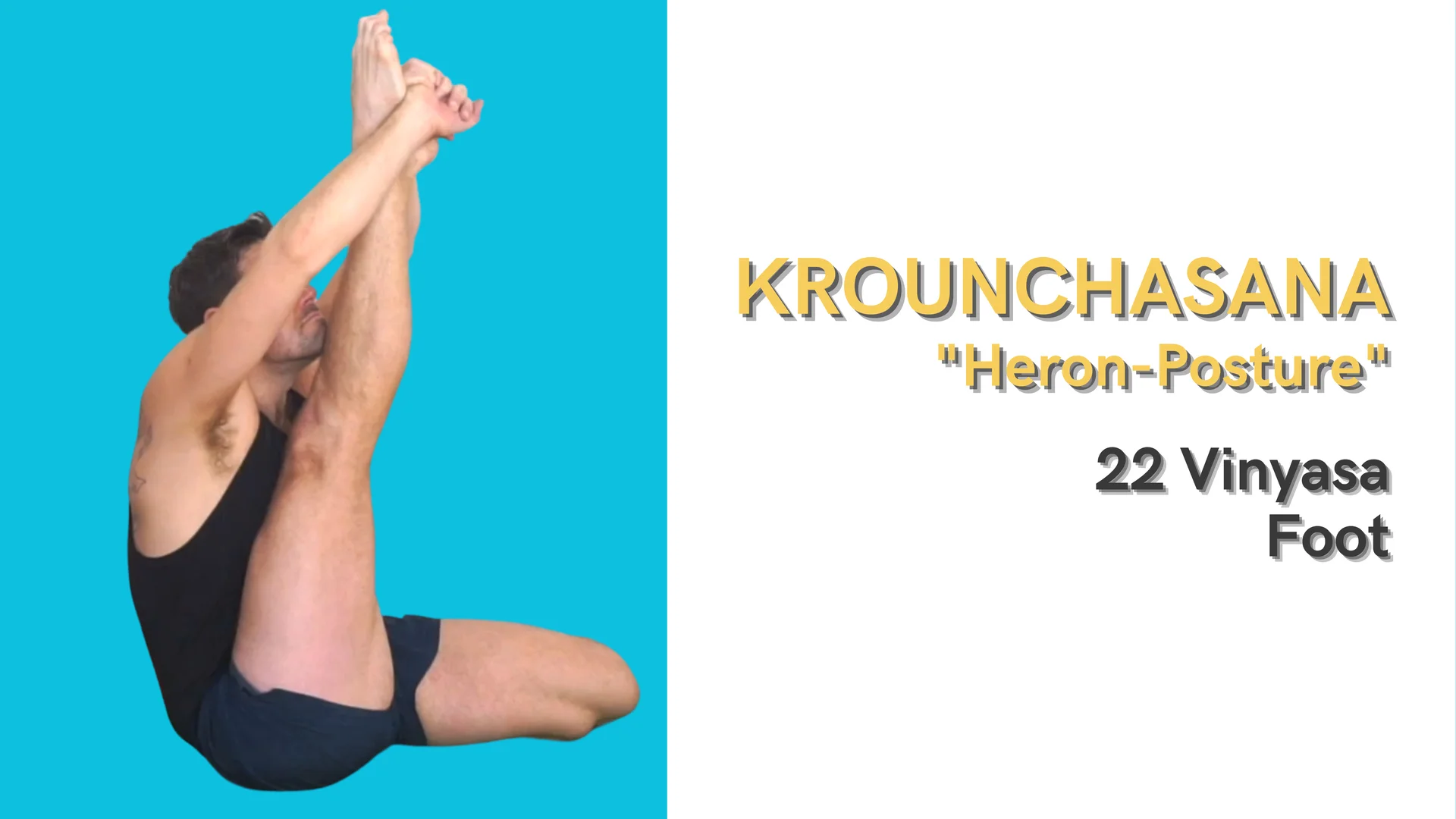
In this lesson, we present Krounchasana, which builds on triang mukhaikapada paschimottanasana by lifting the straight leg into the air and folding forward over it.
Objective
Become familiar with the biomechanics of lifting and folding over an extended leg, and how to use muscular engagement to tilt your pelvis forward and deepen the stretch.
What You'll Get
What You'll Get: You'll learn how to lift your leg while maintaining forward tilt in your pelvis, a key action that deepens the hamstring stretch without rounding your back. This pose challenges your ability to integrate hip flexion, knee extension, and spinal length all at once. You'll walk away with practical techniques for working the edge of your hamstring flexibility while protecting your lower back. For professionals, this lesson offers insight into how pelvic positioning affects hamstring lengthening, and how to cue clients toward better alignment and safer stretching in forward-folding poses.
Krounchasana takes the story of triang mukhaikapada paschimottanasana to an- other level. The most obvious new element is the lift of the straight leg into the air. This action provides several opportunities to apply our various techniques.
Vinyasa Count: Krounchasana
| # | Sanskrit | Instruction |
|---|---|---|
| 7 | Sapta | Inhale, jump through, bind hands around left foot, straight arms |
| 8 | Astau | Exhale, chin to shin |
| 9 | Nava | Inhale, straight arms |
| Exhale | ||
| 10 | Dasa | Inhale, lift up |
| 11 | Ekadasa | Exhale, jump back, Chaturanga Dandasana |
| 12 | Duadasa | Inhale, Urdhva Mukha Svanasana |
| 13 | Trayodasa | Exhale, Adho Mukha Svanasana |
| 14 | Caturdasa | Inhale, jump through, bind hands around right foot, straight arms |
| 15 | Pancadasa | Exhale, chin to shin |
| 16 | Sodasa | Inhale, straight arms |
| Exhale | ||
| 17 | Saptadasa | Inhale, lift up |
| 18 | Astaudasa | Exhale, jump back, Chaturanga Dandasana |
| 19 | Ekunavimsatih | Inhale, Urdhva Mukha Svanasana |
| 20 | Vimsatih | Exhale, Adho Mukha Svanasana |
Anatomy
Krounchasana takes the story of triang mukhaikapada paschimottanasana to an- other level. The most obvious new element is the lift of the straight leg into the air. This action provides several opportunities to apply our various techniques. As the hip of the straight leg flexes and the knee extends, the muscles at the back of the leg (those that flex the knee and extend the hip) stretch and draw the pelvis down and back into retroversion, rounding the back. Conversely, factors that tilt the pelvis forward—even just a little bit draw the sitting bones back. This tweaks the pose because the ischial tuberosities are the origins of the same muscles that are lengthening, and moving these bones augments the stretch. To experience this, hold the foot of the straight leg with one hand and press down with the other hand onto the bent knee. Then attempt to lift that knee against the hand (while resisting). This activates the hip flexors on this side of the pelvis and tilts it forward. Tilting the pelvis forward rotates the ischial tuberosities back slightly, pulling on the hamstring muscles at their origins and creating a unique type of stretch. You may need to try this more than once to get it. There are several subplots to the pose as well. The arms draw the foot toward the body, and the abdominals flex the trunk forward. The breath in the background is the soundtrack.
BASIC JOINT POSITIONS
- The straight-leg hip flexes.
- The knee extends.
- The ankle plantar flexes.
- The foot everts.
- The bent-leg hip flexes.
- The ankle plantar flexes.
- The trunk flexes.
- The shoulders flex, abduct, and externally rotate.
- The elbows flex.
- The forearms supinate.
- The wrists flex.
Continue Reading with Ashtanga Tech
This study guide is available to members. Join to access 800+ in-depth guides on anatomy, philosophy, sequencing, and the science of practice.
Join for $5.50/mo — the cost of a DC coffeeAlready a member? Log in here
Discussion
or explore Student Union