
Marichiyasana A
 Yoga Techniques and Fitness
Overview
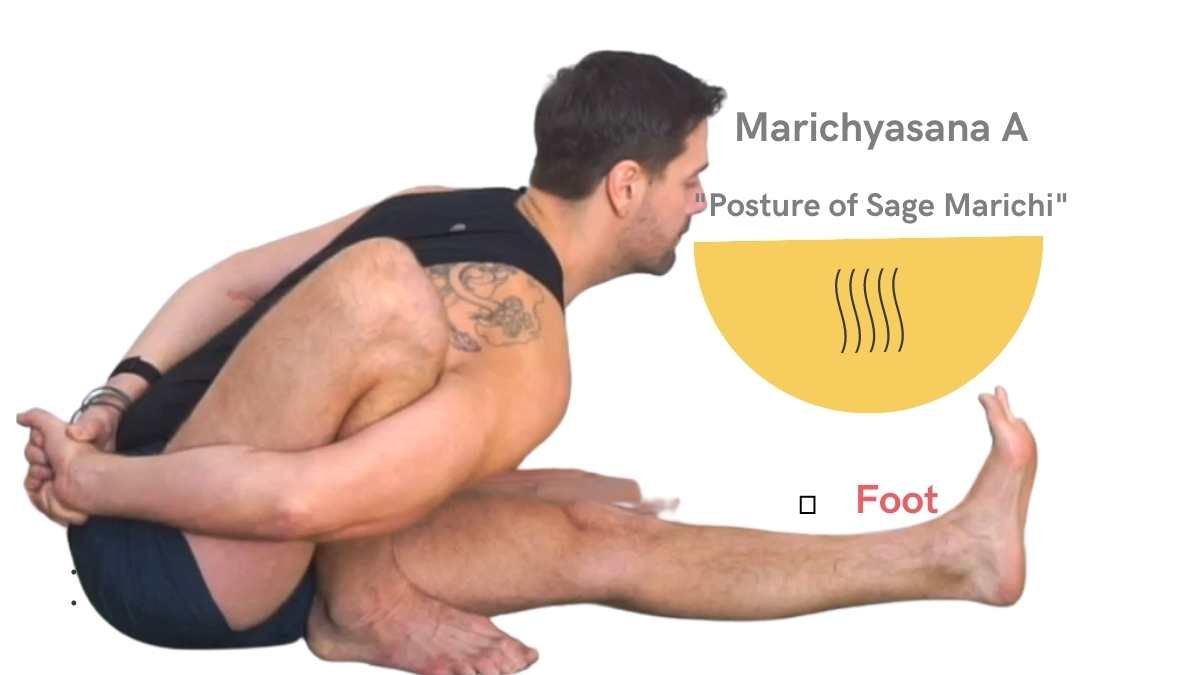
In this lesson, we introduce Marichyasana A, a seated twist that rotates the upper body away from the lower body while binding the arms.
Objective
Understand how to combine multiple smaller twists throughout the body to deepen the main rotation of the torso.
What You'll Get
What You'll Get: This pose teaches you to twist from multiple points at once—the legs, pelvis, spine, and shoulders all contribute. You'll learn to refine rotation by working with the bent and straight legs as counterbalances, creating a spiral that moves energy upward through the spine. For personal practice, it opens the lower back and shoulders while teaching you to breathe through compression. For professionals, it's a window into rotational capacity and spinal mobility, useful for assessing functional movement patterns and diagnosing restrictions in the trunk.
In marichyasana i we rotate the upper body away from the lower body. This is the main story of the pose.
| MARICHASANA A (20 MOVEMENTS) | ||
| 7 | SAPTA | Inhale, jump through, right knee up |
| 8 | ASTAU | Exhale, fold |
| 9 | NAVA | Inhale, look up |
| Exhale | ||
| 10 | DASA | Inhale, lift up |
| 11 | EKĀDASA | Exhale, jump back, Chaturanga |
| 12 | DUADASA | Inhale, Upward-Fasing Dog |
| 13 | TRAYODASA | Exhale, Downward-Facing Dog |
| 14 | CATURDASA | Inhale, jump through, left knee up |
| 15 | PANCADASA | Exhale, fold |
| 16 | SODASA | Inhale, look up |
| Exhale | ||
| 17 | SAPTADASA | Inhale, lift up |
| 18 | ASTAUDASA | Exhale, jump back, Chaturanga |
| 19 | EKUNAVIMŠATIḤ | Inhale, Upward-Facing Dog |
| 20 | VIMSATIH | Exhale, Downward-Facing Dog |
Anatomy
In marichyasana i we rotate the upper body away from the lower body. This is the main story of the pose. There are, however, a variety of smaller twists or subplots that contribute to the main story. For example, if we think of the lower body turning away from the upper body, then we can augment the twist of the lower body by turning the bent leg in a direction that synergizes the pose. To do this, we externally rotate the bent leg as a unit and internally rotate the straight leg. In this way, both lower extremities combine to turn the lower half of the body away from the upper. Similarly, we can rotate the shoulder on the bent-leg side down and toward the opposite leg while bringing the other shoulder up and back to turn the torso. This combination of actions twists the shoulders and pelvis in opposite directions, moving the energy of nerve conduction upward through the susumna nadi in the torso. The key to this pose is seeking out all parts in the body that have the capacity to rotate and then combining them to deepen the twist.
BASIC JOINT POSITIONS
- The hips flex.
- The straight-leg knee extends.
- The held-leg knee flexes.
- The trunk flexes and rotates.
- The shoulders internally rotate and extend.
- The elbows extend and the forearms pronate.
- The held wrist extends
Continue Reading with Ashtanga Tech
This study guide is available to members. Join to access 800+ in-depth guides on anatomy, philosophy, sequencing, and the science of practice.
Join for $5.50/mo — the cost of a DC coffeeAlready a member? Log in here
Discussion
or explore Student Union