
Navasana
 Yoga Techniques and Fitness
Overview
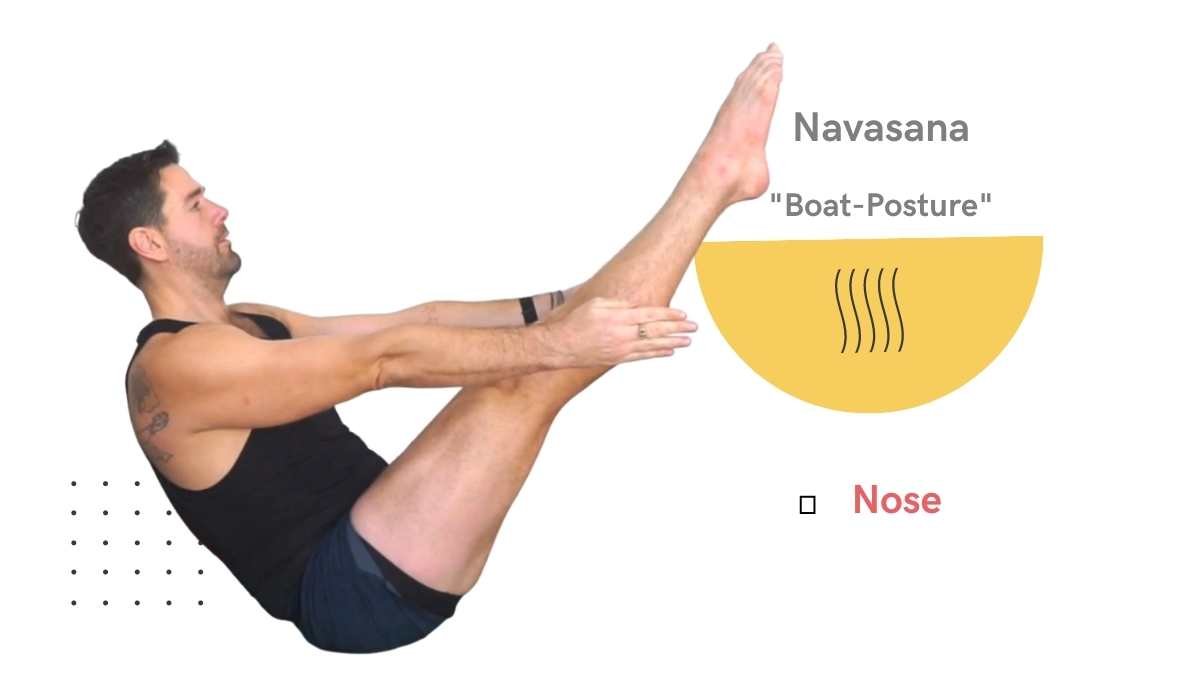
In this lesson, we explore Navasana, a pose that flexes the trunk in an open-chain fashion, strengthening the core, hip flexors, and quadriceps.
Objective
Gain understanding of how to isolate and strengthen the abdominal muscles while maintaining stability through co-activation of the legs and shoulders.
What You'll Get
What You'll Get: This pose is pure strength work. You'll learn to engage the core muscles continuously while stabilizing the legs and shoulders. The challenge is maintaining the form without collapsing—squeezing the knees together recruits the adductors, which in turn helps you engage the abdominals more forcefully. For personal practice, it builds the foundational strength needed for arm balances and transitions. For teachers and therapists, it's a simple way to assess core strength and endurance. You'll also learn how to cue the pose in layers, starting with bent knees and progressing to straight legs as strength develops.
Navasana resembles a boat floating in the water. The arms form the gunwales, and the legs and torso form the hull. This pose flexes the trunk in an “open chain” fashion, strengthening the psoas and quadriceps muscles at the front of the hip, thighs, and abdomen.
| NAVASANA (11 MOVEMENTS) | ||
| 7 | SAPTA | Inhale, jump through, legs up, reach forward |
| 8 | ASTAU | Inhale, lift up |
| repeat SAPTA ASTAU 5 times | ||
| 9 | NAVA | Exhale, jump back, Chaturanga |
| 10 | DASA | Inhale, Upward-Facing Dog |
| 11 | EKĀDASA | Exhale, Downward-Facing Dog |
Anatomy
I place navasana in the forward-folding section because it flexes the trunk. This is a forward bend that requires constant muscular effort to maintain. For this reason, the main story in the pose is an isolated strengthening of the core abdominal muscles and not so much a focused stretch, as with the other forward bends. Moving outward from the abdominals, several steps can be taken to stabilize the pose. For example, squeezing the knees together isolates and engages the adductor muscles of the thighs. Contracting the quadriceps straightens the knees and engaging the pelvic muscles flexes the hips. Similar subplots exist in the arms and shoulders. This type of co-activation produces the phenomenon of recruitment. For example, note that if you squeeze the knees together, you can more forcefully engage the abdominals.
BASIC JOINT POSITIONS
- The hips flex.
- The knees extend.
- The ankles plantar flex.
- The feet evert.
- The trunk flexes.
- The shoulders flex, adduct, and externally rotate.
- The forearms are neutral.
Continue Reading with Ashtanga Tech
This study guide is available to members. Join to access 800+ in-depth guides on anatomy, philosophy, sequencing, and the science of practice.
Join for $5.50/mo — the cost of a DC coffeeAlready a member? Log in here
Discussion
or explore Student Union