
Parighasana
 Yoga Techniques and Fitness
Overview
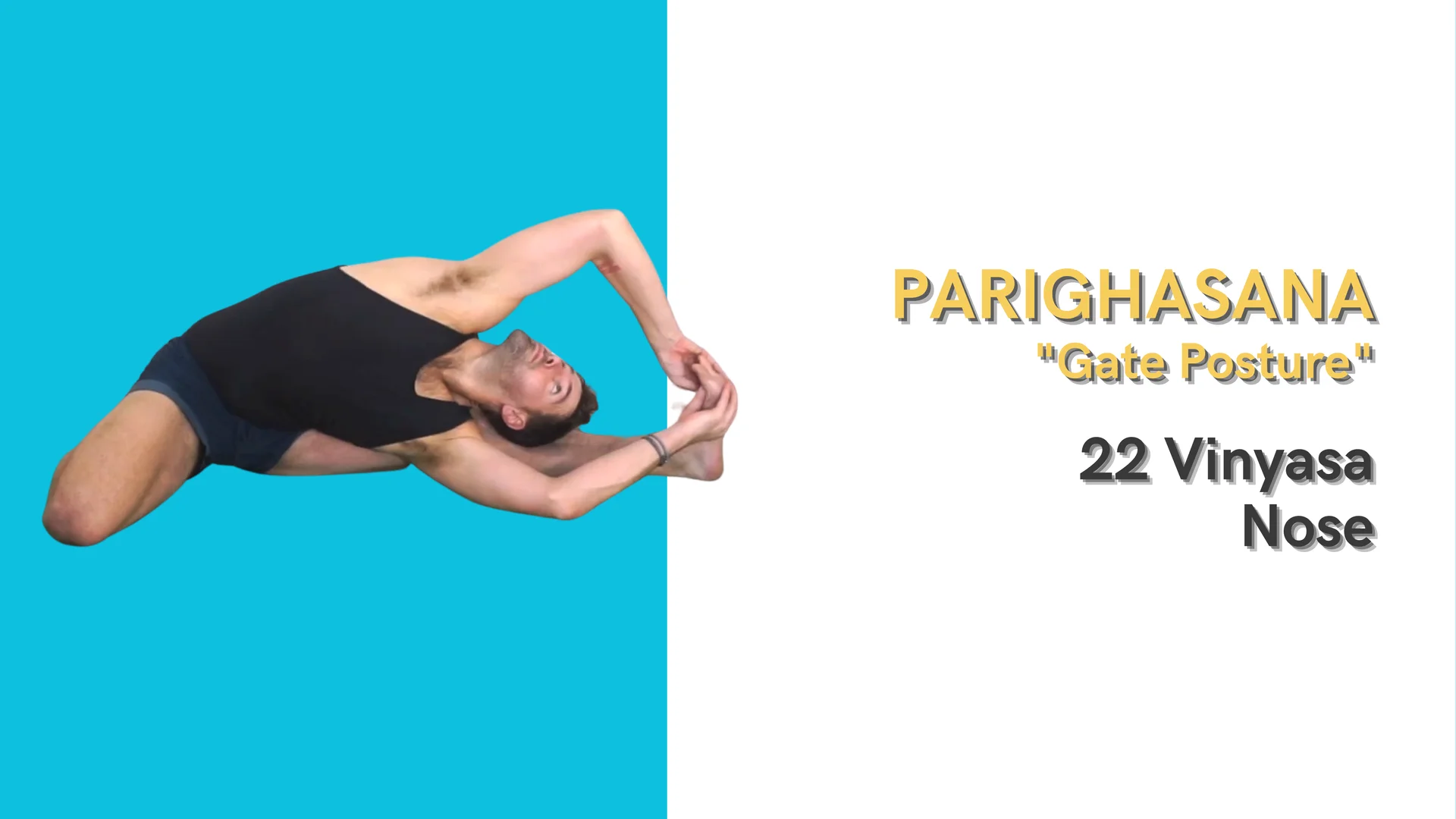
In this lesson, we explore Parighasana (Gate Pose), a side-bending posture that combines trunk flexion, hip opening, and spinal rotation while connecting the upper and lower body.
Objective
Understand how to engage the psoas and gluteals to stabilize the pelvis, activate the quadriceps to ground the legs, and coordinate side bending with hip extension.
What You'll Get
You'll learn how to press both feet into the mat to create a stable foundation, how to engage the core muscles to produce a bandha effect across the pelvis, and how to refine balance while stretching the side body. Practitioners walk away with a safer, more grounded side bend. Teachers, therapists, and trainers gain anatomical clarity for cueing foot engagement, pelvic stability, and trunk flexion to help clients access Gate Pose without collapse or strain.
Parighasana combines twisting the torso and forward bending. This pose connects the upper and lower extremities and uses this connection to carry the twist into the spine and torso.
Anatomy
Look closely and you can see that there are several overlapping stories in Parighasana. First, it is a side bend that flexes the trunk over the leg. Second, it is a hip opener that stretches the muscles at the front of the bent leg pelvis. Balancing along a line between the straight and bent legs also teaches poise. Refine equilibrium by pressing the top of the bent-leg foot and the sole of the straight-leg foot into the mat. Remember that stability originates from the pelvic core, with the gluteals engaging on one side and the psoas contracting on the other. This produces a bandha across the pelvis, tightening the sacroiliac ligaments to create a “wringing” effect (known as ligamentotaxis) that grounds the pose. Engage the straight-leg quadriceps to extend the knee and the calf muscles to press the sole of the foot into the mat. Similarly, activate the bent leg side quadri- ceps and tibialis anterior to press the top of the foot into the floor. Actively pressing the feet into the floor creates a strong foundation, which connects the bones of the legs to the pelvis, stabilizing it.
BASIC JOINT POSITIONS
- The straight-leg hip flexes and externally rotates.
- The knee extends.
- The ankle plantar flexes.
- The bent-leg hip extends and externally rotates.
- The bent-leg knee flexes.
- The ankles plantar flex.
- The trunk laterally flexes.
- The shoulders flex, abduct, and externally rotate.
- The elbows extend.
- The forearms are pronated.
Continue Reading with Ashtanga Tech
This study guide is available to members. Join to access 800+ in-depth guides on anatomy, philosophy, sequencing, and the science of practice.
Join for $5.50/mo — the cost of a DC coffeeAlready a member? Log in here
Discussion
or explore Student Union