Pasasana
 Yoga Techniques and Fitness
Overview
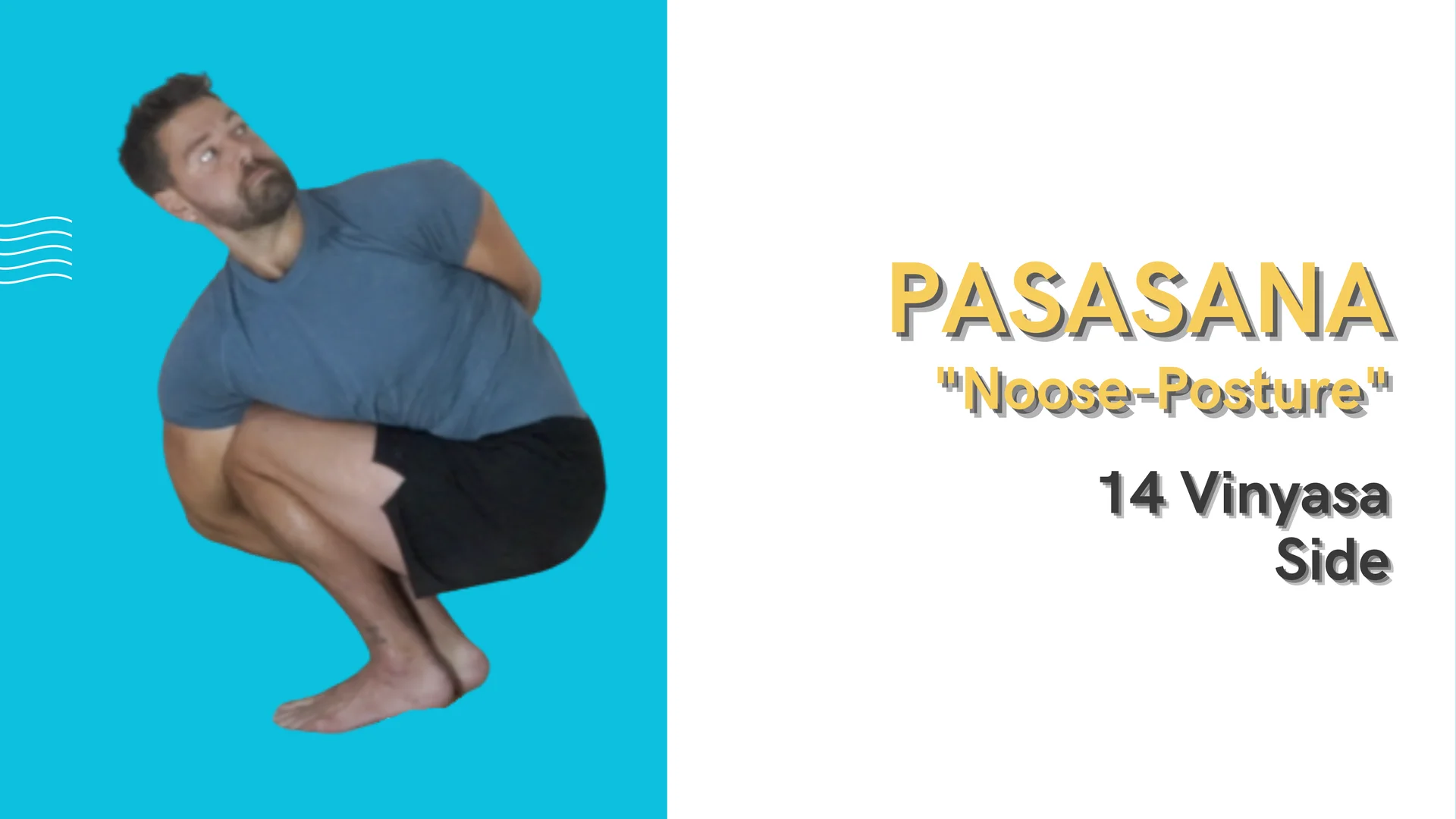
In this lesson, we explore Pasasana, a deep squat with a spinal twist, examining its component parts and how they integrate into the full expression of the pose.
Objective
Understand the anatomical relationships and specific actions that create stability and depth in this challenging twisted squat.
What You'll Get
What You'll Get: You'll break down Pasasana into its subplots—calf flexibility, hip alignment, spinal rotation, and shoulder positioning—then learn how to weave them back together. This approach reveals how different parts of your body collaborate to create the pose, rather than just forcing yourself into shape. You'll walk away with practical cues for deepening your squat, balancing your hips, and finding more ease in the twist. For teachers and therapists, this lesson offers a detailed anatomical roadmap for guiding students through one of the more demanding seated twists in the Ashtanga intermediate series.
Every pose tells a story, and every story is comprised of subplots. break Pasasana down into its component parts—the subplots of the main story. Then reconstruct these parts into the whole.
Vinyasa Count: Pasasana
| # | Sanskrit | Instruction |
|---|---|---|
| 7 | Sapta | Inhale, jump forward |
| Exhale, twist left | ||
| 8 | Astau | Twist right |
| 9 | Nava | Inhale, lift up |
| 10 | Dasa | Exhale, jump back, Chaturanga Dandasana |
| 11 | Ekadasa | Inhale, Urdhva Mukha Svanasana |
| 12 | Duadasa | Exhale, Adho Mukha Svanasana |
Anatomy
Every pose tells a story, and every story is comprised of subplots. break Pasasana down into its parts the subplots of the main story. Then reconstruct these parts into the whole. See how each subplot contributes to the final pose. Yoga reveals the interrelationships between all parts of the body. This is one characteristic that distinguishes yoga from practices such as Western physical therapy, which tend to focus on specific regions (such as a painful shoulder or knee). Yoga looks at the whole. Nevertheless, we can learn from focusing on individual parts of a pose and then integrate this knowledge into the final posture. In Pasasana, for example, several specific actions take place. First, look at the lower legs. The calf muscles stretch from dorsiflexing the feet and ankles. This stretch differs somewhat from that in Dog Pose. In the latter, the calves lengthen more in the region of the knees. Here the stretch is concentrated in the distal part of the muscle, where it blends into the Achilles tendon, which attaches to the heel. Actively dorsiflexing the ankle joint engages the tibialis anterior muscle at the front of the lower leg. At the same time, this signals the gastrocnemius and soleus muscles antagonists of the tibialis anterior to relax via reciprocal inhibition. Next, look at the pelvis and hips. The hip that you twist toward flexes relatively more than the other hip. This leads to the knees being uneven. Balance this by extending the forward-leg hip (with the gluteus maximus) and flexing the back-leg hip(with the psoas). Note how this brings the knees even with each other. Lock this position by squeezing the knees together (with the adductor group). This creates a bandha in the pelvis, stabilizing the pose. Finally, look at the shoulder girdle. Use the muscles of the shoulders and arms to gently leverage and rotate the upper body in the opposite direction of the lower, stretching the muscles of the trunk and back.
BASIC JOINT POSITIONS
- The hips flex and adduct.
- The knees flex.
- The ankles dorsiflex.
- The trunk flexes and rotates.
- The shoulders internally rotate and extend.
- The elbows extend and the forearms pronate.
- The held wrist extends.
Continue Reading with Ashtanga Tech
This study guide is available to members. Join to access 800+ in-depth guides on anatomy, philosophy, sequencing, and the science of practice.
Join for $5.50/mo — the cost of a DC coffeeAlready a member? Log in here
Discussion
or explore Student Union