Uttitha Parsvakonasana A & B
 Yoga Techniques and Fitness

Overview
In this lesson, we explore Utthita Parsvakonasana A and B, examining how extended side angle pose progresses naturally from Warrior II.
Objective
Become familiar with how lateral flexion combined with leg strengthening creates a full-body stretch from the back foot through the extended arm.
What You'll Get
You'll walk away understanding the relationship between Warrior II and side angle, and how the pose mimics the follow-through of throwing a spear. We cover how to anchor the back foot to create length in the upper side body, what's happening in the shoulders and pelvis as they tilt in opposite directions, and how to work with the twist in both the extended and revolved versions. You'll learn how to keep the front knee tracking safely and how to modify for students who can't reach the floor.
UTTHITA PĀRSVAKOŅĀSANA A (5 MOVEMENTS) | ||
| 1 | EKAM | Inhale, open to the right, arms out |
| 2 | DVE | Exhale, right hand down, left arm reaches |
| 3 | TRINI | Inhale, up. Feet parallel, arms out. |
| 4 | CATVARI | Exhale, left hand down, right arm reaches |
| 5 | PANCA | Inhale, up |
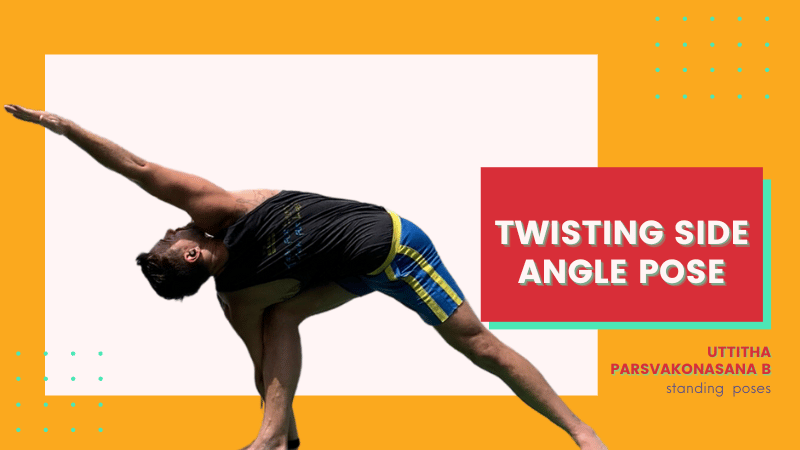 UTTHITA PĀRSVAKONASANA B (5 MOMENTS) | ||
| 1 | EKAM | Inhale, open to the right, arms out |
| 2 | DVE | EXHALE, TWIST LEFT HAND DOWN |
| 3 | TRIŅI | INHALE, UP. Feet parallel, arms out. |
| 4 | CATVARI | EXHALE, TWIST RIGHT HAND DOWN |
| 5 | PANCHA | INHALE, UP EXHALE, SAMASTHITI |
Anatomy
UTTHITA PARSVAKONASANA
EXTENDED LATERAL ANGLE POSE
This pose represents a natural progression from virabhadrasana II—another exam- ple of continuity between poses. Imagine that in Warrior II you are taking an exag- gerated step in preparation to throw a spear. Utthita Parsvakonasana would be the “follow through” of throwing the spear. We go from an erect trunk in Warrior II to one that is laterally flexing in this pose. The back arm moves from extending away from the body in Warrior II to stretching over the head in Utthita Parsvakonasana. Combining the action of the shoulder and arm with anchoring the back foot into the ground creates a stretch of the entire upper side of the body. Turn the back foot in and the front foot out ninety degrees. Straighten the back knee and externally ro- tate the hip. Flex the torso over the front thigh and rotate the chest upward from the abdomen. This causes the lower side of the body to shrink and the upper side to stretch. Look at how the shoulders and pelvis tilt in opposite directions, com- municating with each other through the spine. Press the front foot into the floor with the weight starting at the posterior heel and spreading across the ball of the foot and toe mounds. Turn the face slightly upward and tilt the head back. Remember that the underlying story of this pose is in the breath. Use the accessory muscles of breathing to open the chest and deepen your inhalations while relaxing into the exhalations. Turning the body activates the abdominal mus- cles, which work in conjunction with the internal intercostals and the elastic recoil of the lungs to aid in exhalation. Remember to ease in and out of the breath to cre- ate a sound like waves on a beach. Use ujjayi breathing.
Continue Reading with Ashtanga Tech
This study guide is available to members. Join to access 800+ in-depth guides on anatomy, philosophy, sequencing, and the science of practice.
Join for $5.50/mo — the cost of a DC coffeeAlready a member? Log in here
Discussion
or explore Student Union