
Virabhadrasana A & B
 Yoga Techniques and Fitness
Overview
In this lesson, we explore Virabhadrasana I and II, examining how these warrior poses embody disciplined energy and create stability through opposing movements.
Objective
Gain understanding of how Warrior I progresses naturally from Parsvottanasana and how it balances forward folding with upward expansion.
What You'll Get
You'll walk away knowing how to sequence the warriors logically within the standing series and how to cue the turn of the pelvis from facing forward in Warrior II to facing the front leg in Warrior I. We cover how simultaneous movements in different directions create stillness and potential energy, what's happening in both the front and back legs, and how to protect the knees while opening the chest. You'll learn the anatomical details that make these fundamental poses both safe and powerful.
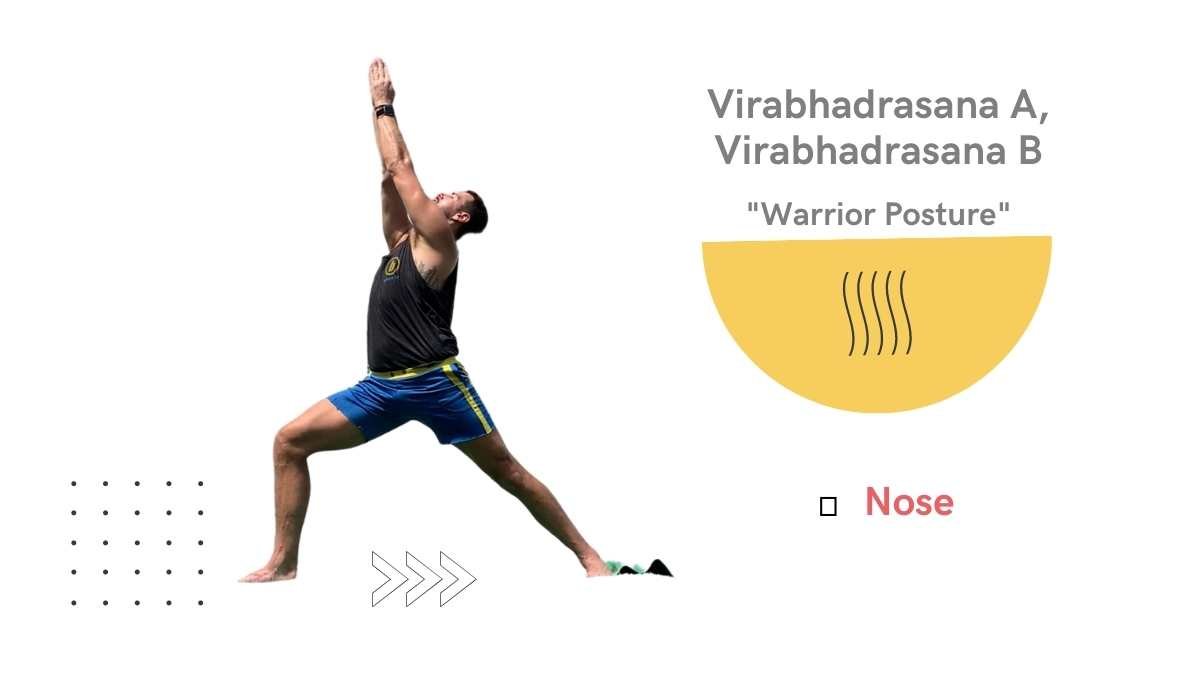
This fundamental standing pose is a type of lunge with the torso extending and the chest opening upward Although a still posture, Warrior I sug- gests disciplined muscle energy waiting to be unleashed.
| VIRABHADRASANA A & B (14 MOVEMENTS) | ||
| 7 | SAPTA | Inhale, right side Virabhadrasana A |
| 8 | ASTAU | Exhale, left side Virabhadrasana A |
| 9 | NAVA | Inhale, right side Virabhadrasana B |
| 10 | DASA | Exhale, left side Virabhadrasana B |
| Exhale, hands down | ||
| 11 | EKĀDASA | Inhale, up |
| 12 | DUADASA | Exhale, Chaturanga |
| 13 | TRAYODASA | Inhale, Upward-Facing Dog |
| 14 | CATURDASA | Exhale, Downward-Facing Dog |
Anatomy
Warrior I illustrates the concept of creating stillness by balancing simultaneous movements in different directions. The front hip flexors and back hip extensors engage to descend and stabilize the pelvis while the chest lifts upward toward the sky. Similarly, the front hip and knee flex to create a sense of forward movement while the back hip and knee extend to constrain the rear foot onto the mat. As a result of these simultaneous movements, the body becomes a storehouse for potential energy, like a sprinter preparing to bolt out of the blocks. Positioning Warrior I after Parsvottanasana in the standing pose sequence creates a synergistic progression that continues the turn of the pelvis from facing forward in poses such as Trikonasana and Warrior II, to facing toward the front leg in
Warrior I. Placing Warrior I after Parsvottanasana balances folding forward (Parsvottanasana) with expanding upward (Warrior I). In Parsvottanasana the torso folds over the leg to create a deep stretch along the back side of the body; Warrior I rises from this position, expanding from the core and extending upward through the chest.
BASIC JOINT POSITIONS
- The back foot turns inward 30 degrees and supinates.
- The front foot turns out 90 degrees.
- The back hip and knee extend.
- The front hip and knee flex.
- The shoulders flex overhead.
- The elbows extend.
- The back extends.
- The cervical spine extends.
Continue Reading with Ashtanga Tech
This study guide is available to members. Join to access 800+ in-depth guides on anatomy, philosophy, sequencing, and the science of practice.
Join for $5.50/mo — the cost of a DC coffeeAlready a member? Log in here
Discussion
or explore Student Union