
Ustrasana
 Yoga Techniques and Fitness
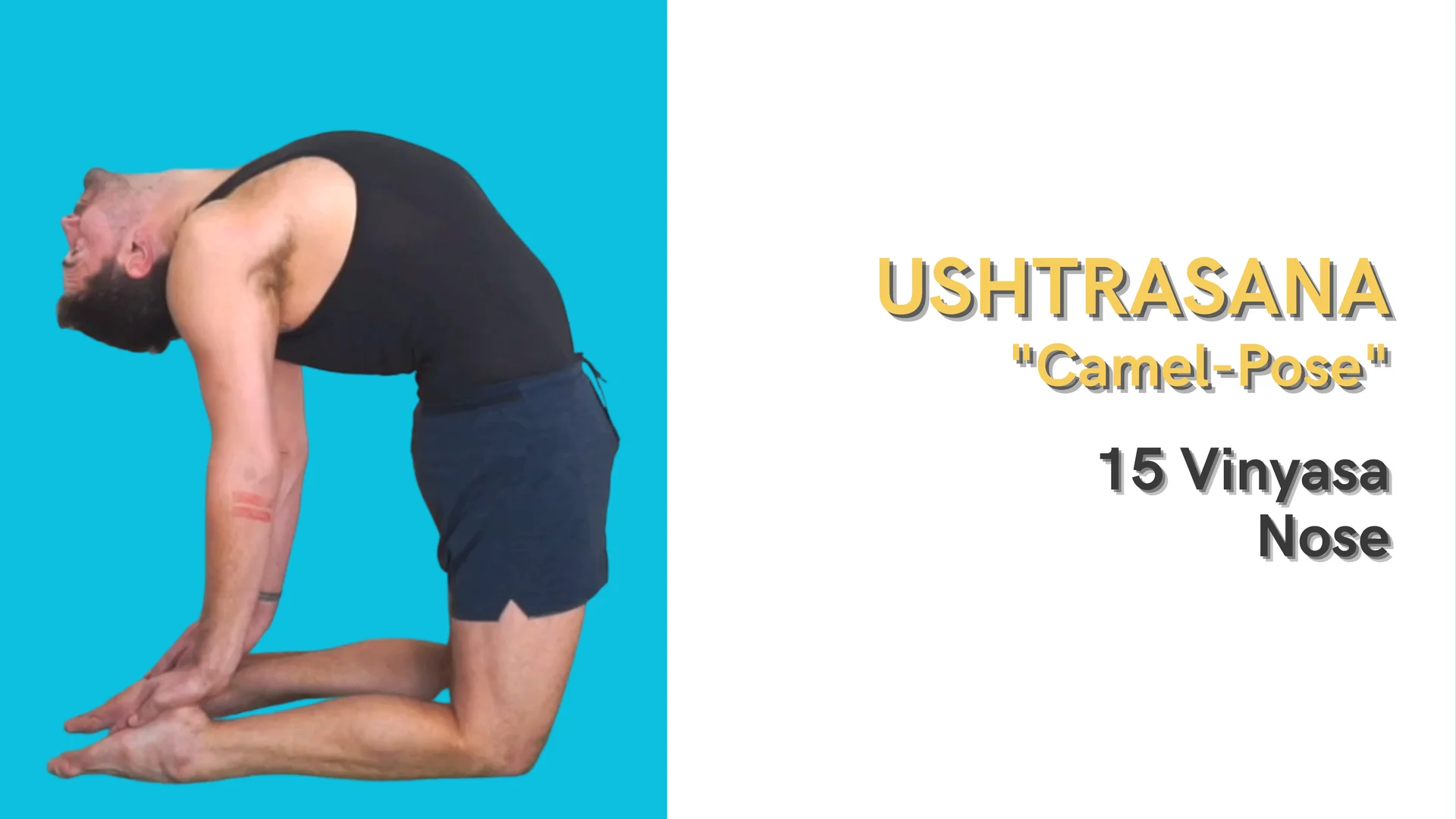
Camel Pose Ustrasana is a back bend in which the shoulders extend out behind (as in Purvottanasana). The hands on the feet connect the upper and lower appendicular skeletons (as in Danurasana).
Vinyasa Count: Ustrasana
| # | Sanskrit | Instruction |
|---|---|---|
| 7 | Sapta | Inhale, jump forward, hold waist |
| Exhale, engage the pelvic floor | ||
| Inhale, prepare by lifting the spine away from the pelvis | ||
| 8 | Astau | Exhale, hold heels to enter posture, five breaths |
| 9 | Nava | Inhale, come up, hold waist, exhale |
| 10 | Dasa | Inhale, lift up |
| 11 | Ekadasa | Exhale, jump back, Chaturanga Dandasana |
| 12 | Duadasa | Inhale, Urdhva Mukha Svanasana |
| 13 | Trayodasa | Exhale, Adho Mukha Svanasana |
Anatomy
Ustrasana extends the back of the body to stretch the front. The shoulders draw back to link the hands to the soles of the feet, and the knees lever the body up and forward to deepen the pose. The thighs tend to drift backward in Ustrasana, decreasing the angle between the upper and lower legs. Contract the quadriceps to extend the knees. This brings the thighs perpendicular to the floor, deepening the backbend (especially when the hands are holding the bottoms of the feet). Review the section on facilitated stretches to see how isolated stretching of the fronts of the shoulders and hips can improve this pose. Notice how the individual parts work together to deepen the asana. For example, combine the subplot of extending the shoulders with the subplot of extending the knees to “triangulate” the spinal extension. Then engage the abdominals to produce the abdominal “airbag” effect. This prevents hyper-extension of the lumbar spine and aids in protecting the lower back.
BASIC JOINT POSITIONS
- The knees flex.
- The ankles plantar flex.
- The hips extend, internally rotate, and adduct.
- The trunk extends.
- The shoulders extend.
- The elbows extend.
- The forearms supinate.
Continue Reading with Ashtanga Tech
This study guide is available to members. Join to access 800+ in-depth guides on anatomy, philosophy, sequencing, and the science of practice.
Join for $5.50/mo — the cost of a DC coffeeAlready a member? Log in here
Discussion
or explore Student Union