
Postural Issues & Conditions
 Anatomy & Physiology
Overview
In this lesson, we explore postural issues and conditions.
Objective
Become familiar with the vocabulary, characteristics, and anatomical patterns of common postural conditions including hyperkyphosis, hyperlordosis, crossed syndromes, and swayback.
What You'll Get
Become knowledgeable about postural issues such as thoracic mobility issues, hyperlordosis and kyphosis, and the vast variety of potential causal factors.
Vocabulary
hyperkyphosis, hyperlordosis, kyphosis, lordosis, lower crossed syndrome, swayback / hollow back / saddle back, thoracic kyphosis, upper crossed syndrome

- HYPERKYPHOSIS — Another name for kyphosis
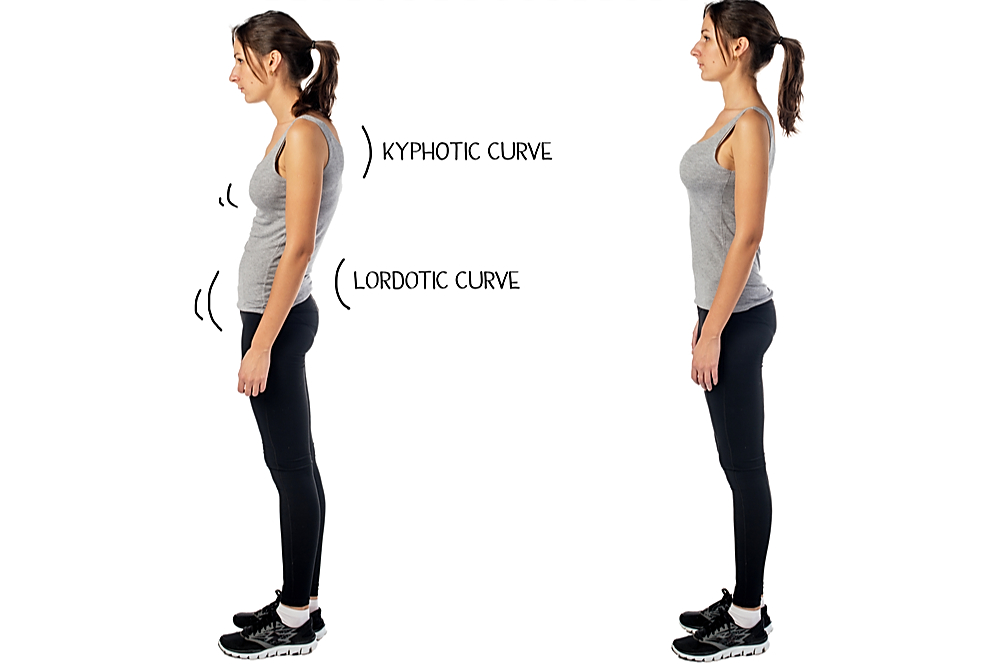
- HYPERLORDOSIS — Excessive inward curvature of the lumbar spine, causing a forward (anterior) pelvic tilt
- KYPHOSIS — Excessive forward curvature of the thoracic spine (clinically defined as greater than 50 degrees)
- LORDOSIS – Sometimes used as another name for hyperlordosis
- LOWER CROSSED SYNDROME — A postural pattern in which muscles of the core, back and legs are out of balance; may present as posterior pelvic crossed syndrome or anterior pelvic crossed syndrome (source)
- SWAYBACK / HOLLOW BACK / SADDLE BACK — Other names for hyperlordosis
- THORACIC KYPHOSIS — Another name for kyphosis
- UPPER CROSSED SYNDROME — A postural pattern in which muscles around the shoulder girdle are out of balance; may appear as rounded shoulders and upper back, winging shoulder blades and a forward head (source)
Introduction
Here you will find quite a number of potential issues. We invite you to:
- Review the anatomy of a healthy spine and what it means to have healthy posture.
- Next, review the potential issues and effects listed here.
- Reflect on the many potential situations of students. (Even though teachers may see a few common conditions, awareness of the multiplicity of individual situations can help you to stay inquisitive and open to new information.)
- Use this section as a resource to return to if you face something new for you.
For related teaching considerations, please see:
- Teaching Anatomy of the Spine & Healthy Posture
- Joint Mobility & Stability, Hyperextension, Hypermobility and How Yoga Can Help
- Back & Spinal Conditions
- Low Back Pain
- Neck, Shoulder & Upper Back Issues
Conditions & Issues
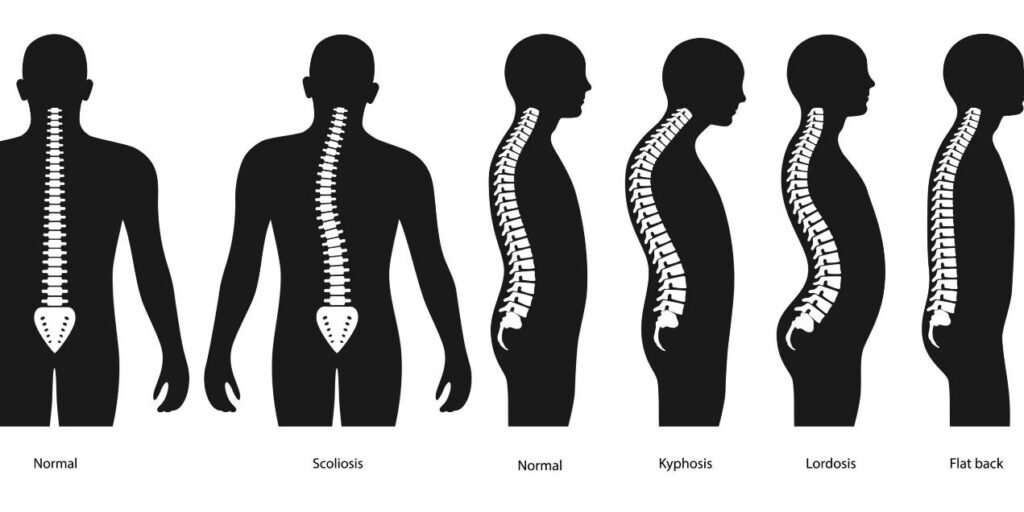
Following are postural conditions that students may be experiencing, some of which may be related:
- Muscular imbalances such as upper and lower crossed syndrome
- Hyperlordosis
- Forward head
- Kyphosis
- Thoracic immobility
- Rounded shoulders
- Rib thrust / Rib shear
- Winging shoulder blades
- Excessive anterior pelvic tilt
- Q Angle issues
- Knee hyperextension or poor knee tracking
- Excessive pelvic tucking
- Flattened low back
- Overpronation of feet and/or flattened foot arches
- Misaligned vertebrae
See Also
- Back & Spinal Conditions Introduction
- Common Problems & Cueing for Spinal Alignment, Pelvic Tucking, Rib Shear
- Safety & Adaptations
Q ANGLE
“All of these problems [bunion, plantar fasciitis, patellofemoral knee syndrome and hip bursitis] can derive from the same postural imbalance… the exaggerated anterior [forward] tilt of the pelvis, the internal rotation of the thighs, hyperextension of the knees or poor knee tracking, and overpronation of the feet—the inward drop of the ankles and the flattening of the inner arches. This pattern can cause symptoms at the hip, knee, or foot, and often, in more than one of these places.” … What physical therapists would call the mild knock-kneedness that is part of this pattern is more accurately identified as an increased quadriceps angle, or “Q angle,” which determines the pull on the patella (kneecap). The Q angle is measured from the ASIS (anterior superior iliac spine) to the midpoint of the patella, as shown here. – Amber Burke
Continue Reading with Ashtanga Tech
This study guide is available to members. Join to access 800+ in-depth guides on anatomy, philosophy, sequencing, and the science of practice.
Join for $5.50/mo — the cost of a DC coffeeAlready a member? Log in here
Discussion
or explore Anatomy & Physiology