
Connective Tissue & Fascia
 Anatomy & Physiology
Overview
In this lesson, we introduce the anatomy and significance of connective tissue and fascia, and how to apply this knowledge in teaching.
Objective
Understand the anatomy and physiology of connective tissue, the functions and significance of fascia, and techniques for applying this knowledge in teaching.
What You'll Get
Define connective tissue, fascia, ligament, tendon and tensegrity. Describe fascia in ways that help students to get a clearer sense for this pervasive tissue. Explain up to eight functions of fascia including what it communicates to the brain. Give the meaning and significance of the term “myofascia” and how the “myofascial meridian theory” differs from the traditional anatomy model. Provide techniques, teachings, practices and sequences for application of this knowledge.
Vocabulary

- BODILY TISSUE — A group of similar cells that together perform a common function
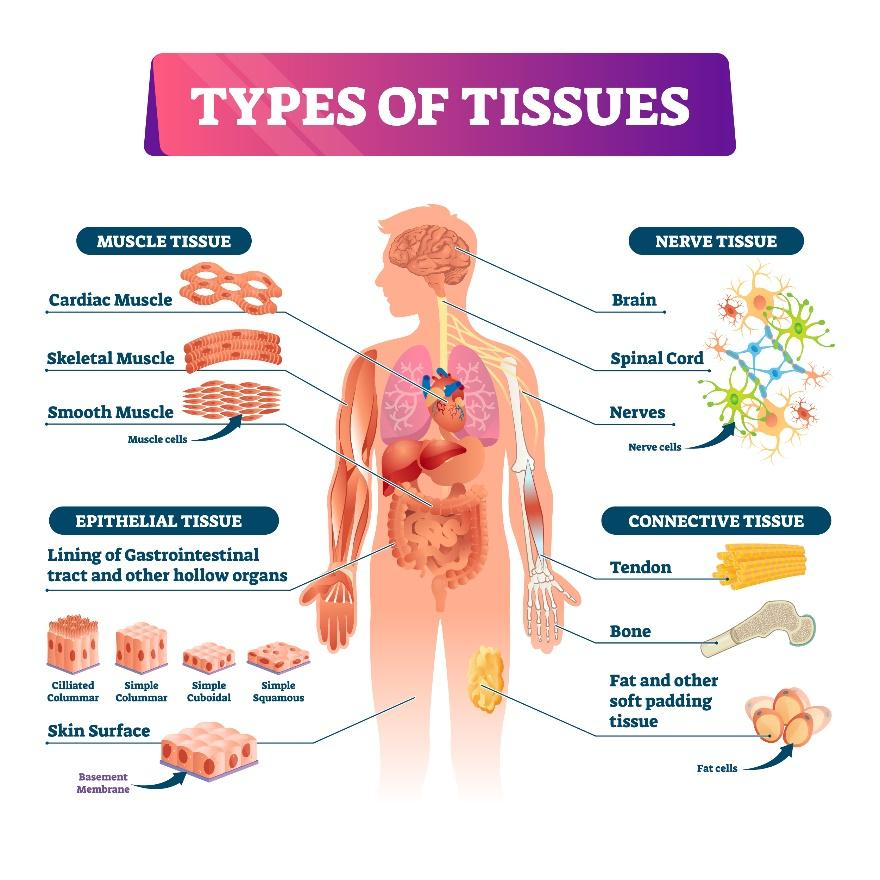
- CONNECTIVE TISSUE — A fibrous type of body tissue that connects, supports, binds, or separates other tissues or organs
- FASCIA — While previously known as a subset of connective tissue, this term is increasingly being used as a synonym for connective tissue; a pervasive tissue that holds the 70 trillion cells of the body together, providing not only form to the physical structures, but an organizing intelligence and communication through sensory nerve endings
- JOINT CAPSULE — A type of connective tissue that surrounds synovial joints
- LIGAMENT — A type of connective tissue that connects bones together at the joint
- MYOFASCIA — Muscles and surrounding tissues
- TENDON — A type of connective tissue that attaches muscle to bone
- TENSEGRITY / BIOTENSEGRITY — Formed from the words tensile and integrity, the concept is based on Buckminster Fuller’s work; refers to the forces of tension (provided by muscles, tendons, ligaments, and fascia) pulling on structure (bones and joints) that help keep the body both stable and efficient (thefreedictionary.com)
Introduction
Continue Reading with Ashtanga Tech
This study guide is available to members. Join to access 800+ in-depth guides on anatomy, philosophy, sequencing, and the science of practice.
Join for $5.50/mo — the cost of a DC coffeeAlready a member? Log in here
Discussion
or explore Anatomy & Physiology