
Backbends
 Yoga Techniques and Fitness

Introduction
Backbends can be practiced from a variety of foundations, including standing, kneeling, supine and prone.
Backbends stretch the front of the body. In active (as opposed to passive or restorative) backbends, there is the secondary effect of strengthening the back muscles.
The term “spinal extension” means reducing the spinal curves or lengthening the entire spine. It refers to the relationship of the spinal curves to each other while the phrases “forward bending” and “backbending” refer to particular movements through space.
The ability to bend backward varies not only due to personal practice and experience, but on a person’s individual musculoskeletal system. Bernie Clark explains:
BONE STRUCTURE MAKE A MAJOR IMPACT
A great deal of variation exists between lumbar spines, including differences in the number of lumbar vertebrae you may have (anywhere from four to six) and the natural amount of backward curve (called lordosis) you may possess (anywhere from 29° to 69°). Another key variation that has a dramatic effect on your backbends are your spinous processes. Spinous processes are the bumpy bits of our vertebrae that you can feel when you palpate your spine. Some people have big spinous processes… and some rare individuals may have one or two missing completely! … Imagine the students who possess the lumbar spines shown in figure 1 doing cobra pose as shown in figure 2 (above)… Notice the spaces between the spinous processes… The student on the left has very small gaps. Indeed, between L4 and L5 there is no gap at all. His processes are already kissing, so there is no room for any extension at this joint. But this need not disqualify him from moving to his natural limits or from doing his yoga practice with attention and intention. – Bernie Clark
As Olga Kabel so clearly explains here, there are four types of backbends: 1) prone, 2) downward arch, 3) upward arch, and 4) asymmetrical. See more on each below.
Prone
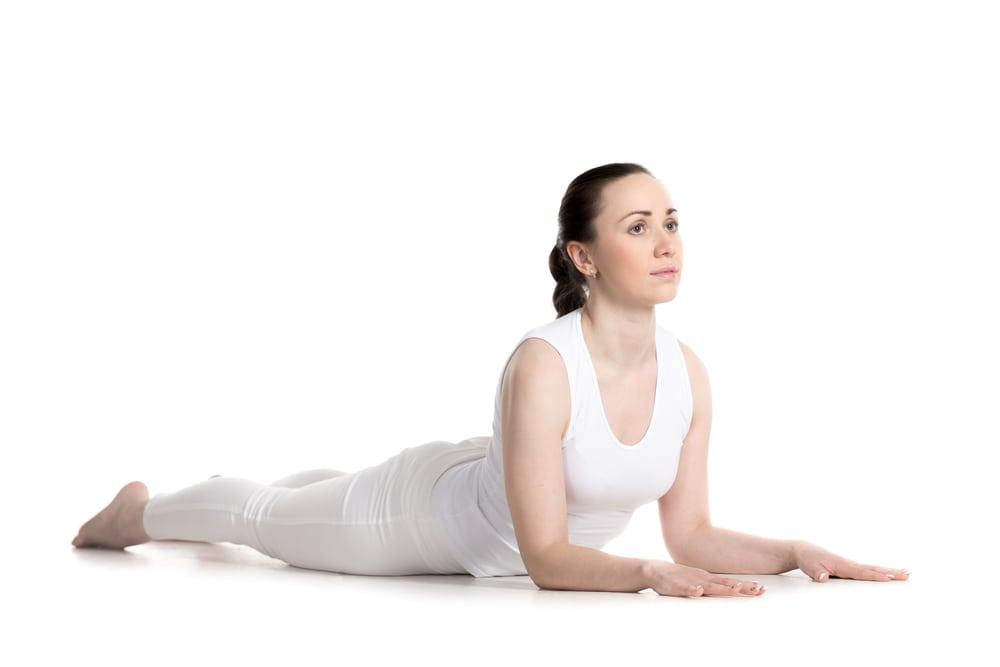
- Purpose: Strengthen back
- Examples: Salamba Bhujangasana (Supported Cobra / Sphinx Pose), Bhujangasana (Cobra Pose), Salabhasana (Locust Pose)
Continue Reading with Ashtanga Tech
This study guide is available to members. Join to access 800+ in-depth guides on anatomy, philosophy, sequencing, and the science of practice.
Join for $5.50/mo — the cost of a DC coffeeAlready a member? Log in here
Discussion
or explore Student Union